
Findings F183 Computing and mathematics, Method and statistics found 2026-10-31
After we fixed our own bug, CMA-ES ranked first and two nature-inspired optimisers proved centre-biased
Our first benchmark said optimisers named after slime moulds, wolves, bees and ants beat the standard methods. The win came partly from a bug in our own CMA-ES code. Fixed, CMA-ES ranked first on the shifted tests, and two popular nature-inspired methods turned out to work well only when the answer sits at the centre of the search box. As groups, plain and nature-inspired methods did not differ (mean rank gap 0.09, p 0.45).
- Tier
- D, honest null
- Outcome
- mixed
- Rung
- thesis
- Verdicts
- 17 passed, 3 failed
- Corrections
- 4, latest 2026-11-14
- Version
- v3, 2026-11-14
- Redo it
- Reproduce
Download PDF 511 KB BuildTeX source F183.bld
What this means for a reader
When a benchmark says a new nature-inspired optimiser wins, check two things: whether the test functions have their best point at the centre of the search box, and whether the standard methods it beat were run correctly. Our own first run failed the second check, and the result looked like a win for the nature-inspired group. Two popular methods in that group did well only when the answer sat at the centre. A good result on centred test functions can come from a method that guesses the centre.
Objection
Seven functions, 10 dimensions, one budget of 20,000 evaluations and 15 repeats. Other functions, dimensions or budgets could reorder the methods.
What would change the call. Our publication register records no condition that would raise or overturn this call.
From the paper's first stated limitation; our register records no separate objection.
Abstract
Optimisers named after slime moulds, wolves, bees and ants are often reported to beat standard methods. Our first preregistered benchmark seemed to agree: the biologically labelled group had the better mean rank, 5.04 against 6.20. Tracing a poor CMA-ES score showed a bug in our own code, and several other methods had a related fault. We kept that run, fixed the box handling for every method, wrote a new preregistration and ran again on seven test functions in 10 dimensions. After the fix, CMA-ES ranked first on the shifted functions with a mean rank of 2.00, and the best method with a biological label, ACOR, ranked second at 3.14. Moving the optimum away from the centre cost the slime mould method 12.1 and the grey wolf method 13.6 decades of median error, while ACOR, IWO and PSO lost 0.0006, 0.07 and 0.42 decades. Without random search the plain group's mean rank was 3.98 against 5.54 for the biologically labelled group; with random search counted as plain the groups were 5.45 and 5.54, a gap that sat inside the label-permutation range (p 0.45). The group contest does not settle much in either direction. The method-level results do.
c1 observed, evidence for claim 1
- The numbers in claim 1
- 2.00; 3.14 matches the result file, 2026-11-09
- Chart 2
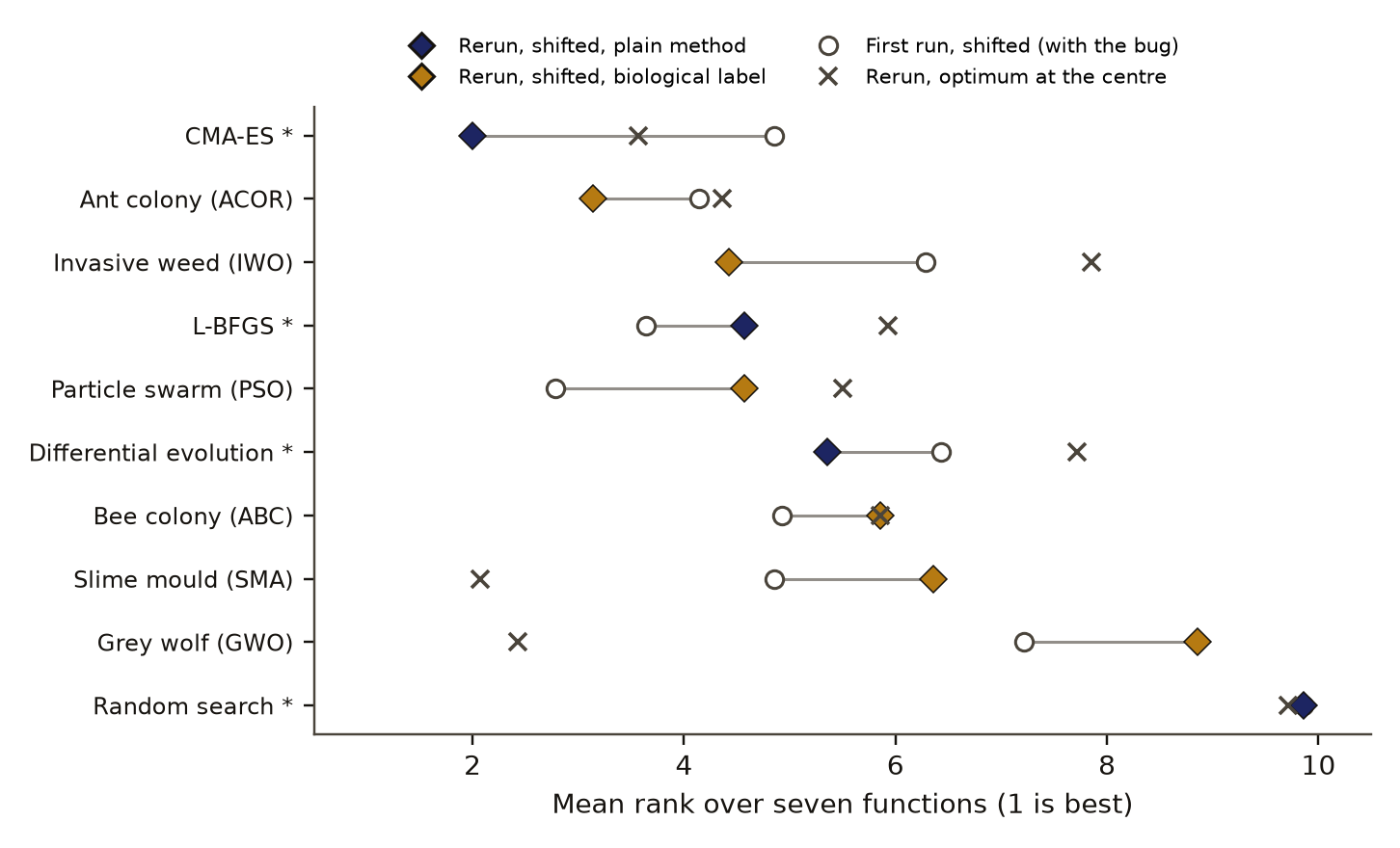
- Mean rank of each method on the shifted functions, first run against rerun.
- Basis
- observed: measured in this study, with a result file
c2 observed, evidence for claim 2
- The numbers in claim 2
- 12.1; 13.6; 0.0006; 0.07; 0.42 matches the result file, 2026-11-09
- Chart 3
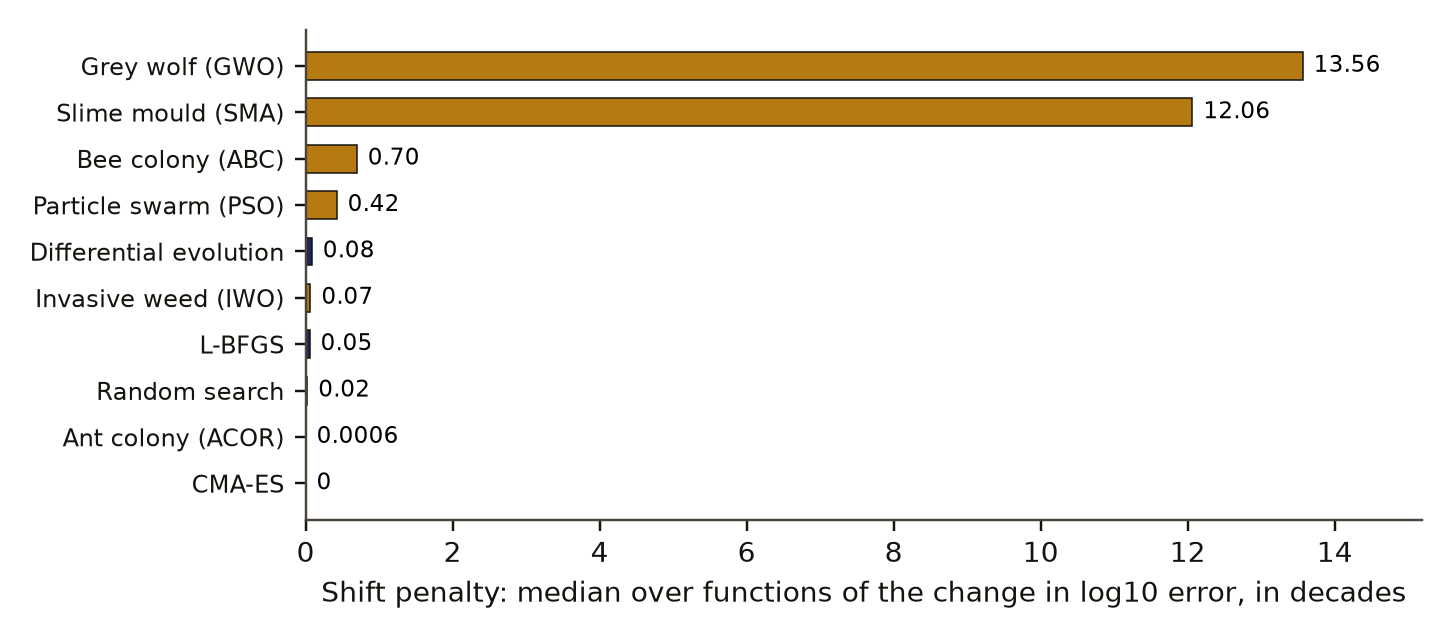
- What moving the minimum off the centre cost each method in the rerun.
- Basis
- observed: measured in this study, with a result file
c3 observed, evidence for claim 3
- The numbers in claim 3
- 3.98; 5.54; 5.45; 0.45 matches the result file, 2026-11-09
- Chart 4
- The gap between the two groups against the range that shuffled labels give.
- Basis
- observed: measured in this study, with a result file
Introduction
A metaheuristicDefinition: metaheuristic optimisation A general recipe for searching for the minimum of a function by sampling and updating a set of candidate points, used when the function gives no gradient or has many local minima. Excludes exact methods that come with a proof of finding the minimum. full definition is a general recipe for searching a function for its minimum by sampling and updating candidate points. Sörensen [1] described a flood of "novel" metaheuristics built on metaphors of natural or man-made processes and argued that the trend threatens to lead the field away from scientific rigour. Camacho-Villalón, Dorigo and Stützle [2] took six widely used metaphor-based methods for continuous problems apart into components, the grey wolf optimiser among them, and reported that none of them proposes a new idea; one section of their paper is titled "The grey wolf optimizer is PSO".
Kudela [3] pointed to a defect in how such methods are tested. Several common test functionsDefinition: test function optimisation benchmarking A formula with a known minimum, chosen to be easy or hard in a known way, on which optimisers are compared by how close they get. Excludes real engineering problems, whose minimum is unknown. full definition have their minimum at the centre of the feasible set, and a method whose update rule has a centre biasDefinition: centre bias evolutionary computation benchmarking, after Kudela A tendency of a method's update rule to pull candidates toward the centre of the search box, which helps on any function whose minimum happens to sit there. Excludes good performance that survives when the minimum is moved. full definition solves those functions easily. Comparisons between such a method and one without the bias on centred functions say little.
The no free lunchDefinition: no free lunch optimisation theory, after Wolpert and Macready The result that, averaged over all possible functions, every search method that never revisits a point does equally well, so any advantage on one class of functions is paid for on another. Excludes claims about any one class of functions, such as the test functions here. full definition theorems of Wolpert and Macready [4] give the background for any optimiser comparison: averaged over all possible functions, no method beats another, so an advantage on one class is paid for on another.
This study tested biologically labelled methodsDefinition: biologically labelled method our usage for this study An optimiser whose published description is framed by an animal, plant or other organism, here slime mould, grey wolf, particle swarm, bee colony, ant colony and invasive weed. Excludes any claim that the method works the way the organism does. full definition against plain ones with the optimum moved off the centre. It became a study of our own error as well. The first run's headline came from a bug in our CMA-ESDefinition: CMA-ES evolutionary computation, after Hansen and colleagues Covariance matrix adaptation evolution strategy: it samples candidates from a multivariate normal distribution and adapts the distribution's centre, shape and step size from the best samples. Excludes the larger-population restart schedule known as IPOP, which our version did not use. full definition code. CMA-ES, the covariance matrix adaptation evolution strategy, samples candidates from a normal distribution and adapts the distribution's centre, shape and step size. Auger and Hansen [5] described a version that restarts with a doubled population each time, known as IPOP. Ours restarts with the same population size.
Preregistration and design
The study ran twice, each time under its own preregistrationDefinition: preregistration research method (metascience) A dated written plan for a study, fixed and hash-locked before any result is seen: the question, the data, the statistic, the controls, the forecasts and the kill conditions. Excludes a plan revised after looking at the outcome, and a protocol written only for the record after the run. full definition. The first (here, the first run) was hash-locked on 31 October 2026 before any result of the run was seen; only smoke runs (short trial runs that check the code executes) in 3 dimensions with small budgets had been made, to fix crashes, and no rankings were read from them. It named the methods, the functions, the measures, two controlsDefinition: control statistics and experimental design A version of the data with the structure under test removed (for example shuffled or pooled), scored the same way as the real data, so the real score has something to beat. Excludes a comparison with a different dataset or with a published number. full definition, the forecasts and the kill conditionsDefinition: kill condition research method (our usage, after Popper's falsification) A rule written in the preregistration that, when met, decides against the claim with no room for judgement after the run. Excludes reasons found after the run for setting a result aside. full definition. The decision it informs was written in it: no slime or plant-labelled optimiser becomes a default search method in our tools unless it beats differential evolution and CMA-ES on the shifted functions.
The second (the rerun) was hash-locked on 31 October 2026 after the first run had been read in full. It records what went wrong, the fix, and new forecasts. Its own kill condition reads: if CMA-ES fails to bring the median error on the shifted ellipsoid below 1, it is still broken and the study stops. It also commits to reporting any biologically labelled method that beats the best plain one, whatever we expected.
Both preregistrations' SHA-256 hashes are in the reproduction section.
Data and provenance
No external data were used. All results come from our own implementations of ten optimisers and seven standard test functions, run on one desktop computer. The method update rules were written from their published descriptions with default settings and no tuning. Every number in this paper is read from the two runs' result files.
Methods
Methods compared
The plain group is random search, L-BFGS-B with restarts and a numeric gradient, differential evolution (rand/1/bin) and CMA-ES with restarts. The biologically labelled group is the slime mould algorithm (SMA), the grey wolf optimiser (GWO), particle swarm optimisation (PSO), artificial bee colony (ABC), ant colony optimisation for continuous domains (ACOR) and invasive weed optimisation (IWO). Every method gets the same budget of 20,000 function evaluations; a numeric gradient spends evaluations from that budget.
Functions and arms
The seven functions are the sphere, an ellipsoid with a condition number of one million, Rosenbrock, Rastrigin, Ackley, Griewank and Schaffer F7, each in 10 dimensions with a minimum value of 0. The search boxDefinition: search box optimisation The allowed region, here every coordinate between -100 and 100. A method may only propose and keep points inside it. Excludes constraints other than simple bounds on each coordinate. full definition allows every coordinate from -100 to 100. On the shifted armDefinition: shifted arm our usage for this study The version of each test function whose minimum is moved to a random point with every coordinate between -70 and 70 and whose axes are turned by a random rotation, the same for every method within one repeat. Excludes the unshifted arm, with the minimum at the centre and the axes aligned. full definition each base function is evaluated as
where is a random shift with every coordinate drawn from -70 to 70 and a random rotation. Every method sees the same and within one repeat. On the unshifted arm is zero and is the identity, so the minimum sits at the centre of the box. Each method ran 15 repeats on each function on each arm.
Measures
For method on function , let be the median best error over the 15 repeats on the shifted arm and the same on the unshifted arm, each floored at . Methods are ranked on each function by the base-10 logarithm of rounded to two decimals, with ties sharing their average rank. Call that rank . The mean rankDefinition: mean rank benchmarking statistics Each method's rank on each function by median final error, averaged over the seven functions. 1 is best and 10 is worst. Excludes how large the differences in error are. full definition is
The change in error from moving the minimum, in decadesDefinition: decade measurement A factor of ten. A change of one decade in error is a change of one in its base-10 logarithm. Excludes a difference on a linear scale. full definition, is
and a method's shift penaltyDefinition: shift penalty our usage for this study For one method, the median over the seven functions of how many decades its median error grows when the function moves from the unshifted arm to the shifted arm. Excludes effects of the rotation alone, which the design does not separate from the shift. full definition is the median of over the seven functions. The group gap is
where and are the averages of over each group, so a positive gap means the plain group did better.
The bug and the fix
In the first run CMA-ES scored a median error of 14 million on the ellipsoid. Tracing it showed that the distribution's centre had left the box (its norm reached 498 against a box half-width of 100). Every sample was clipped to the same corner, the step size fell to about , and the method never restarted. Differential evolution, ABC, ACOR and IWO also kept candidates outside the box in their internal state. These were errors in our code.
For the rerun every method keeps its candidates inside the box. CMA-ES adds a quadratic penalty for any part of a sample outside the box,
where is the absolute value of and is how far coordinate lies outside the box, zero inside. It restarts from a random point when its step size falls below . No method's parameters were tuned.
Controls and planted checks
Two planted checksDefinition: planted check research method; called a positive control in experimental science Data built so that the right answer is known, run through the same analysis before the real data, to show that the analysis can see the effect when it is there. Excludes any check made on the real data, which cannot show what the analysis misses. full definition guard the instrument. CMA-ES must bring the shifted sphere below . A centre cheatDefinition: centre cheat our usage for this study A dummy method that only samples points within a tiny distance of the centre of the box, so it solves any function whose minimum sits there and nothing else. Excludes any real optimiser. full definition, a dummy method that samples only points next to the centre, must solve the unshifted sphere (error below 0.001) and fail the shifted one (base-10 logarithm of its error above 3). The cheat shows that the unshifted arm can be won by guessing the centre and that the shifted arm cannot.
- data10 optimisers, 7 test functions4 plain methods and 6 named after organisms. Each runs on every function with the minimum at the centre and with it shifted and rotated.
- planted checkCentre cheatA dummy method that samples only next to the centre. Rerun: error 7.2e−7 on the centred sphere, and a base-10 logarithm of 4.27 on the shifted one.
- controlTie check, first runOn a function of independent random values no method can do better than another, so the methods must tie. Kruskal-Wallis p had to be above 0.01. It was 0.0015, so the first run's ranking is void by its own rule.
- measurementBug tracedCMA-ES median error on the shifted ellipsoid in the first run: 13,988,073. Its search centre had left the box. Four other methods also kept points outside the box.
- rule set in advanceFix and new preregistrationEvery method keeps its points inside the box. Stop rule for the rerun: CMA-ES median error on the shifted ellipsoid below 1. It was 2.4e−15.
- controlTie check, rerunp 0.13 on the best value found and 0.74 on the best of the first 500 distinct cells visited. Both above 0.01.
- controlLabel permutationMethod names shuffled within each function's ranks 2,000 times. Rerun group gap 0.09 against a shuffled range of −1.22 to 1.16, p 0.45.
- standMethod ranksCMA-ES ranks first at 2.00 and ACOR (ant colony) second at 3.14.
- no difference shownGroup contestThe gap between the plain and the labelled group is inside its shuffled range in both runs.
Read from first-run-result.json, run 20261031T083319Z. SHA-256 of the run's file 70697cc139e507a3862a240a57328966afb0a3e6ecd7adf8c6233a59f12900a0 and of the published copy 568117f6dc4edd3f8c8cdcfaa3c8533f28873ad022a5af86e3049700fe373561. In the copy, file paths are cut to the file name and the layout (indentation, line endings) may differ; every value is the same.
Read from rerun-result.json, run 20261031T085324Z. SHA-256 of the run's file eb614f8e94aa639cfe8c33b3130a31ae036d6bb72a8280be175486a1301f7f59 and of the published copy 855cee724aff05f768731f5fc6809bf4a2380f72f25c11aa6b953926843f5c8d. In the copy, file paths are cut to the file name and the layout (indentation, line endings) may differ; every value is the same.
The label permutationDefinition: label permutation statistics (permutation test) Shuffling which method name goes with which rank within each function, 2,000 times, to see how large a gap between the two groups' mean ranks arises by chance. Excludes uncertainty from the random repeats of each run. full definition control shuffles method names within each function's ranks 2,000 times and records the group gap each time. A real gap must clear the 95th percentile of that null distributionDefinition: null distribution statistics The spread of scores a control gives over many random draws. Its 95th percentile is the bar a real score must clear. Excludes a theoretical distribution assumed rather than drawn from the data. full definition.
The no-free-lunch check runs every method on a test function in which each integer cell of the box gets an independent random value, with a budget of 5,000 evaluations and 30 repeats. No method can exploit such a function, so the methods should tie. Ties are tested with the Kruskal-Wallis testDefinition: Kruskal-Wallis test statistics A rank-based test of whether several groups of numbers come from the same distribution. Excludes a test of which group is better. full definition, with L-BFGS left out because it can stall on a flat cell, on the best value found and, in the rerun, on the best of the first 500 distinct cells visited.
In the rerun CMA-ES reached a median error of 1.6e-15 on the shifted sphere, written in the e-notation used in the tables. The centre cheat reached 7.2e-7 on the unshifted sphere and an error whose base-10 logarithm is 4.27 on the shifted sphere. Both planted checks held.
Results
Table 1 gives every method's mean rank in both runs and its shift penalty in the rerun, and Figure 1 draws the ranks. After the fix, CMA-ES ranked first on the shifted functions with a mean rank of 2.00, and the best method with a biological label, ACOR, ranked second at 3.14. The fix moved CMA-ES from 4.86 to 2.00 and PSO, the first run's leader, from 2.79 to 4.57.
mean rank on the shifted functions, 1 is best
- first run, with the bug
- rerun, after the fix
Data behind chart 2 10 rows
| Method | Group | First run, shifted | Rerun, shifted | Rerun, centred |
|---|---|---|---|---|
| CMA-ES | plain | 4.86 | 2.00 | 3.57 |
| ACOR (ant colony) | labelled | 4.14 | 3.14 | 4.36 |
| IWO (invasive weed) | labelled | 6.29 | 4.43 | 7.86 |
| L-BFGS | plain | 3.64 | 4.57 | 5.93 |
| PSO (particle swarm) | labelled | 2.79 | 4.57 | 5.50 |
| Differential evolution | plain | 6.43 | 5.36 | 7.71 |
| ABC (bee colony) | labelled | 4.93 | 5.86 | 5.86 |
| SMA (slime mould) | labelled | 4.86 | 6.36 | 2.07 |
| GWO (grey wolf) | labelled | 7.21 | 8.86 | 2.43 |
| Random search | plain | 9.86 | 9.86 | 9.71 |
Read from first-run-result.json, run 20261031T083319Z. SHA-256 of the run's file 70697cc139e507a3862a240a57328966afb0a3e6ecd7adf8c6233a59f12900a0 and of the published copy 568117f6dc4edd3f8c8cdcfaa3c8533f28873ad022a5af86e3049700fe373561. In the copy, file paths are cut to the file name and the layout (indentation, line endings) may differ; every value is the same.
Read from rerun-result.json, run 20261031T085324Z. SHA-256 of the run's file eb614f8e94aa639cfe8c33b3130a31ae036d6bb72a8280be175486a1301f7f59 and of the published copy 855cee724aff05f768731f5fc6809bf4a2380f72f25c11aa6b953926843f5c8d. In the copy, file paths are cut to the file name and the layout (indentation, line endings) may differ; every value is the same.
With the minimum at the centre, SMA ranked first (2.07) and GWO second (2.43). Figure 2 shows what moving the minimum did to each method. Moving the optimum away from the centre cost the slime mould method 12.1 and the grey wolf method 13.6 decades of median error, while ACOR, IWO and PSO lost 0.0006, 0.07 and 0.42 decades. The centre bias described by Kudela [3] shows in two of the six labelled methods and not in the other four.
Table 2 gives the group contest. Without random search the plain group's mean rank was 3.98 against 5.54 for the biologically labelled group; with random search counted as plain the groups were 5.45 and 5.54, a gap that sat inside the label-permutation range (p 0.45). The preregistered label-permutation control was computed only for the gap with random search included. The gap of 1.56 without it has no control of its own.
labelled minus plain mean rank
- first run
- rerun
- shuffled labels, 5th to 95th percentile
- control mean
- no difference, 0
Data behind chart 4 3 rows
| Comparison | Plain mean rank | Labelled mean rank | Gap | Shuffled 5th to 95th percentile | p |
|---|---|---|---|---|---|
| First run, random search counted as plain | 6.20 | 5.04 | −1.16 | −1.19 to 1.19 | 0.95 |
| Rerun, random search counted as plain | 5.45 | 5.54 | 0.09 | −1.22 to 1.16 | 0.45 |
| Rerun, random search left out | 3.98 | 5.54 | 1.56 | not computed | not computed |
Read from first-run-result.json, run 20261031T083319Z. SHA-256 of the run's file 70697cc139e507a3862a240a57328966afb0a3e6ecd7adf8c6233a59f12900a0 and of the published copy 568117f6dc4edd3f8c8cdcfaa3c8533f28873ad022a5af86e3049700fe373561. In the copy, file paths are cut to the file name and the layout (indentation, line endings) may differ; every value is the same.
Read from rerun-result.json, run 20261031T085324Z. SHA-256 of the run's file eb614f8e94aa639cfe8c33b3130a31ae036d6bb72a8280be175486a1301f7f59 and of the published copy 855cee724aff05f768731f5fc6809bf4a2380f72f25c11aa6b953926843f5c8d. In the copy, file paths are cut to the file name and the layout (indentation, line endings) may differ; every value is the same.
In the first run the labelled group's lead of 1.16 ranks came partly from our bug and partly from counting random search as plain, and it sat inside its own label-permutation range. The first run's preregistration had a kill condition we did not apply when we first read it: if the no-free-lunch check fails to tie, the ranking is void. That check failed (p 0.0015), so by its own rule the first run's ranking was voidDefinition: void research method (our usage) The verdict of a run whose planted check failed or whose sample fell below its stated minimum. It says nothing for or against the claim. Excludes a null result, which comes from a working instrument. full definition. In the rerun the methods tied on that function, at p 0.13 on the best value and p 0.74 on the best of the first 500 distinct cells. The rerun's preregistration traced the first run's failure to converged methods revisiting the same cells, which the theorem does not count; in the rerun IWO visited a median of 2,870 distinct cells in 5,000 evaluations, against 5,000 for random search and ACOR.
c4 observed, evidence for claim 4
- The numbers in claim 4
- 1.16 matches the result file, 2026-11-09
- Chart 1
- How the first run was thrown out and what the rerun had to pass.
- Chart 4
- The gap between the two groups against the range that shuffled labels give.
- Basis
- observed: measured in this study, with a result file
Table 3 sets the rerun's forecasts against its outcomes.
Discussion
The first run is a record of how a benchmark goes wrong in the direction of a popular story. CMA-ES was the strongest plain method we had, and our implementation of it was broken in a way that did not crash: it returned numbers, just bad ones. The labelled group won that run, and the error showed only because one score, 14 million on the ellipsoid, looked wrong. The rerun's preregistration was written after reading the first run, so the rerun is not blind to it; what keeps it honest is that its forecasts and kill condition were fixed before it ran.
The method-level results are the ones that hold up. CMA-ES ranked first once it was run correctly. SMA and GWO ranked first and second on centred functions and near the bottom on shifted ones, which is the pattern Kudela [3] describes for methods with a centre-biased update step. ACOR, IWO and PSO lost almost nothing when the minimum moved, so the centre-bias charge does not reach every method with a biological label. Camacho-Villalón and colleagues [2] argue from the structure of the update rules that GWO is a form of PSO. In our runs the two behave differently once the minimum moves: GWO loses 13.6 decades and PSO 0.42. A component that pulls candidates toward the centre would explain the gap, and we did not test which component it is.
The group result is weak. With random search counted as plain, the two groups' mean ranks differ by 0.09, well inside the label-permutation range. Leaving random search out gives a gap of 1.56, but that comparison had no control. Ranking methods by group label says less than ranking them one at a time.
Limitations
- Seven functions, 10 dimensions, one budget of 20,000 evaluations and 15 repeats. Other functions, dimensions or budgets could reorder the methods.
- Every method used default parameters. Tuning could change the ranking.
- The shifted arm moves and rotates the function at once, so the shift penalty mixes the two effects. A rotation-only arm was not run.
- Errors are floored at before ranking, so methods that reach that level tie, and a shift penalty measured from a centred error of 0 counts from . The 12 and 13.6 decades for SMA and GWO are bounded by that floor.
- The methods were written from published descriptions by us, and the first run shows how such code can be wrong without crashing. Other bugs may remain.
- PSO's biological label is thin: it is a velocity rule with a metaphor, and it predates the recent flood of such methods.
- Scoring was done by our own code and checked by the same analyst who wrote it.
Evidence
Mixed. The group contest between plain and biologically labelled optimisers sat inside the label-permutation range (p 0.45); the method-level ranks hold.
Figures
These are the paper's own figures, numbered as in the PDF, and each "Figure" reference in the text points here. The charts on this page redraw the same results from the result files and carry their own numbers.
Tables
| Method | Group | First run, shifted | Rerun, shifted | Rerun, centred | Shift penalty |
|---|---|---|---|---|---|
| CMA-ES | plain | 4.86 | 2.00 | 3.57 | 0 |
| ACOR (ant colony) | labelled | 4.14 | 3.14 | 4.36 | 0.0006 |
| IWO (invasive weed) | labelled | 6.29 | 4.43 | 7.86 | 0.07 |
| L-BFGS | plain | 3.64 | 4.57 | 5.93 | 0.05 |
| PSO (particle swarm) | labelled | 2.79 | 4.57 | 5.50 | 0.42 |
| Differential evolution | plain | 6.43 | 5.36 | 7.71 | 0.08 |
| ABC (bee colony) | labelled | 4.93 | 5.86 | 5.86 | 0.70 |
| SMA (slime mould) | labelled | 4.86 | 6.36 | 2.07 | 12.06 |
| GWO (grey wolf) | labelled | 7.21 | 8.86 | 2.43 | 13.56 |
| Random search | plain | 9.86 | 9.86 | 9.71 | 0.02 |
| Comparison | Plain | Labelled | Gap | Permuted interval, p |
|---|---|---|---|---|
| First run, random counted as plain | 6.20 | 5.04 | -1.16 | -1.19 to 1.19, p 0.95 |
| Rerun, random counted as plain | 5.45 | 5.54 | 0.09 | -1.22 to 1.16, p 0.45 |
| Rerun, random left out | 3.98 | 5.54 | 1.56 | not computed |
| Quantity | Forecast | Outcome |
|---|---|---|
| CMA-ES mean rank | at most 3 | 2.00 |
| PSO among the top three | yes | no, 4.57 |
| Plain mean rank, random left out | 3.8 | 3.98 |
| Labelled mean rank | 5.0 | 5.54 |
| Best plain ahead of best labelled | at least 0.3 ranks | 1.14 ranks |
| SMA and GWO shift penalty | above 3 decades | 12.06 and 13.56 |
| No-free-lunch tie on distinct cells | p above 0.01 | p 0.74 |
| L-BFGS in the top two on smooth functions | yes | not scored |
Appendix A. The preregistered verdicts
Each verdict is a set of rules written before the run. A verdict passes only when every rule holds. Values are read from the result files.
| Verdict | Deciding rule | Value | Holds |
|---|---|---|---|
| CMA-ES solves the sphere | shifted sphere error below 1e-8 | 1.6e-15 | yes |
| CMA-ES solves the ellipsoid | shifted ellipsoid median error below 1 | 2.4e-15 | yes |
| Cheat caught | unshifted below 0.001 and shifted log10 above 3 | 7.2e-7; 4.27 | yes |
| No free lunch, raw | Kruskal-Wallis p above 0.01 | 0.13 | yes |
| No free lunch, distinct | Kruskal-Wallis p above 0.01 | 0.74 | yes |
| Plain beats labelled | gap with random left out above 0 | 1.56 | yes |
| Best plain beats best labelled | best labelled rank minus best plain rank above 0 | 1.14 | yes |
| No labelled method dominates | wins over every plain method on at most 2 of 7 functions | 1 | yes |
| SMA centre bias | shift penalty above 3 decades | 12.06 | yes |
| GWO centre bias | shift penalty above 3 decades | 13.56 | yes |
| Plain methods unbiased | CMA-ES and differential evolution penalty below 0.5 | 0; 0.08 | yes |
| Verdict | Deciding rule | Value | Holds |
|---|---|---|---|
| CMA-ES solves the sphere | shifted sphere error below 1e-8 | 3.9e-15 | yes |
| Cheat caught | unshifted below 0.001 and shifted log10 above 3 | 6.2e-7; 4.18 | yes |
| No free lunch | Kruskal-Wallis p above 0.01 | 0.0015 | no |
| Plain beats labelled | gap with random counted as plain above 0 | -1.16 | no |
| Best plain beats best labelled | best labelled rank minus best plain rank above 0 | -0.86 | no |
| No labelled method dominates | wins over every plain method on at most 2 of 7 functions | 2 | yes |
| SMA centre bias | shift penalty above 3 decades | 12.06 | yes |
| GWO centre bias | shift penalty above 3 decades | 13.49 | yes |
| Plain methods unbiased | CMA-ES and differential evolution penalty below 0.5 | 0.45; 0.26 | yes |
What lowers it
- scoring Scored by code and by the agent that ran it; self-graded. from our publication register, on who scored it
- depth of reading The cited literature was read at the level of abstracts and publisher pages; full texts were not read. from the Verified section
What holds it up
- preregistration Preregistered and hash-locked before the run (sha256 dbf3b210). from the Reproduce section
Where the claim stands
- lead
- hypothesis
- thesis
- conjecture
- theorem
- law candidate
- killed
Named rival, which the finding stood against: Bio-labelled optimisers as better search. Decisive observation against the rival: Shifted known optima: CMA-ES rank 2.0 against best bio 3.14, and SMA and GWO lose 12 and 13.6 decades. Tier D: After our own bug fix the nature-inspired methods showed no edge as a group (mean rank gap 0.09, p 0.45), and CMA-ES ranked first; default parameters only.
Trail
Versions
- v3 2026-11-14, this page corrected, 1 item; the PDF and its BuildTeX source are still paper version 1.0
- v2 2026-11-09, paper version 1.0, first published PDF sha256 2c1d02484bcb2dd1
- v1 2026-10-31, entered in the findings ledger
Corrections
2026-11-14 number found by a review of the published pages
A review of the published page found the title wider than the result. now It said plain optimisers beat nature-inspired ones; the rerun's group contest gave a mean rank gap of 0.09, inside the label-permutation range (p 0.45), and two nature-inspired methods ranked second and third. The title and the summary now name what the method-level ranks show: CMA-ES first at 2.00, and the slime-mould and grey-wolf methods losing their lead when the optimum leaves the centre.
2026-11-09 wording found by the publication pass
Our ledger and write-up did not report that the group gap with random search sat inside the label-permutation range in both runs, nor that the rerun's forecast of PSO in the top three failed. now This paper reports both.
2026-11-09 wording found by the publication pass
The first run's preregistration voids its ranking when the no-free-lunch check fails to tie, and it failed. now Our ledger entry did not say so; this paper does.
2026-10-31 wording found by the study itself, before publication
The first run's headline, that the labelled group beat the plain group, came partly from a bug in our CMA-ES code and in the box handling of four other methods. now The run is kept as it ran, and the rerun replaces its ranking.
Each correction is a dated note; the findings ledger is never rewritten, and a note governs where it differs.
Ledger and version dates up to publication are local dates in US Pacific time. Clock times in the text are UTC, seven or eight hours ahead, so a lock or a run stamped just after midnight UTC belongs to the previous local day. Corrections from 14 November 2026 on are dated in UTC.
References
- Sörensen, K. (2015). Metaheuristics: the metaphor exposed. International Transactions in Operational Research 22(1), 3-18. doi:10.1111/itor.12001 abstract or summary, 2026-11-09: abstracts and publisher pages; full text not read used in Introduction
- Camacho-Villalón, C. L., Dorigo, M. and Stützle, T. (2023). Exposing the grey wolf, moth-flame, whale, firefly, bat, and antlion algorithms: six misleading optimization techniques inspired by bestial metaphors. International Transactions in Operational Research 30(6), 2945-2971. doi:10.1111/itor.13176 abstract or summary, 2026-11-09: abstracts and publisher pages; full text not read used in Introduction, Discussion
- Kudela, J. (2022). A critical problem in benchmarking and analysis of evolutionary computation methods. Nature Machine Intelligence 4, 1238-1245. doi:10.1038/s42256-022-00579-0 abstract or summary, 2026-11-09: abstracts and publisher pages; full text not read used in Introduction, Results, Discussion
- Wolpert, D. H. and Macready, W. G. (1997). No free lunch theorems for optimization. IEEE Transactions on Evolutionary Computation 1(1), 67-82. doi:10.1109/4235.585893 abstract or summary, 2026-11-09: abstracts and publisher pages; full text not read used in Introduction
- Auger, A. and Hansen, N. (2005). A restart CMA evolution strategy with increasing population size. Proceedings of the IEEE Congress on Evolutionary Computation 2005, 1769-1776. doi:10.1109/CEC.2005.1554902 abstract or summary, 2026-11-09: abstracts and publisher pages; full text not read used in Introduction
Cited by later findings
- No later record in the findings ledger treats this finding.
Reproduce
Preregistration
sha256 dbf3b21010c50808e984aa422ad15639f3fd93af28409e44eb4ca34c8cc53a54
plan 234b69bfb9702c86b356344553e6e8de24169a843d994fdac870bbc0575bef39
Steps
- Implement the ten methods with default parameters and keep every candidate inside the box from -100 to 100. Give CMA-ES the penalty of eq. 5 and a restart when its step size falls below .
- Run each method on the seven functions in 10 dimensions with 20,000 evaluations and 15 repeats, once with the minimum at the centre and once shifted and rotated as in eq. 1, the same shift and rotation for every method within a repeat.
- Rank methods per function by the median best error, floored at and taken as a base-10 logarithm rounded to two decimals, and average the ranks, eq. 2. Compute eqs. 3 and 4.
- Permute method labels within each function 2,000 times for the null distribution of the gap.
- Rerun preregistration SHA-256: dbf3b21010c50808e984aa422ad15639f3fd93af28409e44eb4ca34c8cc53a54. Plan SHA-256: 234b69bfb9702c86b356344553e6e8de24169a843d994fdac870bbc0575bef39. Run 20261031T085324Z, seed 20261054.
- First run preregistration SHA-256: 43edb85abe56495fcd70d726ef7b6f224917033ac10fefbd56fa9d1f2aa559c0. Plan SHA-256: e6fab72152c93c516de1f03d02999c1bcd691360bbef5123781902484f1059ba. Run 20261031T083319Z, seed 20261041.
Cost. The rerun's timing record gives 1,179 seconds for the analysis on one desktop CPU. The study was not re-run for this paper.
Downloads
- Whitepaper, PDF F183.pdf, 511 KB
- BuildTeX source F183.bld, 34 KB
- Build receipt F183.buildtex.json, 1 KB
- BuildLang doc module doc.bld, 5 KB, imported by the source
The PDF is typeset by BuildTeX from F183.bld, which is written from the same source as this page. The receipt records the source's SHA-256 and the PDF's (2c1d02484bcb), so anyone can rebuild it and compare. The copy here has its hidden author field blanked, as the site does for every file it publishes; blank the same field in a rebuild before comparing. The name stays on the first page.
Verified
Verified on 2026-11-09. On 9 November 2026 every mean rank, group mean, gap, shift penalty, planted-check value, label-permutation mean, percentile and p value, and both no-free-lunch p values in this paper were re-read from the two runs' result files. The rerun's values match the findings ledger. The function count, dimension, budget, repeats, box, shift range and rank rules were read from the study's code and build files. Both preregistrations' SHA-256 hashes were recomputed from the locked files and match the hashes recorded in the result files. The first run left two result files with identical analysis values; this paper cites the later one. Both figures were drawn by a script that reads only the two result files.
Not checked. The study was not re-run for this paper. The literature in the introduction was found by searches run on 9 November 2026 and read at the level of abstracts and publisher pages; the full texts of the cited papers were not read.
Terms on this page
Each term is defined where it is first used on this page. Each name below opens its entry in the findings glossary, which lists every page that uses it.
- metaheuristic optimisation first use
- test function optimisation benchmarking first use
- centre bias evolutionary computation benchmarking, after Kudela first use
- no free lunch optimisation theory, after Wolpert and Macready first use
- biologically labelled method our usage for this study first use
- CMA-ES evolutionary computation, after Hansen and colleagues first use
- preregistration research method (metascience) first use
- control statistics and experimental design first use
- kill condition research method (our usage, after Popper's falsification) first use
- search box optimisation first use
- shifted arm our usage for this study first use
- mean rank benchmarking statistics first use
- decade measurement first use
- shift penalty our usage for this study first use
- planted check research method; called a positive control in experimental science first use
- centre cheat our usage for this study first use
- label permutation statistics (permutation test) first use
- null distribution statistics first use
- Kruskal-Wallis test statistics first use
- void research method (our usage) first use
To report an error, name the finding, the claim number and the source on the Work page, which gives the address. Accepted corrections join the Trail with their date.