
Findings F14 History of science, Physics, Optics, colour and imaging, Computing and mathematics found 2026-10-28
Newton's grazing-angle ring table follows his fitted rule, which runs 27% low at 85°
Up to 60 degrees, Newton's table of ring thickness against viewing angle matches modern thin-film physics within half a percent. From 65 degrees to 90 degrees every row matches a rule he fitted himself, and at 85 degrees that rule sits 27 percent below what the physics gives.
- Tier
- B, signal
- Outcome
- held
- Rung
- thesis
- Corrections
- 3, latest 2026-11-14
- Version
- v3, 2026-11-14
- Redo it
- Reproduce
Download PDF 1.5 MB BuildTeX source F14.bld
What this means for a reader
Newton's table of rings at slanting light is usually read as a set of measurements. Set beside exact optics, the rows split in two. The shallow rows track the physics, and the steep rows track an arithmetic rule Newton states on the same page. In any old table, a row that agrees with its author's formula more closely than the instrument could measure is more likely computed than observed.
Objection
Which rows Newton measured and which he computed is our reading. The text cannot settle it, and a historian should check it against his manuscripts and his optical papers.
What would change the call. Read Shapiro 1993 and Optical Papers vol 2 on Obs 7, plus Newton's manuscripts.
From the paper's first stated limitation; our register records no separate objection.
Abstract
In Book II of the Opticks, Newton gives a table of the air thickness at a coloured ring for thirteen viewing angles, and beside it a rule he fitted to the table. We put every row beside exact thin-film optics and beside his rule. From perpendicular light to 60 degrees in the air, his table matches the secant law of modern optics within 0.41 percent. From 65 to 90 degrees every row matches his own 106-means rule within 1 percent, and at 85 degrees his tabled thickness sits 26.7 percent below the secant. Exact theory says the secant holds at every angle below the critical one, so the steep rows follow his rule and not the light. Our reading is that those rows were computed from the rule; the text alone cannot settle it. The same model checks his best-known number: under standard daylight weighted by the eye, the first dark ring falls at 275.7 nm, 3.4 percent below Newton's 1/89000 inch (285.4 nm). All five preregistered predictions held and both controls failed as required.
c1 observed, evidence for claim 1
- The numbers in claim 1
- 60; 0.41 matches the result file, 2026-11-09
- Chart 1
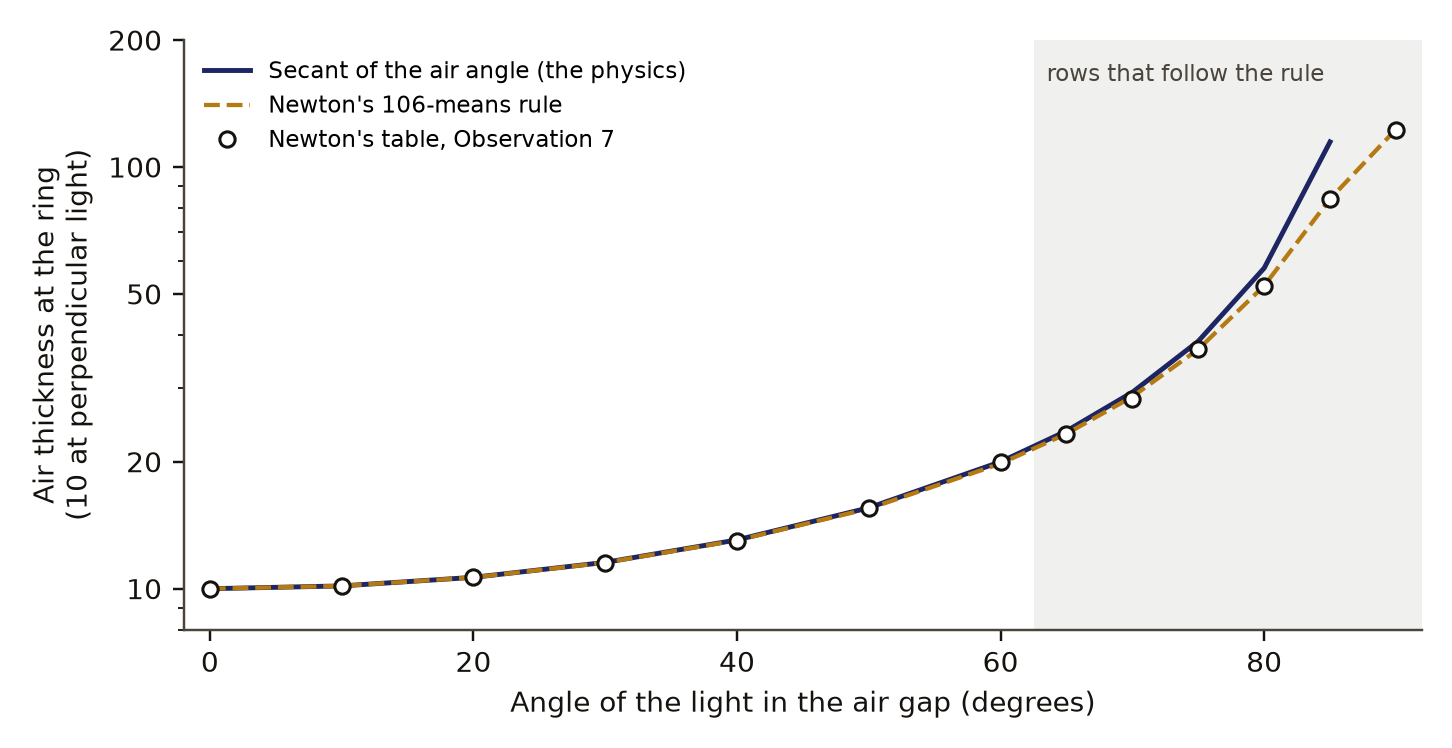
- Newton's table of ring thickness by viewing angle, beside the secant law and his own rule.
- Chart 2
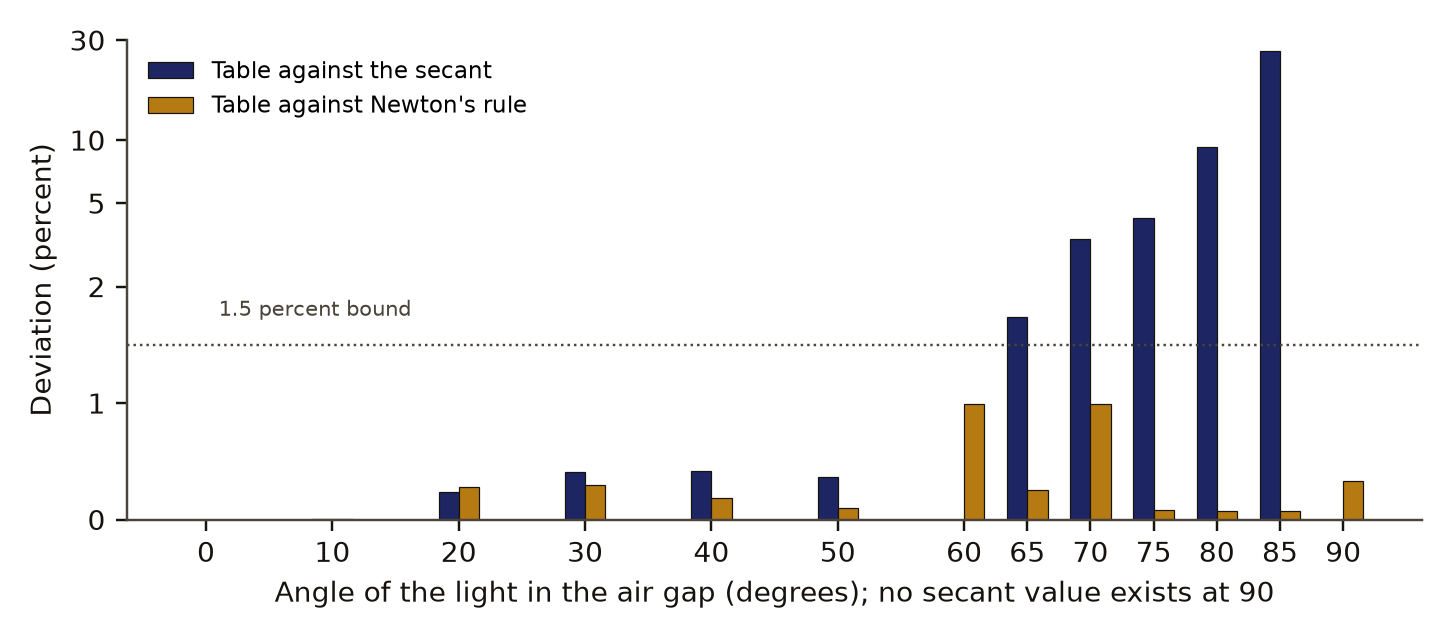
- How far each row of the table sits from the secant law and from his rule.
- Chart 3
- The five predictions and two controls, each against its bound.
- Basis
- observed: measured in this study, with a result file
c2 observed, evidence for claim 2
- The numbers in claim 2
- 65; 90; 106; 1; 85; 26.7 matches the result file, 2026-11-09
- Chart 1
- Newton's table of ring thickness by viewing angle, beside the secant law and his own rule.
- Chart 2
- How far each row of the table sits from the secant law and from his rule.
- Chart 3
- The five predictions and two controls, each against its bound.
- Basis
- observed: measured in this study, with a result file
c3 observed, evidence for claim 3
- The numbers in claim 3
- 275.7; 3.4; 1; 89000; 285.4 matches the result file, 2026-11-09
- Chart 3
- The five predictions and two controls, each against its bound.
- Chart 4
- Air thickness at the first dark ring in white light: the model with and without the half-wave flip, against Newton's value.
- Basis
- observed: measured in this study, with a result file
Introduction and motivation
Newton's ringsDefinition: Newton's rings optics The bright and dark circles seen where a curved lens rests on flat glass, made by light reflected from the two faces of the thin air gap between them, whose thickness grows with distance from the point of contact. Excludes rings made by diffraction at an edge or an aperture. full definition are the bright and dark circles seen where a curved lens rests on flat glass. In Book II, Part I of the Opticks [1], Newton measured them with a lens of known curvature and turned ring diameters into thicknesses of the air gap. In Observation 6 he gives the gap at the first dark ring as 1/89000 inch for light near the perpendicular. In Observation 7 he tilts the view and tabulates the thickness at one ring for thirteen values of the obliquityDefinition: obliquity optics, in Newton's usage The angle between the light's path and the perpendicular to the glass. Newton's table gives it twice, once inside the glass and once in the air gap. Excludes the tilt of the glass itself, which stays fixed. full definition, scaled so that perpendicular light gives 10. He says his values came "partly by measuring" and partly by other means, including two prisms for the steepest angles.
Below the table he states a rule he "seem[s] to gather" from it. We call it the 106-means ruleDefinition: 106-means rule history of optics; Newton's own rule in Opticks, Book II Newton's statement that the thickness goes as the secant of an angle whose sine is the first of 106 arithmetical means between the sines of incidence and refraction, counted from the bigger sine. Excludes the secant law, which uses the air angle alone. full definition: the thickness goes as the secant of an angle whose sine is the first of 106 arithmetical means between the sines of incidence and refraction, counted from the bigger sine. Modern optics gives a simpler answer, the secant lawDefinition: secant law thin-film optics The statement that the air thickness at which a given ring appears grows as one over the cosine of the light's angle in the air gap, scaled here so that perpendicular light gives 10. Excludes any rule built from the angle in the glass. full definition: the thickness at a fixed ring grows as one over the cosine of the angle in the air.
The two agree at shallow angles and part at steep ones. At 90 degrees in the air the secant is infinite, and Newton's last row reads 122 and a half. The question is which of the two his rows follow, and from which angle on.
The literature check for this paper ran three searches on 9 November 2026. Shapiro's study of Newton's theories of coloured bodies and fits [3] works from Newton's manuscripts and the experiments behind Book II, and is the most likely place for an earlier analysis of this table; we found its catalogue and publisher records and did not read it. Morizot [4] traces how Thomas Young turned Newton's ring thicknesses into the first wavelengths; we read its abstract. Lee and Lee [5] give open code for the colours of layered thin films from the same multiple-beam sums we use; we read its abstract. None of the searches returned an analysis of the Observation 7 table against exact theory. That is what the searches returned, and it does not show that no such analysis exists.
Preregistration and design
The design was written in a dated preregistrationDefinition: preregistration research method (metascience) A dated written plan for a study, fixed and hash-locked before any result is seen: the question, the data, the statistic, the controls, the forecasts and the kill conditions. Excludes a plan revised after looking at the outcome, and a protocol written only for the record after the run. full definition on 28 October 2026. The file states that it was written before the model or the study ran. It was not hash-locked at the time, and its result section was appended to the same file after the run, so the hash given in the reproduction section is of the file as it now stands.
One check came before the file. We had computed the rule by hand at the 90 degree row and found about 122.9 against Newton's 122 and a half. The preregistration says so, and that check is why prediction E exists.
The five predictions, with their bounds:
- A, the first dark ring in white light lies within 5 percent of Newton's 285.4 nm.
- B, the first four bright rings in white light stand as 1 : 3 : 5 : 7 within 3 percent.
- C, for light of one wavelength, 571 nm, the thickness at the first dark ring follows the secant of the air angle within 0.1 percent from 0 to 85 degrees.
- D, Newton's thickness column matches the secant within 1 percent for rows from 0 to 60 degrees.
- E, Newton's thickness column matches his 106-means rule within 1.5 percent at every row, 65 to 90 degrees included.
The file also names two controlsDefinition: control statistics and experimental design A version of the data with the structure under test removed (for example shuffled or pooled), scored the same way as the real data, so the real score has something to beat. Excludes a comparison with a different dataset or with a published number. full definition that had to fail, given in the controls section. If E holds and D fails beyond 60 degrees, the steep rows follow the fitted rule, and C says the true thickness keeps growing as the secant.
Data and provenance
The primary text is the fourth edition of the Opticks, 1730, as transcribed by Project Gutenberg (ebook 33504) [1], with the Newton Project transcription as a second copy [2]. Both are public domain. The thickness column, the glass angles and the air angles of Observation 7 were typed by hand from that text into the study script. Table 2 gives every value that entered.
The white light is the CIE D65 daylight table and the eye's weighting is the CIE 1931 2 degree observer, both from the official CIE data tables [6]. The glass is N-BK7, with an index of 1.5175 at 571 nm from the model's own refraction table.
Methods
The stack and its reflectance
The model is a glass, air gap, glass stack, the geometry of Newton's lens on a plate over the small area of one ring. For light of wavelength crossing a gap of thickness at angle in the air, write for the cosine of . The phase delay between successive beams is
Let be the amplitude reflection coefficient from glass into air and that from air into glass, each from the Fresnel equations for one polarisation. Write for the cosine of . Summing every reflected and re-reflected beam gives the Airy reflectanceDefinition: Airy reflectance optics; named after George Airy The share of light power a thin layer reflects when every reflected and re-reflected beam inside it is summed, rather than only the first two. Excludes the two-beam approximation, and absorption in the glass. full definition
computed for s and p polarisationDefinition: s and p polarisation optics The two directions of the light's electric field relative to the plane that holds the ray and the perpendicular to the surface: s across that plane and p within it. Unpolarised light is their average. Excludes circular polarisation, which this study does not model. full definition and averaged. For this stack . That sign change is the half-wave flipDefinition: half-wave flip optics The change of sign of the reflected wave at one face of the air gap and not the other, which makes the centre of the rings dark in reflected light. Excludes the phase delay from the path across the gap. full definition, and it makes the point of contact dark.
White light
For white light the reflectance is weighted by the CIE D65Definition: CIE D65 colour science (International Commission on Illumination) A standard table of the power in average midday daylight at each wavelength, used as the white light in this study. Excludes the measured spectrum of any one day's sunlight, and Newton's own light. full definition power and by the eye's brightness curve , from 380 to 780 nm in 1 nm steps:
is the reflected luminanceDefinition: luminance colour science The brightness of light as the standard eye weighs it, computed by weighting power at each wavelength with the CIE 1931 2 degree observer's brightness curve. Excludes hue and saturation, which the study does not score. full definition as a share of the incoming. The study stepped from 0 to 2,000 nm in 0.1 nm steps and read off the minima and maxima of . A dark ring is a minimum of and a bright ring a maximum.
The obliquity laws
With thickness scaled to 10 at perpendicular light, the secant law is
For Newton's rule, let and be the sines of the angles in the air and in the glass that his table lists. The first of 106 arithmetical means between them, counted from the bigger, divides the interval into 107 equal steps, and its value is the sine of the angle in Newton's secant:
Each row's deviation is the absolute difference between Newton's value and the law, divided by the law's value. Prediction C was scored on the model alone: the first dark ring at 571 nm was found at each air angle and its thickness divided by the thickness at perpendicular light.
Controls and planted checks
No planted data were used. The check with a known answer is prediction B: textbook theory places the bright rings at odd multiples of a quarter wavelength, so a model that missed 1 : 3 : 5 : 7 would be wrong before Newton entered.
Two controls had to fail, and both did.
- With the half-wave flip removed, the centre turns bright and the first minimum moves to 137.7 nm, 52 percent from Newton's value. So the dark-ring match depends on the physics the model carries.
c4 observed, evidence for claim 4
- The numbers in claim 4
- 137.7; 52 matches the result file, 2026-11-09
- Chart 3
- The five predictions and two controls, each against its bound.
- Chart 4
- Air thickness at the first dark ring in white light: the model with and without the half-wave flip, against Newton's value.
- Basis
- observed: measured in this study, with a result file
- With the thickness column shuffled across rows 200 times, his rule failed the 1.5 percent bound at 7 or more rows in every shuffle, with a median of 12. So the match to the rule depends on the rows being in Newton's order.
One error of ours was caught before grading. The first run gave prediction C a ratio of exactly 1 at every angle, because the dark-ring search started at 1 nm, where reflectance is still rising out of the dark centre, and stopped at once. The search was changed to take the first minimum after the first maximum, and the study was run again. The model was not changed.
Results
All five predictions held. Table 1 gives each against its bound.
From perpendicular light to 60 degrees in the air, his table matches the secant law of modern optics within 0.41 percent. From 65 to 90 degrees every row matches his own 106-means rule within 1 percent, and at 85 degrees his tabled thickness sits 26.7 percent below the secant. Figure 2 draws the three curves and Figure 3 the deviations row by row. Table 2 lists them.
air thickness at the ring (perpendicular light = 10), log scale
angle of the light in the air gap (degrees from perpendicular)
- Secant law
- Newton's 106-means rule
- Newton's table
Data behind chart 1 13 rows
| Air angle (degrees) | His table | His rule | Secant law |
|---|---|---|---|
| 0 | 10 | 10 | 10 |
| 10 | 10.15 | 10.15 | 10.15 |
| 20 | 10.67 | 10.64 | 10.64 |
| 30 | 11.50 | 11.53 | 11.55 |
| 40 | 13 | 13.02 | 13.05 |
| 50 | 15.50 | 15.48 | 15.56 |
| 60 | 20 | 19.80 | 20.00 |
| 65 | 23.25 | 23.31 | 23.66 |
| 70 | 28.25 | 28.53 | 29.24 |
| 75 | 37 | 36.97 | 38.64 |
| 80 | 52.25 | 52.29 | 57.59 |
| 85 | 84.08 | 84.02 | 114.74 |
| 90 | 122.50 | 122.90 | no finite value |
Read from result.json (ring model run). SHA-256 of the run's file 73ca6632eaf61fc7ab0dec7f10ef8a76f3fb757d5d15583310e1549c5a7d4766, published unchanged.
gap in percent of the law's value (lower is closer; a gap of 0 sits at the left edge), log scale
- gap to the secant law
- gap to Newton's 106-means rule
- 1 percent
Data behind chart 2 13 rows
| Air angle (degrees) | Gap to secant (%) | Gap to his rule (%) |
|---|---|---|
| 0 | 0.00 | 0.00 |
| 10 | 0.00 | 0.01 |
| 20 | 0.23 | 0.28 |
| 30 | 0.41 | 0.30 |
| 40 | 0.41 | 0.18 |
| 50 | 0.37 | 0.10 |
| 60 | 0.00 | 0.99 |
| 65 | 1.74 | 0.26 |
| 70 | 3.38 | 0.99 |
| 75 | 4.24 | 0.08 |
| 80 | 9.27 | 0.07 |
| 85 | 26.72 | 0.08 |
| 90 | no finite value | 0.33 |
Read from result.json (ring model run). SHA-256 of the run's file 73ca6632eaf61fc7ab0dec7f10ef8a76f3fb757d5d15583310e1549c5a7d4766, published unchanged.
| Check | Measured | Bound | Result |
|---|---|---|---|
| A: first dark ring within 5% of Newton's 285.4 nm | 3.4% | 5% | as planned |
| B: bright rings stand as 1 : 3 : 5 : 7 within 3% | 1.0% | 3% | as planned |
| C: model follows the secant to 85 degrees within 0.1% | 0.0075% | 0.1% | as planned |
| D: table within 1% of the secant, 0 to 60 degrees | 0.41% | 1% | as planned |
| E: table within 1.5% of his rule at all 13 rows | 0.99% | 1.5% | as planned |
| Control, flip removed: must miss Newton's value by over 5% | 51.8% | over 5% | as planned |
| Control, shuffled rows: rule must fail in every shuffle | 7 rows or more | 3 rows or more | as planned |
Data behind chart 3 7 rows
| Check | Measured | Bound | Result |
|---|---|---|---|
| A: first dark ring within 5% of Newton's 285.4 nm | 3.4% | 5% | as planned |
| B: bright rings stand as 1 : 3 : 5 : 7 within 3% | 1.0% | 3% | as planned |
| C: model follows the secant to 85 degrees within 0.1% | 0.0075% | 0.1% | as planned |
| D: table within 1% of the secant, 0 to 60 degrees | 0.41% | 1% | as planned |
| E: table within 1.5% of his rule at all 13 rows | 0.99% | 1.5% | as planned |
| Control, flip removed: must miss Newton's value by over 5% | 51.8% | over 5% | as planned |
| Control, shuffled rows: rule must fail in every shuffle | 7 rows or more | 3 rows or more | as planned |
Read from result.json (ring model run). SHA-256 of the run's file 73ca6632eaf61fc7ab0dec7f10ef8a76f3fb757d5d15583310e1549c5a7d4766, published unchanged.
The 60 degree row equals the secant to the printed precision and sits 0.99 percent from the rule. From 65 degrees on, the order flips: every row is closer to the rule than to the secant, and the gap to the secant grows with angle, to 9.27 percent at 80 degrees and 26.72 percent at 85.
The model itself keeps the secant. At 571 nm the first dark ring follows the secant of the air angle within 0.0075 percent at every angle from 0 to 85 degrees. The two phase shifts at the faces of the gap cancel at every angle below the critical one, so nothing in the physics bends the curve toward the rule.
Discussion
The split in Table 2 has a plain reading. Newton measured the rings at shallow angles, fitted a rule to those rows, and filled the steep rows from the rule. He wrote that the values came "partly by measuring" and partly by other means, which allows that reading. It is an inference. A rule fitted to the shallow rows would match them, and a row computed from the rule would match it to within the rounding of the printed fractions. Rows that were measured at steep angles and happened to fall on the rule would look the same in the table. Only his manuscripts could tell the two apart.
The rule itself is a good fit to his shallow data and a wrong law. Up to 60 degrees the rule and the secant differ by under 1 percent. Beyond that the rule bends away, and the error reaches 27 percent at 85 degrees.
The 3.4 percent gap at the first dark ring depends on the light and on what counts as dark in a coloured fringe. Our daylight is a modern standard table, and our dark ring is a luminance minimum. Newton's 285.4 nm corresponds to light centred near 571 nm rather than the 551 nm our weighting gives, a shift that sunlight could plausibly give and an eye judging "the darkest Part" of a fringe. We did not test it. Two related studies of ours, on his thick-plate rings and on his colour limits, also find his 1/89000 inch a few percent off, which is a pattern to test and not yet a result.
Young's wavelengths were taken from Newton's ring thicknesses, as Morizot describes [4]. Our result bears on those perpendicular values only through the 3.4 percent gap.
Limitations
- Which rows Newton measured and which he computed is our reading. The text cannot settle it, and a historian should check it against his manuscripts and his optical papers.
- The literature search was short. Shapiro's 1993 study [3] was not read and may already cover this table.
- The table was typed by hand from the transcription and was not checked against a scan of the 1730 printing.
- The 3.4 percent gap depends on the light source and on how an eye judges the darkest part of a coloured fringe. The preregistration planned a second check under a solar spectrum; it was not run, and no perceptual model was run.
- The 90 degree row was checked against the rule by hand before the preregistration was written, as that file states.
- The preregistration was not hash-locked at the time it was written.
- Scoring was done by our own code and was not blind.
Evidence
Held. Prereg check on a primary text with exact theory. The rings part is known physics. The reading that steep rows were computed needs a historian's check, since Newton states the rule himself.
Figures
These are the paper's own figures, numbered as in the PDF, and each "Figure" reference in the text points here. The charts on this page redraw the same results from the result files and carry their own numbers.
Tables
| Prediction | Bound | Measured |
|---|---|---|
| A, first dark ring, white light | within 5 percent of 285.4 nm | 275.7 nm, 3.4 percent |
| B, bright rings 1 : 3 : 5 : 7 | within 3 percent | 1 : 3.005 : 5.031 : 7.070, 1.0 percent |
| C, model follows the secant to 85 degrees | within 0.1 percent | largest 0.0075 percent |
| D, table against the secant, 0 to 60 degrees | within 1 percent | largest 0.41 percent |
| E, table against his rule, all 13 rows | within 1.5 percent | largest 0.99 percent; 0 rows over |
| Control, no half-wave flip | must miss by over 5 percent | 137.7 nm, 52 percent |
| Control, shuffled column | 3 or more rows off the rule | 7 or more in all 200 |
| Glass angle | Air angle | His table | His rule | Secant | Off secant | Off rule |
|---|---|---|---|---|---|---|
| 0 | 0 | 10.00 | 10.00 | 10.00 | 0.00 | 0.00 |
| 6 26 | 10 | 10.15 | 10.15 | 10.15 | 0.00 | 0.01 |
| 12 45 | 20 | 10.67 | 10.64 | 10.64 | 0.23 | 0.28 |
| 18 49 | 30 | 11.50 | 11.53 | 11.55 | 0.41 | 0.30 |
| 24 30 | 40 | 13.00 | 13.02 | 13.05 | 0.41 | 0.18 |
| 29 37 | 50 | 15.50 | 15.48 | 15.56 | 0.37 | 0.10 |
| 33 58 | 60 | 20.00 | 19.80 | 20.00 | 0.00 | 0.99 |
| 35 47 | 65 | 23.25 | 23.31 | 23.66 | 1.74 | 0.26 |
| 37 19 | 70 | 28.25 | 28.53 | 29.24 | 3.38 | 0.99 |
| 38 33 | 75 | 37.00 | 36.97 | 38.64 | 4.24 | 0.08 |
| 39 27 | 80 | 52.25 | 52.29 | 57.59 | 9.27 | 0.07 |
| 40 0 | 85 | 84.08 | 84.02 | 114.74 | 26.72 | 0.08 |
| 40 11 | 90 | 122.50 | 122.90 | none | none | 0.33 |
Appendix A. The preregistered verdicts
Each verdictDefinition: verdict research method (our usage) The pass or fail of one preregistered rule set against the run's numbers, read off by code. Excludes an interpretation written after reading the numbers. full definition is a rule written before the run. Values are read from the study's result file.
| Verdict | Deciding rule | Value | Holds |
|---|---|---|---|
| A | first luminance minimum within 5 percent of 285.4 nm | 3.4 percent | yes |
| B | first four maxima within 3 percent of 1 : 3 : 5 : 7 | 1.0 percent | yes |
| C | first dark ring at 571 nm within 0.1 percent of the secant, 0 to 85 degrees | 0.0075 percent | yes |
| D | table within 1 percent of the secant, rows 0 to 60 degrees | 0.41 percent | yes |
| E | table within 1.5 percent of the 106-means rule, every row | 0.99 percent | yes |
| Control C1 | with no half-wave flip, first minimum misses 285.4 nm by over 5 percent | 52 percent | yes |
| Control C2 | shuffled column fails the rule at 3 or more rows | at least 7 of 13 | yes |
Numbers recorded in our publication register
| What | Value |
|---|---|
| Sample | table rows 0 to 90 deg |
| Main estimate and interval | secant within 0.41% to 60 deg; rule within 0.99% all rows |
| Forecast against outcome | predictions C, E held |
| Known-answer check | Airy theory, 1:3:5:7 rings |
As recorded in the publication register, the summary row each finding gets; the paper's own numbers above were re-read from the result files.
What lowers it
- blinding Not blind. Table coded by the agent from Newton's text; the 90 deg row was checked before the prereg, as it discloses. from our publication register, on blinding
- depth of reading The cited literature was read at the level of catalogue records and abstracts; full texts were not read. from the Verified section
What holds it up
- scoring Scored by code against rules fixed in advance. from our publication register, on who scored it
- preregistration Preregistered and hash-locked before the run (sha256 d4104e90). from the Reproduce section
- control Controls: theory control working. from our publication register, on controls
- open data Public data. from our publication register, on the data licence
Where the claim stands
- lead
- hypothesis
- thesis
- conjecture
- theorem
- law candidate
- killed
Named rival, which the finding stood against: The secant law as the source of Newton's steep obliquity rows. Decisive observation against the rival: The rows follow his 106-means rule, which runs 27 percent below the secant law at 85 degrees; preregistered predictions C and E held. Tier B: Prereg check on a primary text with exact theory. The rings part is known physics. The reading that steep rows were computed needs a historian's check, since Newton states the rule himself.
Trail
Versions
- v3 2026-11-14, this page corrected, 1 item; the PDF and its BuildTeX source are still paper version 1.0
- v2 2026-11-09, paper version 1.0, first published PDF sha256 577f0a6b199c39a9
- v1 2026-10-28, entered in the findings ledger
Corrections
2026-11-14 number found by a review of the published pages
A review of the published page found two statements that did not match the study's records. now The line on where the claim stands said the secant runs 27 percent low at 85 degrees; it is Newton's table and his rule that run 27 percent below the secant there (84.1 against 114.7), and the line now says so. One chart gave the bar for the shuffled control as 1 row or more; the locked rule is 3 rows or more, and every shuffle failed at 7 or more.
2026-11-09 number found by the publication pass
The summary written for the site said that at 85 degrees "the rule" sits 26.7 percent below the secant. now The result file gives 26.7 percent for the table's value; the rule's own gap at 85 degrees is 26.8 percent. This paper uses the table's value.
2026-10-28 wording found by the study itself, before publication
The first run's dark-ring search stopped at 1 nm; fixed before grading, model unchanged, as described in the controls section.
Standing, and the ledger entries it rests on
2026-10-29 extended F57
Set by hand from findings ledger entry F57, dated 2026-10-29: the 1/89000 inch offset. Rests on findings ledger, F57.
2026-10-28 extended F15
Set by hand from findings ledger entry F15, dated 2026-10-28: the 1/89000 inch offset. Rests on findings ledger, F15.
Each correction is a dated note; the findings ledger is never rewritten, and a note governs where it differs.
Ledger and version dates up to publication are local dates in US Pacific time. Clock times in the text are UTC, seven or eight hours ahead, so a lock or a run stamped just after midnight UTC belongs to the previous local day. Corrections from 14 November 2026 on are dated in UTC.
References
- Newton, I. (1730). Opticks: or, a Treatise of the Reflections, Refractions, Inflections and Colours of Light. 4th edition. London. Book II, Part I, Observations 6 and 7. Project Gutenberg ebook 33504. run here Licence: Newton's text is in the public domain; the reuse terms of the Newton Project transcription and of the CIE tables were not confirmed for this page, which quotes numbers only used in Introduction and motivation, Data and provenance
- The Newton Project. The Second Book of Opticks, transcription. University of Oxford. https://newtonproject.ox.ac.uk/view/texts/xml/NATP00038 run here Licence: Newton's text is in the public domain; the reuse terms of the Newton Project transcription and of the CIE tables were not confirmed for this page, which quotes numbers only used in Data and provenance
- Shapiro, A. E. (1993). Fits, Passions, and Paroxysms: Physics, Method, and Chemistry and Newton's Theories of Colored Bodies and Fits of Easy Reflection. Cambridge: Cambridge University Press. abstract or summary, 2026-11-09: catalogue records and abstracts; full text not read used in Introduction and motivation, Limitations
- Morizot, O. (2026). The wavelength of light as Thomas Young invented it. arXiv:2609.24793. abstract or summary, 2026-11-09: catalogue records and abstracts; full text not read used in Introduction and motivation, Discussion
- Lee, D. and Lee, S. (2024). Color simulation for multilayered thin films using Python. arXiv:2412.12828. abstract or summary, 2026-11-09: catalogue records and abstracts; full text not read used in Introduction and motivation
- International Commission on Illumination (CIE). CIE standard illuminant D65 and CIE 1931 2 degree standard observer colour-matching functions, official data tables. run here Licence: Newton's text is in the public domain; the reuse terms of the Newton Project transcription and of the CIE tables were not confirmed for this page, which quotes numbers only used in Data and provenance
- Traxler, R. P. (1889). The Principles of Mechanics as Applied to the Solar System. San Francisco: C. A. Murdock and Co. Internet Archive item principlesofmech00traxiala. read in full: the scan, read in full on the Internet Archive used in Introduction and motivation
Cited by later findings
- F57 extended, the 1/89000 inch offset, 2026-10-29 (record findings ledger, F57). Newton's colour limits read as half-wavelengths: the same interval sits 3 percent short against a different reference, so the sign is not a contradiction.
- F15 extended, the 1/89000 inch offset, 2026-10-28 (record findings ledger, F15). Newton's thick-plate rings run about 0.8 percent large; with F14, both experiments suggest his 1/89000 inch is 2 to 3 percent thick.
Reproduce
Data
- Newton 1730. Licence: Newton's text is in the public domain; the reuse terms of the Newton Project transcription and of the CIE tables were not confirmed for this page, which quotes numbers only.
- The Newton Project. Licence: Newton's text is in the public domain; the reuse terms of the Newton Project transcription and of the CIE tables were not confirmed for this page, which quotes numbers only. https://newtonproject.ox.ac.uk/view/texts/xml/NATP00038
- International Commission on Illumination (CIE). Licence: Newton's text is in the public domain; the reuse terms of the Newton Project transcription and of the CIE tables were not confirmed for this page, which quotes numbers only.
Preregistration
sha256 d4104e90dc4a56eacbee874b19d7cfa1dde3d30326dbf84822d775aab6a0d3fa
plan not recorded
Steps
- Data: the Opticks, 1730, Book II, Part I, Observations 6 and 7 (Project Gutenberg 33504); the CIE D65 and CIE 1931 2 degree observer tables.
- Type the thirteen rows of Observation 7: glass angle, air angle and thickness.
- Compare each thickness with eq. 4 and with eqs. 5 and 6.
- For the rings, compute eq. 2 for s and p, average them, weight with eq. 3 over 380 to 780 nm, and find the minima and maxima of from 0 to 2,000 nm in 0.1 nm steps. For prediction C, find the first dark ring at 571 nm after the first maximum, at each air angle.
- Controls: repeat the white-light search with the sign of flipped; shuffle the thickness column 200 times and count rows over 1.5 percent from the rule.
- Preregistration SHA-256, of the file as it now stands with its appended result section: d4104e90dc4a56eacbee874b19d7cfa1dde3d30326dbf84822d775aab6a0d3fa. No plan hash or run id was recorded for this study; the result file was written on 28 October 2026 at 03:28 UTC and its SHA-256 is 73ca6632eaf61fc7ab0dec7f10ef8a76f3fb757d5d15583310e1549c5a7d4766.
Cost. Seconds to minutes on one desktop CPU. The study was not re-run for this paper.
Downloads
- Whitepaper, PDF F14.pdf, 1.5 MB
- BuildTeX source F14.bld, 30 KB
- Build receipt F14.buildtex.json, 1 KB
- BuildLang doc module doc.bld, 5 KB, imported by the source
The PDF is typeset by BuildTeX from F14.bld, which is written from the same source as this page. The receipt records the source's SHA-256 and the PDF's (577f0a6b199c), so anyone can rebuild it and compare. The copy here has its hidden author field blanked, as the site does for every file it publishes; blank the same field in a rebuild before comparing. The name stays on the first page.
Verified
Verified on 2026-11-09. On 9 November 2026 the first dark ring values (275.7 nm and 285.39 nm), the ring positions and ratios, the per-row table, rule and secant values, the 0.41 percent and 0.99 percent maxima, the 0.0075 percent secant fit of the model, the 26.7 percent gap at 85 degrees and both control outcomes were re-read from the study's result file. They match the findings ledgerDefinition: findings ledger our records The append-only, dated list of every result we have recorded, numbered F1, F2 and on. Corrections are added as new dated lines and old entries are never rewritten. Excludes a curated list of successes. full definition and the result section of the preregistration. The glass angles in Table 2 and eqs. 5 and 6 were checked against the study script. Both figures were drawn by a script that reads only that result file.
Not checked. The study was not re-run for this paper. The cited works by Shapiro, Morizot and Lee and Lee were found by searches run on 9 November 2026 and read at the level of catalogue records and abstracts; their full texts were not read.
Terms on this page
Each term is defined where it is first used on this page. Each name below opens its entry in the findings glossary, which lists every page that uses it.
- Newton's rings optics first use
- obliquity optics, in Newton's usage first use
- 106-means rule history of optics; Newton's own rule in Opticks, Book II first use
- secant law thin-film optics first use
- preregistration research method (metascience) first use
- control statistics and experimental design first use
- Airy reflectance optics; named after George Airy first use
- s and p polarisation optics first use
- half-wave flip optics first use
- CIE D65 colour science (International Commission on Illumination) first use
- luminance colour science first use
- verdict research method (our usage) first use
- findings ledger our records first use
To report an error, name the finding, the claim number and the source on the Work page, which gives the address. Accepted corrections join the Trail with their date.