Atlas essay · psychology and recovery
Growth Needs a Before
Feeling changed after trauma and measuring lasting change are different questions. The studies here show why a before-and-after comparison matters.

In this article
Research summary and limits
Question. When a person reports growth after trauma, what does that report show, and what does it leave unproven about lasting positive change or recovery?
Finding. Growth that people report looking back, which researchers call retrospective perceived growth, and change measured between an earlier and a later observation are different records. Studies that follow people forward in time often find that the two do not closely align.
Evidence. Eight peer-reviewed sources: the article that introduced the questionnaire, four studies that followed people over time, two systematic reviews, and one current conceptual framework for research on growth. A systematic review gathers the published studies on a question by a fixed search method.
Limit. The evidence does not determine whether a particular person's account is accurate, predict an individual's recovery, or provide diagnosis or treatment guidance.
In short
Some people say a trauma changed them for the better, and a questionnaire filled in afterward records how they now see that change, which this essay calls perceived growth. When studies measured the same people at two or more points in time, those scores often did not closely match the difference between the earlier and later measurements, called measured change here. The sections below show why a claim of lasting change needs that earlier measurement, and why no one owes anyone a story of growth.
One sentence can carry several claims
A statement about growth after trauma can carry several different claims. It may report how a person reads their life now, or describe a way of coping. It can also name a measured change, say that the event caused that change, or imply that symptoms and functioning improved. Functioning means how well a person manages work, relationships, and daily care. Each of those claims needs its own kind of record.
Careful measurement can accept that a person means what they say. It asks what the available observation can support. A sincere report can matter as a report. On its own, it is not enough evidence for a baseline (a measured starting point), lasting change, a cause, or a clinical outcome.
What the questionnaire asks
The Posttraumatic Growth Inventory, or PTGI, is a questionnaire about what researchers call posttraumatic growth (PTG). In its original form it has 21 items, and people answer them about themselves. The items cover five areas: new possibilities, relating to others, personal strength, spiritual change, and appreciation of life. People rate positive changes that they attribute to an adverse event, meaning something harmful or deeply distressing that happened to them.
That design makes the score an organized record of perceived change. It holds no measurement of the person from before the event. Two technical checks can support a questionnaire's reliability: answers that agree with each other (internal consistency) and items that group cleanly into the intended areas (a clear factor structure). Both checks concern the answers themselves, and those answers are still given after the event.
The missing before
A claim of change needs at least two comparable observations, one earlier and one later. A single judgment made after the event asks the person to reconstruct an earlier self while also making sense of the present. Memory, current mood, beliefs about change, and coping can all shape that reconstruction.
Prospective measurement, which follows people forward in time, gives a better record. It names an area of life before or near the event and measures it again later. That design has limits too. The earlier and later measures may not capture the same thing, and an event may have no clean start. People can drop out of a study, which researchers call attrition, and that can change who is left in the sample. Timing alone cannot show what caused a change.
What prospective studies found
Four studies followed people over time, and Figure 1 sets them side by side. The first, published in 2009, followed 122 undergraduates who reported a traumatic event during a two-month window. Their perceived growth was generally unrelated to measured change in the matching areas from the start of the study to the end. Perceived growth was linked to increased distress, while measured change toward growth was linked to decreased distress. Those links do not show that perceived growth causes distress, or that lasting positive change never happens.
A later study of students, published in 2019, began with 282 participants, and 66 of them reported a trauma between the two rounds. At the second round, people also rated where they had stood at the start of the semester, with no mention of the trauma. The study turned that look-back rating into a separate measure, which it calls perceived general growth. In the trauma group, the growth people credited to the trauma (perceived PTG) was not significantly related to measured change or to perceived general growth. Here, not significant means the study could not tell the link apart from chance in a group this size. Perceived general growth, the look-back rating with no mention of the trauma, was significantly related to measured change. Depending on the measure, 219 to 221 people sent back follow-up answers, 214 to 218 were in the analyses of the full group, and 61 to 64 of the 66 were in the analyses of the trauma group. The small trauma group and the student setting sharply limit how far the result generalizes.
A study of stem-cell-transplant patients, published in 2021, kept its dropouts in view. Of 275 patients approached, 236 consented. The number of completed questionnaires fell from 187 in the first round to 157 in the second and 91 in the third. Perceived growth and measured change were weakly related when all areas were combined. In three of the five paired areas, the two were not significantly correlated. The result comes from one serious medical setting and gives no estimate of how common the pattern is across other kinds of trauma.
The fourth study, published in 2023, used measurement bursts: short stretches of frequent check-ins, repeated three times over six months. It began with 804 adults in the first round and collected 32,099 experience-sampling assessments, each a brief rating made during daily life. Perceived growth did not predict later measured change, either in how people rated themselves on the growth areas at each round (current standing) or in the brief daily ratings (daily state). Six months may still be too short for some changes. The result does not rule out effects in some subgroups or over longer periods.
A story, a coping process, and a change score are different records
The 2009 study of 122 undergraduates also found that perceived growth on the PTGI was related to positive reinterpretation, a way of coping that recasts a hard event in a more hopeful light. A later systematic review and meta-analysis combined results from 47 studies. A meta-analysis pools the numbers from many studies into one analysis. It found links between perceived growth and several measured cognitive biases, which are consistent tilts in how people judge themselves and events. The strength of the link varied by type of bias. Neither finding reduces a person's report to deception.
A narrative can organize meaning and help a person keep a sense of agency. It can also help someone describe a changed relationship to an event. Those functions differ from a measured improvement in work, relationships, self-care, symptoms, or another named outcome. The honest move keeps the two apart and does not dismiss the narrative.
Growth and distress can coexist
A systematic review of seven studies, eight samples, and 6,776 participants looked at post-traumatic stress and perceived growth together. The studies used person-centered analyses, which sort people into groups, called classes, that share a pattern of scores. Depending on the study, they found between two and five classes. Distress and perceived growth did not sit on one simple scale with opposite ends.
Finding both at once carries no clinical recommendation. It does not make distress good for anyone or turn perceived growth into a stand-in for symptom outcomes, and it does not let a class label diagnose a person. Each of these needs separate evidence: functioning, safety, symptoms, meaning, and reported growth.
What a stronger record would need
A 2026 peer-reviewed conceptual framework proposes six criteria for more credible research on growth. It draws on earlier research and reports no new participant data. Summed up in one sentence, the six criteria ask researchers to show that a positive change lasts, is distinct and meaningful, is connected to the adverse event, and is open to testing with evidence. The framework is current work. It has not been validated as a clinical standard, and it does not represent a professional consensus.
A stronger public claim should name the area of life, keep an earlier comparison, and repeat the observation. It should state the time span it covers, separate cause from timing, include relevant measures of functioning, and disclose its cultural assumptions and its assumptions about what change ought to look like. Uncertainty belongs in plain view as well. No single study cited here meets that whole checklist.
Growth is not an obligation
No person owes anyone a story of improvement, gratitude, forgiveness, resilience, or meaning. A questionnaire result is not a moral rank or a certificate of recovery, and it does not predict what should happen next.
A careful record can respect a person's present account and still keep it from standing in for claims the evidence does not carry. A claim of measured change needs an earlier measurement. A person's sense of meaning matters on its own terms, whether or not anyone measures it.
Figure 1. A report, a baseline, and a change are different records
Four studies that followed people over time compared the growth people credited to the event with the change researchers measured. Each row keeps its own event, sample, time span, and result, and the rows are not combined.
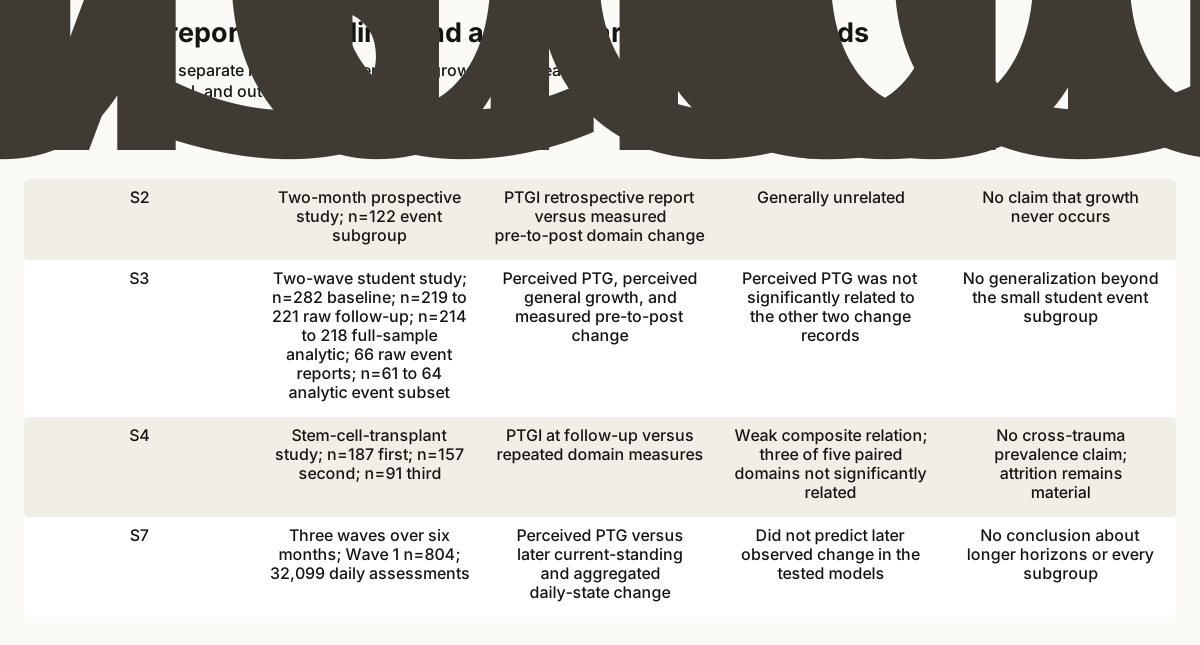
What this cannot show. The figure does not show that positive change never happens, determine whether a particular report is accurate, predict any person's recovery, or tell a reader what care to seek.
Read the data and method
| Study | Who took part, and how many | What was compared | Result | What it does not show |
|---|---|---|---|---|
| S2 | Two-month prospective study; n=122 event subgroup | Growth reported on the questionnaire versus measured change in the matching areas | Generally unrelated | Does not show that growth never happens |
| S3 | Two-wave student study; n=282 baseline; n=219 to 221 raw follow-up; n=214 to 218 full-sample analytic; 66 raw event reports; n=61 to 64 analytic event subset | Perceived PTG, perceived general growth, and measured pre-to-post change | Perceived PTG was not significantly related to the other two; perceived general growth was significantly related to measured change | Does not reach beyond the small group of students who had a trauma |
| S4 | Stem-cell-transplant study; n=187 first; n=157 second; n=91 third | Questionnaire at follow-up versus repeated measures of the same areas | Weakly related overall; not significantly related in three of five areas | Gives no estimate for other kinds of trauma; many patients dropped out |
| S7 | Three waves over six months; Wave 1 n=804; 32,099 daily assessments | Perceived growth versus later change in current standing and in daily ratings | Did not predict later measured change in the tested models | Does not cover longer periods or every subgroup |
- Does not prove
- The figure does not show that positive change never happens, determine whether a particular report is accurate, predict any person's recovery, or tell a reader what care to seek.
- Scope
- Four prospective or measurement-burst studies published from 2009 through 2024
- Units
- Participants, completed questionnaires, experience-sampling assessments, and direction-of-result labels
- Denominator
- Study-specific only; the rows must not be summed: S2 n=122; S3 baseline n=282, 219 to 221 raw follow-up returns, 214 to 218 full-sample analytic comparisons, 66 raw event reports, and n=61 to 64 in trauma-subset analytic comparisons; S4 n=187 first, 157 second, and 91 third; S7 Wave 1 n=804 and 32,099 assessments
- Date
- Sources first published online from 2009-06-08 through 2023-07-20, with S7 in a 2024 issue; observed 2026-09-05
- Transformation
- Findings are paraphrased with study-specific direction labels; no pooling, standardization, interpolation, or cross-study ranking is performed
- Uncertainty
- Events, samples, follow-up windows, measures, attrition, and statistical models differ across rows
- Limitations
- The table shows selected studies and leaves others out. None of the samples represents every kind of adverse event or recovery context.
Sources
- The Posttraumatic Growth Inventory: Measuring the Positive Legacy of Trauma. Journal of Traumatic Stress. The article that introduced the questionnaire. Wiley lists first publication in 1996 and the July 1996 issue, so the date shown marks the month and is not an exact publication day. Published 1996-07-01; observed 2026-09-05.
- Does Self-Reported Posttraumatic Growth Reflect Genuine Positive Change?. Psychological Science. The two-month study of 122 undergraduates. PubMed lists online publication on 8 June 2009, while SAGE lists Article first published online July 1, 2009 and the July 2009 issue. Published 2009-06-08; observed 2026-09-05.
- Perceptions of Change after a Trauma and Perceived Posttraumatic Growth: A Prospective Examination. Behavioral Sciences. The later student study, open access. It began with 282 people and reports 219 to 221 raw follow-up returns, 214 to 218 full-sample analytic comparisons, 66 people who reported a trauma, and 61 to 64 people in the trauma-group analyses. Published 2019-01-15; observed 2026-09-05.
- Retrospective and prospective measures of post-traumatic growth reflect different processes. BMC Psychiatry. The study of stem-cell-transplant patients by Maya Corman and colleagues, open access. Published 2021-01-11; observed 2026-09-05.
- Cognitive biases in perceptions of posttraumatic growth. Clinical Psychology Review. A systematic review and meta-analysis of links between measured cognitive biases and perceived growth. Published 2022-04-21; observed 2026-09-05.
- Empirically Derived Patterns of Posttraumatic Stress and Growth. Trauma, Violence, & Abuse. A systematic review of studies that sorted people into groups by their scores for post-traumatic stress and perceived growth. Published 2022-11-11; observed 2026-09-05.
- Does Perceived Posttraumatic Growth Predict Observed Changes in Current-Standing and State Posttraumatic Growth?. Clinical Psychological Science. The six-month study with three bursts of check-ins, comparing perceived growth with later change in current standing and in daily ratings. Published 2023-07-20; observed 2026-09-05.
- Multidisciplinary Recommendations for Improving the Credibility of Research on Posttraumatic Growth. Personality Science. The 2026 conceptual framework with six proposed criteria. It is not a validated standard, professional consensus, or outcome trial. Published 2026-07-15; observed 2026-09-05.
Claim notes and limitations
The original PTGI is a 21-item self-report instrument with five reported-change domains.
Sources: S1
- Scope
- How the questionnaire is built; it gives no estimate of how common growth is in any population
- Uncertainty
- Factor structure, translation, and interpretation can vary by sample and version
- Does not prove
- That a high score is observed behavioral change, symptom recovery, or a benefit caused by trauma
The original article describes the inventory as assessing reported positive outcomes and reconstructed or strengthened perceptions of self, others, and meaning.
Sources: S1
- Scope
- What the original instrument was designed to ask
- Uncertainty
- An instrument-design statement is not later construct-validity evidence
- Does not prove
- That retrospective attribution supplies a pre-event baseline
In one prospective two-month study, PTGI scores were generally unrelated to measured pre-to-post change in corresponding domains.
Sources: S2
- Scope
- 122 undergraduates reporting an intervening event
- Uncertainty
- Narrow age range, short interval, self-report measures, and opportunistic event exposure
- Does not prove
- That durable positive change never occurs or that a perceived-growth report is meaningless
In that study, perceived growth was associated with increased distress, measured pre-to-post growth was associated with decreased distress, and perceived growth was related to positive reinterpretation coping.
Sources: S2
- Scope
- The same 122-person analytic sample
- Uncertainty
- Associations are not treatment effects and may not generalize to other events or populations
- Does not prove
- That perceived growth causes distress or that reinterpretation is inherently harmful
A later prospective replication found that perceived PTG, not perceived general growth, was not significantly related to measured pre-to-post growth. Perceived PTG was also not significantly related to perceived general growth, the study's separate retrospective reconstruction of change, while perceived general growth was significantly related to measured pre-to-post growth.
Sources: S3
- Scope
- 282 baseline participants; 219 to 221 raw follow-up returns; 214 to 218 full-sample analytic comparisons; 66 reported an intervening trauma, with 61 to 64 in the trauma-subset analytic comparisons
- Uncertainty
- Small event subgroup, university sample, and semester-length follow-up
- Does not prove
- That one null result applies to every domain, population, or time horizon
In the stem-cell-transplant study, retrospective PTGI and prospective change were weakly related at the composite level, and three of five paired domains were not significantly correlated.
Sources: S4
- Scope
- 187 first questionnaires, 157 second questionnaires, and 91 third questionnaires; five-month follow-up
- Uncertainty
- Serious medical context, substantial attrition, and study-specific domain measures
- Does not prove
- The same relation or frequency in bereavement, assault, disaster, war, or other health settings
A meta-analysis found that several measured cognitive biases were associated with perceived PTG, with strength varying by bias type.
Sources: S5
- Scope
- 47 studies and 66 separately coded effects
- Uncertainty
- Bias constructs and measures were heterogeneous
- Does not prove
- That all reported growth is false, fabricated, or clinically useless
Post-traumatic stress and perceived growth can coexist, and person-centered analyses do not place them on one opposite-ended recovery scale.
Sources: S6
- Scope
- Seven studies, eight samples, and 6,776 participants; class solutions varied from two to five
- Uncertainty
- Most included evidence was cross-sectional or based on latent classes with setting-specific measures; one web-rendered critical-findings extract appeared to show n=6,766, so no additional participant arithmetic is derived
- Does not prove
- That distress is beneficial, that high growth means severe symptoms, or that a class label diagnoses a person
In a three-wave, six-month measurement-burst study, perceived growth did not predict subsequent observed change in current-standing or aggregated daily-state growth measures.
Sources: S7
- Scope
- Wave 1 N=804 and 32,099 experience-sampling assessments
- Uncertainty
- Six months is a short horizon for some durable changes; event types and growth domains varied
- Does not prove
- The absence of longer-term or subgroup effects, or that current meaning has no value
A 2026 framework proposes six criteria for a credible account of growth and states that the proposal does not imply positive virtue change is common, likely, or necessary.
Sources: S8
- Scope
- Conceptual and methodological synthesis with no participant denominator
- Uncertainty
- The proposed criteria need future culturally adaptable measures and longitudinal validation
- Does not prove
- A validated clinical standard, professional consensus, or an outcome intervention
A perceived-growth report can be respected as evidence about present interpretation while remaining separate from a claim of durable, causal, or clinical change.
Sources: S1, S2, S3, S4, S5, S6, S7, S8
- Scope
- Editorial synthesis across instrument development, prospective studies, systematic reviews, and one current framework
- Uncertainty
- The literature uses different events, measures, time windows, and definitions; no single study tests the entire sentence
- Does not prove
- That interpretation and coping are unimportant or that research can rank the meaning of a person's account
Corrections
- Rewritten on 25 September 2026 in plainer language. The paragraph on the later student study now states that its look-back rating with no mention of the trauma was significantly related to measured change, as the source reports. No number or source changed.