
Findings F310 Physics, Computing and mathematics, Method and statistics found 2026-10-31
Titius-Bode regularity in 122 exoplanet systems sits in gap sizes; their order adds nothing
Exoplanet systems do look more regular than random gaps would make them, but shuffling each system's own gaps into a new order leaves that regularity in place. A planet's position is predicted better by its two neighbours than by a Titius-Bode fit.
- Tier
- B, signal
- Outcome
- mixed
- Rung
- thesis
- Verdicts
- 2 passed, 4 failed
- Corrections
- 3, latest 2026-11-14
- Version
- v3, 2026-11-14
- Redo it
- Reproduce
Download PDF 3.6 MB BuildTeX source F310.bld
What this means for a reader
If a paper says a Titius-BodeDefinition: Titius-Bode rule planetary astronomy Any formula that places a system's planets at distances or periods growing by a near-constant ratio from one planet to the next, here fitted in three forms to the log of orbital period. Excludes a physical model of how planets form or migrate. full definition fit predicts a missing planet at a given period, ask what the two neighbouring planets alone would predict. A Titius-Bode rule, in planetary astronomy, is any formula that places a system's planets at distances or periods growing by a near-constant ratio from one to the next; it is a description of where planets sit and carries no model of how they formed or migrated. In our sample the neighbours win. A system's planets do tend to sit at similar spacing ratios, a pattern known from Kepler data as "peas in a podDefinition: peas in a pod exoplanet surveys The pattern, reported from Kepler data, that planets inside one system tend to be alike in size and in the ratios between neighbouring periods. Excludes a rule for the order of the gaps, and any likeness between planets of different systems. full definition" [8], and any rule that fits a geometric sequence will fit such a system well. That good fit is not evidence that the sequence itself is a law. The exoplanet survey phrase covers planets inside one system being alike in size and in spacing ratio; it states no rule for the order of the gaps.
Objection
The three forms were written from memory of the published ones, and a later review of our own ledger flagged that. A published form that differs could score differently, so the result covers these three versions only. Blagg's formula with its periodic term was not tested.
What would change the call. Our publication register records no condition that would raise or overturn this call.
From the paper's first stated limitation; our register records no separate objection.
Abstract
The Titius-Bode rule says planets sit at distances that grow by a steady ratio, and its generalised forms have been used to predict planets nobody has seen. We asked whether exoplanet spacing follows such a rule beyond what each system's own set of gaps explains. On 122 systems with four or more planets (543 planets) from the NASA Exoplanet Archive, three forms of the rule were scored against two controls fixed in advance. The real systems beat a control that draws gaps from the whole catalogue (p 0.0005, 2,000 draws), and none of the three forms beat a control that keeps each system's gaps and shuffles their order (p 0.85, 0.995 and 0.68). When an interior planet is dropped, the geometric mean of its two neighbours predicts its period better than the rule does: median error 0.107 against 0.131 in log period, a ratio of 1.23. The regularity is real, and it is the regularity of similar gaps inside one system. The order of those gaps adds nothing we could detect. The preregistered law-like verdict failed.
c1 observed, evidence for claim 1
- The numbers in claim 1
- 0.0005; 2,000; 0.85; 0.995; 0.68 matches the result file, 2026-11-09
- Chart 1
- How the test was built: one score, a planted check and two controls read in order.
- Chart 3
- Real regularity scores against each control's range.
- Chart 5
- Every rule fixed in advance, the value it tested and the bar it had to clear.
- Basis
- observed: measured in this study, with a result file
c2 observed, evidence for claim 2
- The numbers in claim 2
- 0.107; 0.131; 1.23 matches the result file, 2026-11-09
- Chart 4
- Predicting a dropped interior planet: the rule against its two neighbours.
- Chart 5
- Every rule fixed in advance, the value it tested and the bar it had to clear.
- Basis
- observed: measured in this study, with a result file
Introduction
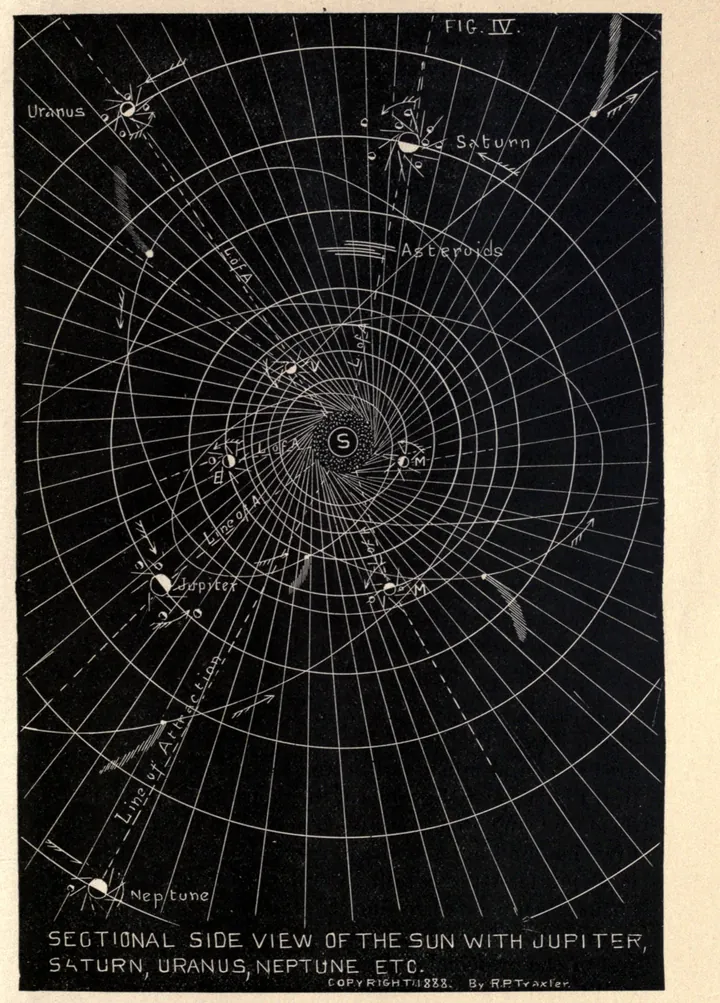
Johann Titius noticed in 1766 that the planets then known sit near distances given by a simple doubling sequence, and Johann Bode popularised it. The rule matched Uranus and the asteroid belt and missed Neptune. It has been rewritten many times since. Blagg [2] fitted the Solar System and the moons of the giant planets with a periodic correction to a geometric progression; Richardson [3] gave another version.
The question of whether the rule means anything was put sharply by Hayes and Tremaine [4]. They drew random planetary systems, rejected the ones that would be unstable, and found that the survivors fit a Titius-Bode law about as well as the Solar System. Their conclusion was that stable systems tend to be regularly spaced, and that this is the whole content of the rule.
Exoplanets gave the rule new material. Bovaird and Lineweaver [5] fitted a generalised Titius-Bode relation to multi-planet systems, allowed for unseen planets in the gaps, and predicted 141 new planets. Huang and Bakos [6] searched the Kepler data for 97 of those predictions and found 5. Bovaird, Lineweaver and Jacobsen [7] replied that many predicted planets would not transit and should not be expected in the data, and ranked new predictions by their chance of transiting.
This paper adds one controlDefinition: control statistics and experimental design A version of the data with the structure under test removed (for example shuffled or pooled), scored the same way as the real data, so the real score has something to beat. Excludes a comparison with a different dataset or with a published number. full definition to that argument. A control, in the sense of experimental design, is a copy of the data with one structure removed and scored exactly like the real data; a comparison with another catalogue or a published number would not count as one. A rule about a sequence should beat a version of the same system with its gaps put in a different order. If it does not, the rule describes the sizes of the gaps and nothing about their arrangement.
Preregistration and design
The design was written and hash-locked on 31 October 2026 as a preregistrationDefinition: preregistration research method (metascience) A dated written plan for a study, fixed and hash-locked before any result is seen: the question, the data, the statistic, the controls, the forecasts and the kill conditions. Excludes a plan revised after looking at the outcome, and a protocol written only for the record after the run. full definition, after the archive file was fetched and its first two rows were seen and before any spacing was computed. The practice comes from clinical trials and psychology: a dated plan fixed before any result is seen, so a plan revised after a look at the outcome does not qualify. The decision it informs was stated in the same file: if the rule fails, it is reported as spacing, and predicted-planet claims built on it get no weight in our work.
The locked file names the data, the three forms, the per-system statistic, the leave-one-outDefinition: leave-one-out prediction statistics, cross-validation Dropping one interior planet, fitting the rule to the others and comparing the predicted period with the true one, repeated for every interior planet. Excludes scoring a planet with a fit that has already seen it. full definition prediction test, the planted systemsDefinition: planted check research method; called a positive control in experimental science Data built so that the right answer is known, run through the same analysis before the real data, to show that the analysis can see the effect when it is there. Excludes any check made on the real data, which cannot show what the analysis misses. full definition, both controls, the forecasts and the kill conditionsDefinition: kill condition research method (our usage, after Popper's falsification) A rule written in the preregistration that, when met, decides against the claim with no room for judgement after the run. Excludes reasons found after the run for setting a result aside. full definition. Leave-one-out is a validation method from statistics: drop one planet, fit the rest and predict the one dropped, so no planet is scored by a fit that has seen it. The planted systems are our planted check, synthetic systems with a known regularity run through the same analysis first to show the score can find regularity when it is there, which no check on real data can show. A kill condition is a rule in the plan that decides against the claim when it is met, with no room for judgement after the run. Nothing was added after the run. The preregistration's SHA-256Definition: SHA-256 cryptography A hash function that turns a file into a 64-character fingerprint which changes if any byte of the file changes. A recorded hash shows the file was not edited after it was taken. Excludes encryption, because the hash keeps nothing secret and cannot be turned back into the file. full definition is given in the reproduction section. SHA-256 is a cryptographic hash, a 64-character fingerprint of a file that changes if any byte changes; it shows the plan was not edited and keeps nothing secret, since it is not encryption.
The two controls are our own constructions, set out in the methods. The order-shuffle controlDefinition: order-shuffle control our usage, a permutation control Each system rebuilt from its own innermost period and its own gaps in log period, put in a random order, and scored with the same form and freedom as the real system. Excludes gaps borrowed from other systems, which the pooled-gap control uses. full definition keeps each system's own gaps and puts them in a random order. The pooled-gap controlDefinition: pooled-gap control our usage, a resampling control Each system rebuilt from gaps in log period drawn at random from all systems' gaps, and scored with the same form and freedom as the real system. Excludes planets or gaps from outside the 122 systems in the sample. full definition rebuilds each system from gaps drawn from the whole sample. Neither brings in any planet from outside the 122 systems.
Kill conditions, without discretion:
- VoidDefinition: void research method (our usage) The verdict of a run whose planted check failed or whose sample fell below its stated minimum. It says nothing for or against the claim. Excludes a null result, which comes from a working instrument. full definition if the planted systems score at or below the pooled-gap control's 95th percentile, or if fewer than 60 systems qualify. A void run, in our usage, says nothing for or against the rule, and differs from a null result, which comes from an instrument that works.
- Law-likeDefinition: law-like our usage, fixed in the preregistration The verdict that a Titius-Bode form beats the order-shuffle control's 95th percentile and predicts dropped planets better than the neighbour baseline. Excludes regularity that similar gaps alone produce, which beats only the pooled-gap control. full definition only if the plain form beats the order-shuffle control's 95th percentile and the leave-one-out ratio is below 1. Otherwise the rule is reported as explained by spacing. Law-like is our label for a rule whose sequence carries information past the sizes of the gaps; regularity that similar gaps alone produce falls outside it.
Data and provenance
The data are the NASA Exoplanet Archive Planetary Systems Composite Parameters table [1], retrieved on 31 October 2026 through the archive's TAP serviceDefinition: TAP service astronomical data services The Table Access Protocol of the International Virtual Observatory Alliance, the standard query interface through which astronomical archives return table rows. Excludes any selection or cleaning of the rows, which the query itself sets. full definition. TAP, the Table Access Protocol set by the International Virtual Observatory Alliance, is the standard query interface of astronomical archives; it fetches rows and applies no selection of its own. A system qualified with at least four listed planets that have orbital periods and a controversy flagDefinition: controversy flag NASA Exoplanet Archive catalogue fields A catalogue field set to 1 when a planet's existence or confirmation has been questioned in the published literature and 0 otherwise. Excludes independent confirmation, which a flag of 0 does not give. full definition of zero. The archive sets that flag to 1 when a planet's existence has been questioned in the published literature, so 0 means no published dispute, which is weaker than independent confirmation. This gave 122 systems and 543 planets. The archive is public and places no restriction on use.
Two selection effects shape the sample. TransitDefinition: transit survey observational astronomy A search that finds planets by the small dip in a star's light as a planet crosses its disc, which favours short periods and orbits seen close to edge-on. Excludes planets found only by other methods, such as radial velocity or direct imaging. full definition surveys find short periods and planets whose orbits are close to edge-on, so long periods and tilted planets are missing, and the gaps we see are partly survey-shaped. A transit survey, in observational astronomy, finds a planet by the dip in starlight as it crosses its star's disc; planets found only by other methods, such as radial velocity, are outside that term. Multi-planet entries in the catalogue are also a selected set. The order-shuffle control keeps both effects, because it uses the same gaps from the same systems. That is why it is the fair control for a claim about order.
Methods
The three forms
For a system with planets sorted by period, let be the period of the th planet. The plain form is log-linear in the index:
The Blagg-Richardson style form adds an offset period , a three-parameter form in period:
The gapped form, in the style of Bovaird and Lineweaver, replaces the index by integers that may skip up to two places, so that up to two unseen planets can be inserted wherever they lower the residual:
All three forms were written from the published descriptions as remembered, not copied from the papers. Blagg's own formula has a periodic correction term that eq. 2 does not carry. The result is therefore about these three versions.
The regularity score
For system , let be the root mean square residualDefinition: root mean square residual statistics The square root of the mean squared difference between fitted and observed log period across a system's planets, a measure of scatter about the fit. Excludes any offset or trend the fit has already absorbed into its parameters. full definition of the fit in , and the mean gap in between neighbouring planets. The per-system statistic divides one by the other, so that systems with wide and narrow spacing are compared on one scale. The residual term is from statistics: the square root of the mean squared difference between fitted and observed , a measure of scatter about the fit that leaves out any offset the fit has already absorbed:
The sample score is minus the median of over the systems, so a higher score means more regular. Each form has its own score.
Prediction by leave-one-out
For each interior planet , the planet is dropped, the plain form is fitted to the rest, and the fitted is compared with the true value. The baseline predicts as the mean of its two neighbours' , which is the geometric meanDefinition: geometric mean statistics For two numbers, the square root of their product, which is the plain average taken on a log scale. Here the neighbour baseline for a dropped planet's period. Excludes the ordinary average of the two periods, which is larger whenever they differ. full definition of their periods. The geometric mean of two numbers is the square root of their product, the plain average taken on a log scale; it is smaller than the ordinary average whenever the two differ. The ratio of median absolute errors is
where is the median error of the fit and that of the neighbour baseline. A ratio above 1 means the neighbours win.
Controls
The order-shuffle control keeps each system's set of gaps in and puts them in a random order, then rebuilds the periods from the innermost planet. The pooled-gap control rebuilds each system from gaps drawn at random from all systems' gaps. Each control is scored with the same form and the same freedom as the real data; for the gapped form that includes the inserted planets. The plain form's controls ran 2,000 draws each and the other two forms' order controls ran 200 each.
The p valueDefinition: p value (from draws) statistics The share of control draws scoring at or above the real score, with one added to the count and to the number of draws, so it is never zero. Excludes a p value from a textbook formula that assumes a distribution. full definition reported for each comparison is the share of control draws scoring at or above the real score, counted with one added to both the numerator and the denominator. It is a p value from draws, as in permutation statistics, and assumes no textbook distribution:
where is the number of draws at or above the real score and the number of draws. This is why the smallest possible value at 2,000 draws is 0.0005.
Controls and planted checks
The instrument was checked on planted systems before the real data were read. Planted systems have exactly log-linear periods with 5 percent jitter and the same numbers of planets as the real systems. They scored -0.050 against the pooled-gap control's 95th percentile of -0.190, so the score sees regularity when it is there. The void condition did not fire.
c3 observed, evidence for claim 3
- The numbers in claim 3
- -0.050; 95; -0.190 matches the result file, 2026-11-09
- Chart 1
- How the test was built: one score, a planted check and two controls read in order.
- Chart 2
- Planted check: does the score see regularity that was put there?
- Basis
- observed: measured in this study, with a result file
- data122 systems, 543 planetsNASA Exoplanet Archive, systems with four or more planets, sorted by period.
- measurementFit three forms, score eachPlain, Blagg-Richardson style and gapped. Score S is minus the median residual over mean gap.
- planted checkPlanted systems score −0.050Exactly log-linear periods with 5 percent jitter. Bar to clear: −0.190.
- controlControl 1: pooled gapsRebuild each system from gaps drawn from all systems, 2,000 times. Asks whether a system's gaps resemble each other.
- controlControl 2: order shuffledKeep each system's gaps, shuffle their order, 2,000 times. Asks whether the order is regular.
- rule set in advanceRule: real score above the control's 95th percentileFixed before the data were read, with at least 60 systems.
- not supportedSequence claimControl 1 beaten (p 0.0005). Control 2 not beaten by any form.
Read from result.json, run 20261031T220149Z. SHA-256 of the run's file 43000bace9a1e11ebc0bda2e2fd94f746f7624811710465d0839ec4e4e84f466 and of the published copy b765461d342cc250e1fe62efabe7256c4d7afe751dd9103ccc1d726bb7a25af6. In the copy, file paths are cut to the file name and the layout (indentation, line endings) may differ; every value is the same.
regularity score S (higher is more regular)
- planted score
- pooled-gap control, 5th to 95th percentile
- control mean
Data behind chart 2 5 rows
| Quantity | Value |
|---|---|
| Planted score | −0.050 |
| Control mean | −0.213 |
| Control 5th percentile | −0.236 |
| Control 95th percentile | −0.190 |
| Control draws | 2,000 |
Read from result.json, run 20261031T220149Z. SHA-256 of the run's file 43000bace9a1e11ebc0bda2e2fd94f746f7624811710465d0839ec4e4e84f466 and of the published copy b765461d342cc250e1fe62efabe7256c4d7afe751dd9103ccc1d726bb7a25af6. In the copy, file paths are cut to the file name and the layout (indentation, line endings) may differ; every value is the same.
The two controls ask different questions, and they are read in that order. Beating the pooled-gap control says the gaps inside a system resemble each other more than gaps drawn from other systems. Beating the order-shuffle control would say the order of those gaps is regular as well. Only the second is a claim about a sequence.
Results
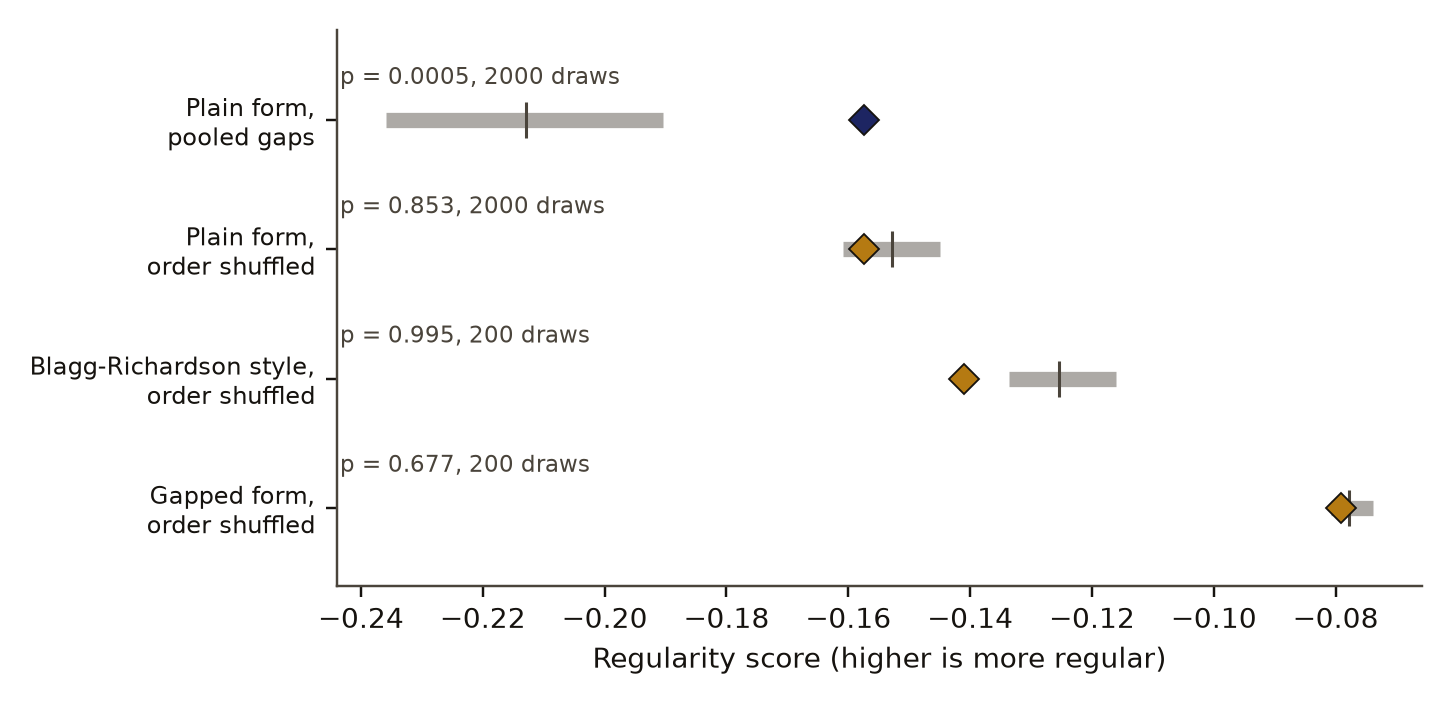
Table 1 gives the score of each form against its controls, and Figure 2 draws the same numbers. The plain form scores -0.157. The real systems are far more regular than systems built from pooled gaps. They are not more regular than their own gaps in a shuffled order: the real score sits inside the order-shuffle range for the plain and gapped forms and below it for the Blagg-Richardson style form (-0.141 against a 5th to 95th percentile range of -0.134 to -0.116).
The Blagg-Richardson style form scores below the 5th percentile of its own order shuffles, and the gapped form sits at its mean. The extra freedom in those forms fits shuffled systems as well as real ones.
c4 observed, evidence for claim 4
- The numbers in claim 4
- 5 matches the result file, 2026-11-09
- Chart 3
- Real regularity scores against each control's range.
- Basis
- observed: measured in this study, with a result file
regularity score S (higher is more regular)
- real score
- control draws, 5th to 95th percentile
- control mean
Data behind chart 3 4 rows
| Form and control | Real score | Control mean | Control 5th pct | Control 95th pct | p | Draws |
|---|---|---|---|---|---|---|
| Plain form, pooled gaps | −0.157 | −0.213 | −0.236 | −0.190 | 0.0005 | 2,000 |
| Plain form, order shuffled | −0.157 | −0.153 | −0.161 | −0.145 | 0.85 | 2,000 |
| Blagg-Richardson style, order shuffled | −0.141 | −0.125 | −0.134 | −0.116 | 0.995 | 200 |
| Gapped form, order shuffled | −0.079 | −0.078 | −0.081 | −0.074 | 0.68 | 200 |
Read from result.json, run 20261031T220149Z. SHA-256 of the run's file 43000bace9a1e11ebc0bda2e2fd94f746f7624811710465d0839ec4e4e84f466 and of the published copy b765461d342cc250e1fe62efabe7256c4d7afe751dd9103ccc1d726bb7a25af6. In the copy, file paths are cut to the file name and the layout (indentation, line endings) may differ; every value is the same.
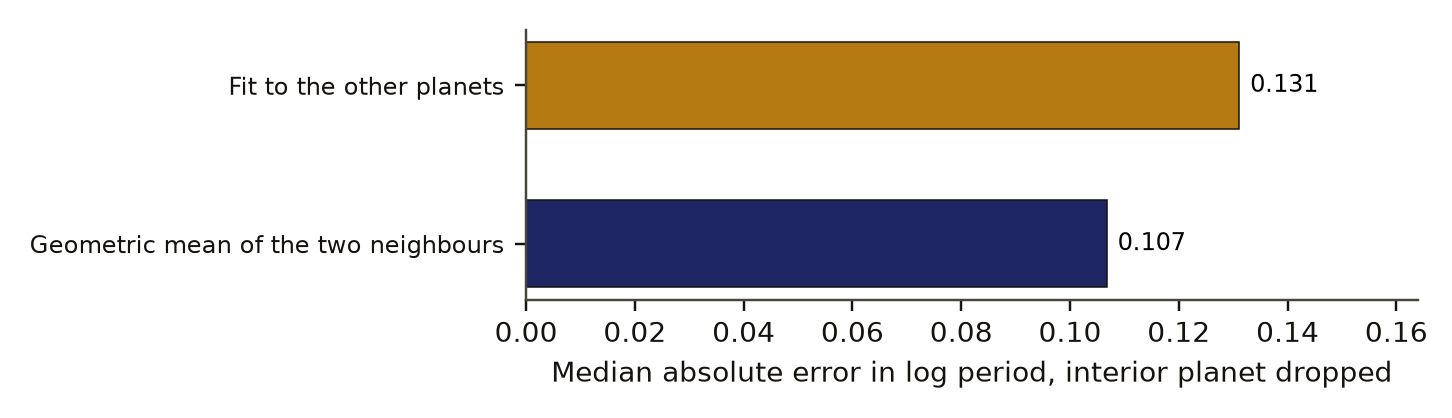
When an interior planet is dropped, the geometric mean of its two neighbours predicts its period better than the rule does: median error 0.107 against 0.131 in log period, a ratio of 1.23. Figure 3 shows the two errors.
| Rule set in advance | Value | Bar | Result |
|---|---|---|---|
| Planted score above the pooled-gap 95th percentile | −0.050 | −0.190 | held |
| At least 60 systems | 122 | 60 | held |
| Plain form above the pooled-gap 95th percentile | −0.157 | −0.190 | held |
| Plain form above the order-shuffle 95th percentile | −0.157 | −0.145 | failed |
| Blagg-Richardson style above its order-shuffle 95th percentile | −0.141 | −0.116 | failed |
| Gapped form above its order-shuffle 95th percentile | −0.079 | −0.074 | failed |
| Leave-one-out ratio below 1.0 | 1.228 | 1.000 | failed |
Data behind chart 5 7 rows
| Rule set in advance | Value | Bar | Result |
|---|---|---|---|
| Planted score above the pooled-gap 95th percentile | −0.050 | −0.190 | held |
| At least 60 systems | 122 | 60 | held |
| Plain form above the pooled-gap 95th percentile | −0.157 | −0.190 | held |
| Plain form above the order-shuffle 95th percentile | −0.157 | −0.145 | failed |
| Blagg-Richardson style above its order-shuffle 95th percentile | −0.141 | −0.116 | failed |
| Gapped form above its order-shuffle 95th percentile | −0.079 | −0.074 | failed |
| Leave-one-out ratio below 1.0 | 1.228 | 1.000 | failed |
Read from result.json, run 20261031T220149Z. SHA-256 of the run's file 43000bace9a1e11ebc0bda2e2fd94f746f7624811710465d0839ec4e4e84f466 and of the published copy b765461d342cc250e1fe62efabe7256c4d7afe751dd9103ccc1d726bb7a25af6. In the copy, file paths are cut to the file name and the layout (indentation, line endings) may differ; every value is the same.
The Solar System was scored beside the test and is not part of it. It has of 0.32 on the plain form and 0.17 on the gapped form, against a catalogue median of 0.157 on the plain form. On this statistic the median exoplanet system is more regular than ours.
Table 2 sets the forecasts written before the run against the outcomes.
Discussion
Hayes and Tremaine [4] argued that a Titius-Bode law is what stable spacing looks like. Our result is a direct check of one consequence of that view on exoplanets. If the rule only describes similar gaps, then a system with its gaps shuffled should fit as well as the real one. It does, for three forms.
The prediction test points the same way. A rule that captured a law of sequence should predict a missing planet better than a local average of its neighbours, because it uses the whole system. It predicts worse. Local spacing carries the information, which fits the correlated period ratios of neighbouring planets reported by Weiss and colleagues [8].
This bears on the prediction debate between Bovaird and Lineweaver [5] [7] and Huang and Bakos [6] in one way. A predicted planet in a gap is a claim that the gaps should be more equal than they look. That claim can be useful as a search target. It does not need a law of sequence, and it should be weighed against the neighbour baseline rather than against no prediction at all.
Limitations
- The three forms were written from memory of the published ones, and a later review of our own ledger flagged that. A published form that differs could score differently, so the result covers these three versions only. Blagg's formula with its periodic term was not tested.
- Transit surveys miss long periods and tilted planets, so the gaps are survey-shaped. The order shuffle keeps that effect, which is why it is the fair control, but the pooled-gap result is partly a survey result.
- The catalogue's multi-planet entries are a selected set, and the sample is 122 systems, short of the 150 we forecast.
- The 200-draw controls for the two richer forms give coarse p values.
- The finding says nothing about the physics that sets spacing.
- Scoring was done by our own code and was not blind.
- The order-shuffle test cannot be passed by an exact geometric law. A system whose log gaps are all equal is unchanged by shuffling them, so the law-like verdict tests only whether unequal gaps come in an ordered sequence. An exact Titius-Bode spacing would show up here as regularity in gap sizes, which the pooled-gap control did detect.
Evidence
Mixed. The spacing signal is real: the systems beat gaps pooled from the whole catalogue (p 0.0005). The order and law-like verdicts are null: against each system's own gaps put in a new order none of the three forms scored above the shuffled range (p 0.85, 0.995 and 0.68).
Figures
These are the paper's own figures, numbered as in the PDF, and each "Figure" reference in the text points here. The charts on this page redraw the same results from the result files and carry their own numbers.
Tables
| Form and control | Real score | Control mean | Control interval | p | Draws |
|---|---|---|---|---|---|
| Plain, pooled gaps | -0.157 | -0.213 | -0.236 to -0.190 | 0.0005 | 2,000 |
| Plain, order shuffled | -0.157 | -0.153 | -0.161 to -0.145 | 0.85 | 2,000 |
| Blagg-Richardson style, order shuffled | -0.141 | -0.125 | -0.134 to -0.116 | 0.995 | 200 |
| Gapped, order shuffled | -0.079 | -0.078 | -0.081 to -0.074 | 0.68 | 200 |
| Quantity | Forecast | Outcome |
|---|---|---|
| Qualifying systems | 150 | 122 |
| Median residual ratio, plain form | 0.22 | 0.157 |
| Beats the pooled-gap control | probability 0.8 | yes |
| Beats the order-shuffle control, plain | probability 0.15 | no |
| Beats the order-shuffle control, gapped | probability 0.15 | no |
| Beats the order-shuffle control, Blagg style | probability 0.2 | no |
| Leave-one-out ratio | 1.15 | 1.23 |
| Planted systems caught | 1.0 | yes |
Appendix A. The preregistered verdicts
Each verdictDefinition: verdict research method (our usage) The pass or fail of one preregistered rule set against the run's numbers, read off by code. Excludes an interpretation written after reading the numbers. full definition is a set of rules written before the run. The word is ours for the pass or fail of one such rule set, read off by code, and it never covers a reading written after the numbers were seen. A verdict passes only when every rule holds. Values are read from the run's result file.
| Verdict | Deciding rule | Value | Holds |
|---|---|---|---|
| Instrument works | planted score above pooled-gap 95th percentile (-0.190); at least 60 systems | -0.050; 122 | yes |
| Beats pooled gaps | plain score above pooled-gap 95th percentile (-0.190) | -0.157 | yes |
| Beats order shuffle, plain | plain score above order-shuffle 95th percentile (-0.145) | -0.157 | no |
| Beats order shuffle, Blagg style | Blagg-style score above its order-shuffle 95th percentile (-0.116) | -0.141 | no |
| Beats order shuffle, gapped | gapped score above its order-shuffle 95th percentile (-0.074) | -0.079 | no |
| Law-like | beats the plain order shuffle and leave-one-out ratio below 1 | -0.157; 1.23 | no |
What lowers it
- scoring Scored by code and by the agent that ran it; self-graded. from our publication register, on who scored it
- blinding Not blind, as the paper's limitations state. from the paper's Limitations
- depth of reading The cited literature was read at the level of abstracts and publisher pages; full texts were not read. from the Verified section
What holds it up
- preregistration Preregistered and hash-locked before the run (sha256 c11616a0). from the Reproduce section
Where the claim stands
- lead
- hypothesis
- thesis
- conjecture
- theorem
- law candidate
- killed
Named rival, which the finding stood against: Titius-Bode spacing is a law-like rule for exoplanet systems. Decisive observation against the rival: fails gap-order shuffle on all three forms at p 0.85, 0.995, 0.68. Tier B: Locked null with a fair control.
Trail
Versions
- v3 2026-11-14, this page corrected, 2 items; the PDF and its BuildTeX source are still paper version 1.0
- v2 2026-11-09, paper version 1.0, first published PDF sha256 ecfdc95d5bfb55ae
- v1 2026-10-31, entered in the findings ledger
Corrections
2026-11-14 scope found by a review of the published pages
A review of the published page found a limit of the decisive test that the page did not state. now Shuffling equal gaps changes nothing, so the order-shuffle test cannot be passed by an exact geometric spacing law; it tests only whether unequal gaps come in order. The limitations now say so.
2026-11-14 number found by a review of the published pages
A review of the published page found one sentence the result file contradicts and one rounded label. now The results said the real score sits inside the order-shuffle range for all three forms; the Blagg-Richardson style score, -0.141, lies below its shuffle range of -0.134 to -0.116, and the text now says so. A chart showed that form's p value as 1.00; the file gives 0.995, as the text does. The line on where the claim stands was reworded so that it reads as the rival reading losing, which is what the verdicts say.
2026-10-31 wording found by a review of our findings ledger
A review of our ledger noted that the three forms were written from memory. now This paper states it in the methods and the limitations.
Standing, and the ledger entries it rests on
2026-10-31 narrowed in part F422
Set by hand from findings ledger entry F422, dated 2026-10-31: the three forms. Rests on findings ledger, F422 correction pass.
Each correction is a dated note; the findings ledger is never rewritten, and a note governs where it differs.
Ledger and version dates up to publication are local dates in US Pacific time. Clock times in the text are UTC, seven or eight hours ahead, so a lock or a run stamped just after midnight UTC belongs to the previous local day. Corrections from 14 November 2026 on are dated in UTC.
References
- NASA Exoplanet Archive. Planetary Systems Composite Parameters table (pscomppars). NASA Exoplanet Science Institute, Caltech/IPAC. Retrieved 31 October 2026. https://exoplanetarchive.ipac.caltech.edu run here Licence: as stated in the paper's data section used in Data and provenance
- Blagg, M. A. (1913). On a suggested substitute for Bode's law. Monthly Notices of the Royal Astronomical Society 73, 414-422. doi:10.1093/mnras/73.6.414 abstract or summary, 2026-11-09: abstracts and publisher pages; full text not read used in Introduction
- Richardson, D. E. (1945). Distances of the planets from the Sun and of satellites from their primaries. Popular Astronomy 53, 14. abstract or summary, 2026-11-09: abstracts and publisher pages; full text not read used in Introduction
- Hayes, W. and Tremaine, S. (1998). Fitting selected random planetary systems to Titius-Bode laws. Icarus 135, 549-557. doi:10.1006/icar.1998.5999 abstract or summary, 2026-11-09: abstracts and publisher pages; full text not read used in Introduction, Discussion
- Bovaird, T. and Lineweaver, C. H. (2013). Exoplanet predictions based on the generalized Titius-Bode relation. Monthly Notices of the Royal Astronomical Society 435, 1126-1138. doi:10.1093/mnras/stt1357 abstract or summary, 2026-11-09: abstracts and publisher pages; full text not read used in Introduction, Discussion
- Huang, C. X. and Bakos, G. A. (2014). Testing the Titius-Bode law predictions for Kepler multi-planet systems. Monthly Notices of the Royal Astronomical Society 442, 674. arXiv:1405.2259 abstract or summary, 2026-11-09: abstracts and publisher pages; full text not read used in Introduction, Discussion
- Bovaird, T., Lineweaver, C. H. and Jacobsen, S. K. (2015). Using the inclinations of Kepler systems to prioritize new Titius-Bode-based exoplanet predictions. Monthly Notices of the Royal Astronomical Society. arXiv:1412.6230 abstract or summary, 2026-11-09: abstracts and publisher pages; full text not read used in Introduction, Discussion
- Weiss, L. M., Marcy, G. W., Petigura, E. A. and others (2018). The California-Kepler Survey. V. Peas in a pod: planets in a Kepler multi-planet system are similar in size and regularly spaced. The Astronomical Journal 155, 48. doi:10.3847/1538-3881/aa9ff6 abstract or summary, 2026-11-09: abstracts and publisher pages; full text not read used in What this means for a reader, Discussion
- Traxler, R. P. (1889). The Principles of Mechanics as Applied to the Solar System. San Francisco: C. A. Murdock and Co. Internet Archive item principlesofmech00traxiala. read in full: the scan, read in full on the Internet Archive used in Introduction
Cited by later findings
- F422 narrowed in part, the three forms, 2026-10-31 (record findings ledger, F422 correction pass). A later review of our ledger recorded one value entered from memory: the three forms were written from memory, so the result covers these three versions only.
Reproduce
Data
- NASA Exoplanet Archive. Licence: as stated in the paper's data section. https://exoplanetarchive.ipac.caltech.edu
Preregistration
sha256 c11616a0373890eb2c65e76375f2a8cd122223f4cd04a624a105d7f29f721b62
plan 45f201bb0197a18dae140e101293b335e179b1bf0ecac6ae48a602712088fdb0
Steps
- Data: query the NASA Exoplanet Archive Planetary Systems Composite Parameters table (pscomppars) for systems with four or more planets with orbital periods and a controversy flag of zero.
- For each system, sort planets by period and fit eqs. 1, 2 and 3, the last with up to two inserted empty places chosen to minimise the residual.
- Score each system with eq. 4, take minus the median, and build both controls with the same fitting freedom: 2,000 draws for the plain form, 200 for the others.
- Compute the leave-one-out ratio, eq. 5, over interior planets.
- Preregistration SHA-256: c11616a0373890eb2c65e76375f2a8cd122223f4cd04a624a105d7f29f721b62. Plan SHA-256: 45f201bb0197a18dae140e101293b335e179b1bf0ecac6ae48a602712088fdb0. Run 20261031T220149Z.
Cost. The whole run took under two minutes on one desktop CPU. The study was not re-run for this paper.
Downloads
- Whitepaper, PDF F310.pdf, 3.6 MB
- BuildTeX source F310.bld, 33 KB
- Build receipt F310.buildtex.json, 1 KB
- BuildLang doc module doc.bld, 5 KB, imported by the source
The PDF is typeset by BuildTeX from F310.bld, which is written from the same source as this page. The receipt records the source's SHA-256 and the PDF's (ecfdc95d5bfb), so anyone can rebuild it and compare. The copy here has its hidden author field blanked, as the site does for every file it publishes; blank the same field in a rebuild before comparing. The name stays on the first page.
Verified
Verified on 2026-11-09. On 9 November 2026 the counts (122 systems, 543 planets), the three real scores, every control mean and percentile, the p values, the draw counts, the planted score, the two leave-one-out errors and their ratio, and the Solar System values were re-read from the run's result file. They match the findings ledgerDefinition: findings ledger our records The append-only, dated list of every result we have recorded, numbered F1, F2 and on. Corrections are added as new dated lines and old entries are never rewritten. Excludes a curated list of successes. full definition, our append-only, dated list of every recorded result, where corrections enter as new lines, old entries are never rewritten and failures stand beside successes. The preregistration's SHA-256 matches the hash recorded in the result file. Both figures were drawn by a script that reads only that result file.
Not checked. The study was not re-run for this paper. The literature in the introduction was found by searches run on 9 November 2026 and read at the level of abstracts and publisher pages; the full texts of the cited papers were not read.
Terms on this page
Each term is defined where it is first used on this page. Each name below opens its entry in the findings glossary, which lists every page that uses it.
- Titius-Bode rule planetary astronomy first use
- peas in a pod exoplanet surveys first use
- control statistics and experimental design first use
- preregistration research method (metascience) first use
- leave-one-out prediction statistics, cross-validation first use
- planted check research method; called a positive control in experimental science first use
- kill condition research method (our usage, after Popper's falsification) first use
- SHA-256 cryptography first use
- order-shuffle control our usage, a permutation control first use
- pooled-gap control our usage, a resampling control first use
- void research method (our usage) first use
- law-like our usage, fixed in the preregistration first use
- TAP service astronomical data services first use
- controversy flag NASA Exoplanet Archive catalogue fields first use
- transit survey observational astronomy first use
- root mean square residual statistics first use
- geometric mean statistics first use
- p value (from draws) statistics first use
- verdict research method (our usage) first use
- findings ledger our records first use
To report an error, name the finding, the claim number and the source on the Work page, which gives the address. Accepted corrections join the Trail with their date.