
Findings F281 Physics, Computing and mathematics found 2026-10-31
A home rerun of the GRB 090510 light-speed test, and sound waves that keep their own limit
Using public Fermi photons from one gamma-ray burst, we bound any energy-dependent change in light speed to under 7.6 parts in a quintillion at 30 GeV, about 24 times weaker than the published limit from the same burst. In a simulated fluid, sound obeys its own speed limit at long wavelengths and leaves it at short ones by a known law.
- Tier
- D, honest null
- Outcome
- honest null
- Rung
- hypothesis
- Verdicts
- 12 passed, 3 failed
- Corrections
- 2, latest 2026-11-14
- Version
- v3, 2026-11-14
- Redo it
- Reproduce
Download PDF 3.1 MB BuildTeX source F281.bld
What this means for a reader
Ask whether some waves can beat the speed of light, and the answer depends on which speed you mean. For light in empty space, the highest-energy photons from a burst 7 billion years away arrived with the low-energy ones, and even our plain reanalysis puts a tight lid on any energy-dependent speed. In a medium, waves have their own limits that bend at short wavelengths by an ordinary, known law. Neither result needs new physics, and the bound from our rerun is weaker than the published one, so quote the published one.
Objection
The bound holds only in the tested band, about 0.1 to 30 GeV, and only for a delay linear in energy. The quadratic form, other energies and other carriers were not tested.
What would change the call. A reader from outside; the full texts behind the values typed by hand from abstracts; an instrument or data of our own where the result is simulated.
From the paper's first stated limitation; our register records no separate objection.
Abstract
Some ideas about quantum gravity predict that light in vacuum travels at a speed that depends slightly on photon energy. A short, distant gamma-ray burst tests this well, because high-energy and low-energy photons leave together and travel for billions of years. We reran the test on the public Fermi Large Area Telescope photons from GRB 090510 with a simple method, fixed in advance. Our rerun bounds any linear energy-dependent change in light speed to less than 7.6e-18 of c at 29.9 GeV, a linear energy scale above 0.32 Planck energies, about 24 times weaker than the published limit of 7.6 Planck energies from the same burst. The value of the rerun is as a reproduction of the method, and the published limits stand. Planted delays from 1 to 10 times our bound were recovered within 0.9 percent, and the fitted slope of zero sat inside the range that shuffled photon energies gave. In the same study we simulated sound, which has a speed limit of its own. Sound in a uniform flow moved at the flow speed plus or minus the sound speed to within 1e-6, and in a simulated condensate the wave frequencies followed the Bogoliubov law within 2 percent, with a short-wavelength packet moving at 2.89 times the sound speed. Twelve of the 15 preregistered verdicts passed; the three that failed were two forecasts of our own bound's strength and one test of a packet near a simulated horizon.
c1 observed, evidence for claim 1
- The numbers in claim 1
- 7.6e-18; 29.9; 0.32; 24; 7.6 matches the result file, 2026-11-09
- Chart 1
- How the photon test was built: one burst, one fitted slope, a shuffle control and a planted delay.
- Chart 2
- The fitted delay slope against the range that shuffled energies give.
- Chart 3
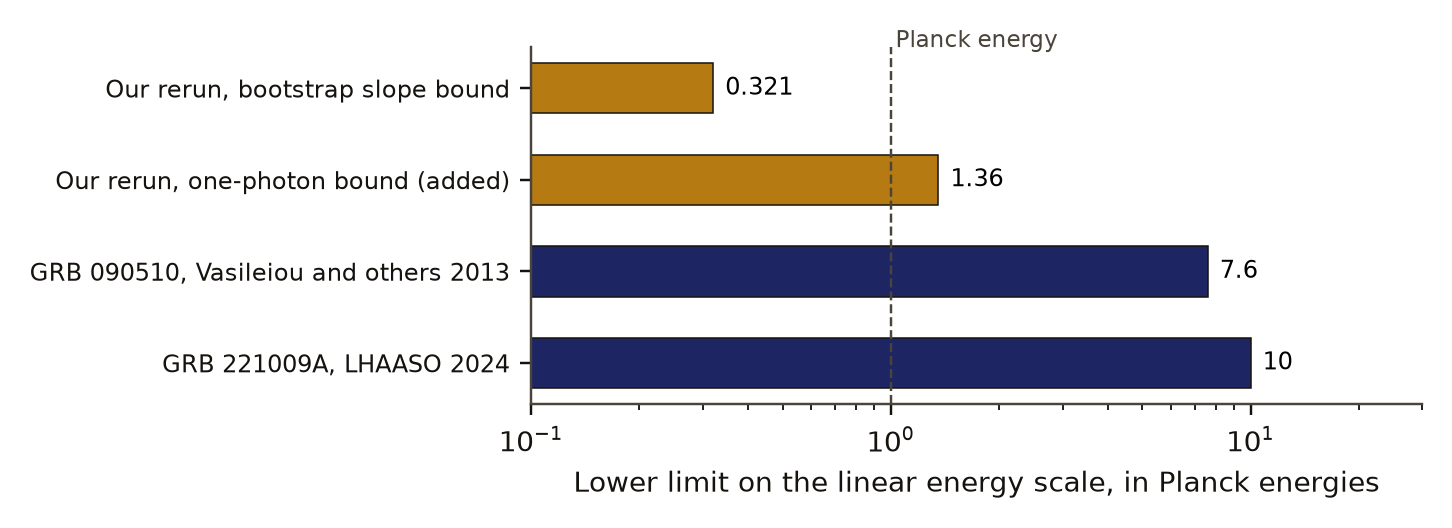
- Lower limits on the energy scale where light speed could start to depend on photon energy.
- Basis
- observed: measured in this study, with a result file
c2 observed, evidence for claim 2
- The numbers in claim 2
- 1; 10; 0.9 matches the result file, 2026-11-09
- Chart 1
- How the photon test was built: one burst, one fitted slope, a shuffle control and a planted delay.
- Chart 2
- The fitted delay slope against the range that shuffled energies give.
- Basis
- observed: measured in this study, with a result file
c3 observed, evidence for claim 3
- The numbers in claim 3
- 1e-6; 2; 2.89 matches the result file, 2026-11-09
- Chart 4
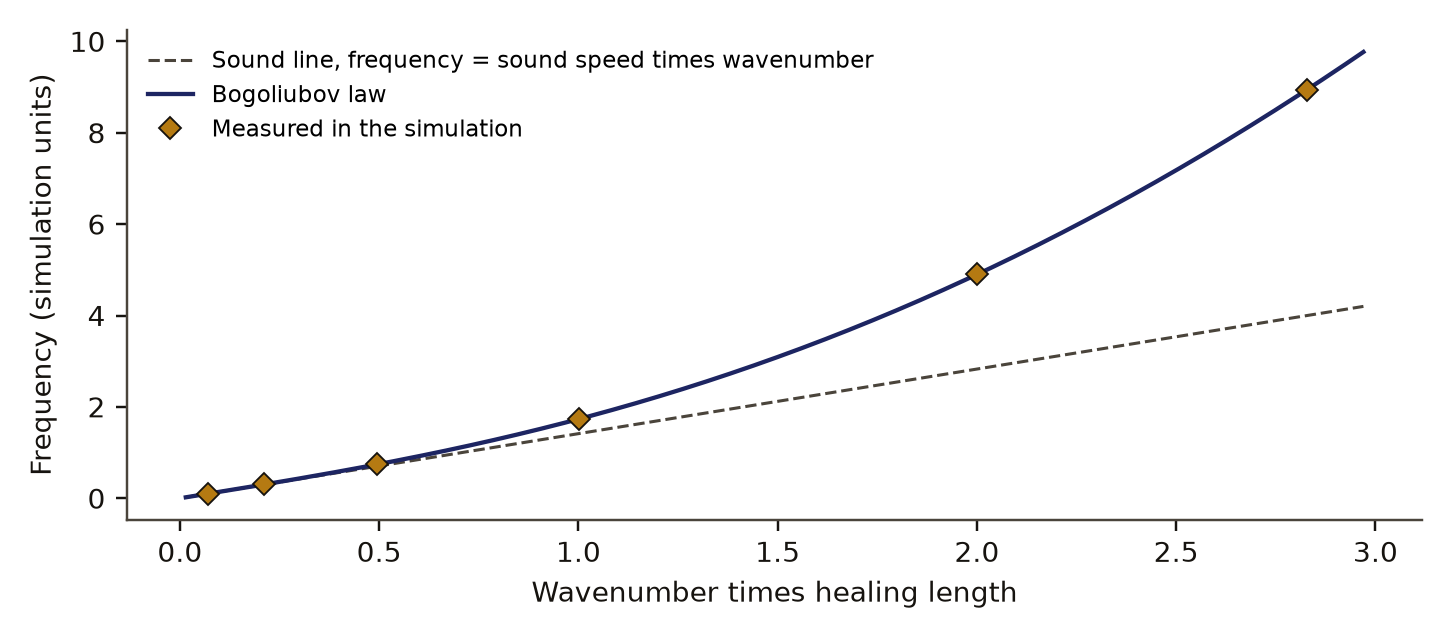
- Wave speed in the simulated condensate against wavenumber: sound has a speed limit that bends at short wavelength.
- Basis
- observed: measured in this study, with a result file
c4 observed, evidence for claim 4
- The numbers in claim 4
- 15 matches the result file, 2026-11-09
- Chart 5
- Every verdict set in advance, the value it tested and the bar it had to clear.
- Basis
- observed: measured in this study, with a result file
Introduction
Special relativity says every observer measures the same speed of light. Several approaches to quantum gravity allow a small Lorentz invariance violationDefinition: Lorentz invariance violation particle physics and quantum gravity phenomenology Any departure from the rule of special relativity that every observer measures the same speed of light. The form tested here is a speed of light in vacuum that changes with photon energy. Excludes the slowing of light in a medium such as glass or plasma, which is ordinary optics. full definition in which that speed depends on photon energy. The size of such an effect is usually stated as a linear energy scale (E_QG,1)Definition: linear energy scale (E_QG,1) quantum gravity phenomenology The photon energy at which a speed change that grows in proportion to energy would reach the full speed of light. A lower limit on it is the usual way to state a time-of-flight bound. Excludes the quadratic scale, for a speed change that grows with the square of energy, which this paper does not bound. full definition, and the natural reference is the Planck energyDefinition: Planck energy physics The energy built from the constant of gravitation, Planck's constant and the speed of light, about 1.22e19 GeV. Many quantum-gravity models expect new effects near it. Excludes any energy reached by a particle accelerator, which is about fifteen powers of ten lower. full definition. A photon of 30 GeV is about 2.5e-18 of the Planck energy, so the expected effect on its speed is tiny, and only a very long flight can make it visible.
Gamma-ray bursts give that flight. Jacob and Piran [5] derived how an energy-dependent speed turns into an arrival-time delay over a path through an expanding universe; that relation is the one used here. GRB 090510 is a short burst at redshift 0.903, measured from the spectrum of its host galaxy [6]. Abdo and colleagues [2] used the Fermi observation of this burst, with emission up to about 31 GeV, and set a lower limit of 1.2 Planck energies on the linear scale under conservative assumptions about when the photons were emitted. Vasileiou and colleagues [3] analysed four bright Fermi bursts with three complementary methods; their strongest limit, from GRB 090510, is above 7.6 Planck energies at 95 percent confidence for the case where higher energies travel slower. The LHAASO collaboration [4] used the TeV photons of GRB 221009A and reported a linear limit above 10 Planck energies.
We had a narrower aim. A published limit rests on a pipeline most readers cannot run. We asked how close a short, plain analysis of the public photon file comes, with its forecasts and kill rules fixed before the run. The same study asked the companion question for sound: sound in a fluid has its own speed limit, and that limit is known to bend at short wavelength. Trachenko and colleagues [7] proposed an upper bound on the speed of sound in condensed matter, about 36 km per second, built from fundamental constants; it entered our study as one table check.
Preregistration and design
The preregistrationDefinition: preregistration research method (metascience) A dated written plan for a study, fixed and hash-locked before any result is seen: the question, the data, the statistic, the controls, the forecasts and the kill conditions. Excludes a plan revised after looking at the outcome, and a protocol written only for the record after the run. full definition and three forecast files were written and hash-locked on 31 October 2026, each before any run or data opening for its item. The hypothesis under test was that some sound and light waves travel faster or slower than c and follow different laws. The decision it informed: if the vacuum form fails, the published limits are quoted and our rerun is used only as a reproduction of method.
- data1,214,533 photons in the weekly fileFermi Large Area Telescope public archive, the week that holds GRB 090510.
- data119 near the burst, 84 in the windowAbove 100 MeV, 1 s before to 3 s after the trigger. The top photon has 29.9 GeV and arrived at 0.828 s.
- measurementFit the delay slopeShift each photon back by slope times energy and keep the slope that bunches arrival times most tightly. Fitted slope: 0 ms per GeV.
- controlShuffle the energies, 300 timesBreaks any link between energy and arrival time. Shuffled slopes ran from −44 to +76 ms per GeV.
- planted checkPlant a known delayDelays of 1, 3, 5 and 10 times the bound were added and refitted. Largest error: 0.9 percent.
- rule set in advanceRule: speed change below 1e−15 of cSet before the run: with a slope consistent with zero, this ends the vacuum form in the tested band.
- rule heldNo energy-dependent speed foundSpeed change below 7.6e−18 of c at 29.9 GeV. The bound is weaker than the published one.
Read from result.json, run 20261031T213610Z. SHA-256 of the run's file 3d53d450658a5c74d341ff8ed79c8c5cd88b9163409eb9c43cdcc5d742072465 and of the published copy 9ede57832c67346bb9e616c8f535961243b8d72b61caeff0c1611dfdbe7e7fa7. In the copy, file paths are cut to the file name and the layout (indentation, line endings) may differ; every value is the same.
The lock records a debug run made before it. That run showed 84 photons in the analysis window and a bootstrap limit weaker than our forecast, so two forecast rows were known to fail. The rows were kept unchanged and are reported as failures. A one-photon bound was added after the debug run, and it is labelled as added wherever it appears. Two simulation settings were retuned in debug: the horizon packet was moved to start near the horizon, and the grid for the frame test was doubled.
Kill conditions, fixed in advance:
- Vacuum form: killed in the tested band if the arrival-time slope against energy is consistent with zero and the implied speed change at the highest tested energy is below 1e-15 of c. It survives outside the tested band.
- Medium form: phase and group speeds above c are already known; the form is killed as new physics if every case keeps its signal front at or below c under the ordinary wave equation.
- Sound form: killed at long wavelength if sound in a moving fluid follows the flow speed plus or minus the sound speed within 1 percent.
Each kill conditionDefinition: kill condition research method (our usage, after Popper's falsification) A rule written in the preregistration that, when met, decides against the claim with no room for judgement after the run. Excludes reasons found after the run for setting a result aside. full definition and forecast became a rule set whose pass or fail is a verdictDefinition: verdict research method (our usage) The pass or fail of one preregistered rule set against the run's numbers, read off by code. Excludes an interpretation written after reading the numbers. full definition read off by code.
Data and provenance
The photons are from the Fermi Large Area Telescope public archive at the NASA High Energy Astrophysics Science Archive Research Center [1]: the weekly photon file for mission week 49 (processing P305, Source event class), which holds 1,214,533 photons, together with the trigger folder for bn090510016, all fetched on 31 October 2026. Fermi data are public with no restriction on use. The trigger time was read from the trigger file header. The burst position and the redshift of 0.903 were entered from memory before the run; the trigger header gives the same position to one decimal place, and the redshift matches the published value [6].
Photons were kept if they arrived between 1 s before and 3 s after the trigger, had energy above 100 MeV and zenith angle below 105 degrees, and fell within an energy-dependent radius of the burst, up to 12 degrees at low energy. That radius was set from memory of the telescope's point-spread function; the published response tables were not used. This gave 119 photons. The analysis window, 0.5 to 1.45 s after the trigger, holds 84 of them, with energies from 0.1 to 29.9 GeV. The highest-energy photon carried 29.9 GeV and arrived 0.828 s after the trigger.
The sound part uses no external data. The sound-speed table for the Trachenko check lists 14 materials with values entered from memory.
Methods
The delay model
If the speed of light changes in proportion to photon energy, a photon of energy arrives later or earlier than a low-energy photon emitted with it by a time proportional to :
where is the delay per GeV. This is dispersionDefinition: dispersion wave physics The dependence of a wave's speed on its frequency or energy, written as a relation between frequency and wavenumber. Excludes a delay that is the same at every energy, such as a fixed travel time. full definition in vacuum. Following Jacob and Piran [5], the slope sets the linear energy scale through a cosmological distance factor :
with the integral taken from 0 to the redshift 0.903, = 67.4 km/s/Mpc and matter density = 0.315. The factor came out at 4.58e17 s. A bound on the slope gives
and the fractional speed change at the top energy is
Fitting the slope
For a trial slope , each photon's time is shifted back to . If the trial slope is right, the shifted times bunch most tightly. The fit maximises a sharpness score
over all photon pairs, where is a Gaussian of width 30 ms. The slope was searched on a grid from -250 to +250 ms per GeV in steps of 2 ms per GeV. This is a simple version of the methods in the published analyses, without the instrument response and without a model of the burst's own spectral lag.
The bound
The 84 photons were resampled with replacement 300 times, a bootstrapDefinition: bootstrap statistics Resampling the data with replacement many times and recomputing the estimate each time, so that the spread of the recomputed values gives an interval for it. Excludes an interval taken from a formula that assumes a distribution. full definition, and the slope refitted each time. The 95% intervalDefinition: 95% interval statistics The range that holds the middle 95 percent of the bootstrap or control draws for a number. We report it beside the number. Excludes a statement that the true value lies inside with 95 percent probability. full definition of the refitted slopes runs from its 2.5th to its 97.5th percentile, and is the larger of its two ends in size. The added one-photon bound assumes the top photon was emitted no earlier than the trigger, so its delay cannot exceed its arrival time:
This form follows the conservative argument of Abdo and colleagues [2] in outline only.
Sound
Three simulations solved the linear wave equation for sound in a moving fluid, in units where the sound speed is 1. In a uniform flow of speed = 0.5, rays should move at
A frame test checked that a solution transforms between frames under the sound speed and fails under a wrong one. A horizon flow , with = 0.4, makes an acoustic horizonDefinition: acoustic horizon analogue gravity The place in a moving fluid where the flow speed equals the sound speed, so that sound travelling against the flow cannot get out. It mimics the horizon of a black hole. Excludes a gravitational horizon, and any place where the flow is slower than sound. full definition at = 0 with surface gravityDefinition: surface gravity (of a horizon) analogue gravity, after black-hole physics The slope of the flow speed at the acoustic horizon. It sets how fast a trapped wave's wavelength is stretched. Excludes the pull of gravity at a planet's surface. full definition ; a wave packet was released near it and its position and wavenumber compared with ray predictions.
The fourth simulation solved the one-dimensional Gross-Pitaevskii equation for a uniform condensate and measured the frequency of small plane waves at six wavenumbers. The known answer is the Bogoliubov dispersionDefinition: Bogoliubov dispersion condensed-matter physics (Bose-Einstein condensates) The frequency of small waves in a uniform condensate: equal to the sound speed times the wavenumber at long wavelength and rising faster, towards the free-particle law, at wavelengths near the healing length. Excludes sound in an ordinary gas or solid, whose dispersion is set by other physics. full definition
where is the healing lengthDefinition: healing length condensed-matter physics The length below which a condensate's density cannot change smoothly. Waves shorter than it stop behaving like sound. Excludes the wavelength of any particular wave. full definition. Its slope, the group velocityDefinition: group velocity wave physics The speed at which a packet of waves, and the energy it carries, moves. It equals the slope of frequency against wavenumber. Excludes the phase velocity, the speed of a single crest, which can differ from it. full definition, rises above once nears 1.
Controls and planted checks
Two checks were run on the photon fit.
delay slope, ms per GeV (zero means no energy-dependent speed)
- Real photons
- 2.5th to 97.5th percentile of the slope refitted on photons resampled with replacement (a bootstrap)
- no delay
- slopes with energies shuffled, 2.5th to 97.5th percentile
Data behind chart 2 10 rows
| Quantity | ms per GeV |
|---|---|
| Fitted slope, real photons | 0 |
| Resampling interval, lower end | −117 |
| Resampling interval, upper end | +46.1 |
| Bound on the size of the slope | 117 |
| Shuffled energies, 2.5th percentile | −44 |
| Shuffled energies, 97.5th percentile | +76 |
| Planted 1 times the bound: planted 117, recovered | 116 (error 0.9 percent) |
| Planted 3 times the bound: planted 351, recovered | 354 (error 0.81 percent) |
| Planted 5 times the bound: planted 585, recovered | 590 (error 0.81 percent) |
| Planted 10 times the bound: planted 1.17e3, recovered | 1.16e3 (error 0.9 percent) |
Read from result.json, run 20261031T213610Z. SHA-256 of the run's file 3d53d450658a5c74d341ff8ed79c8c5cd88b9163409eb9c43cdcc5d742072465 and of the published copy 9ede57832c67346bb9e616c8f535961243b8d72b61caeff0c1611dfdbe7e7fa7. In the copy, file paths are cut to the file name and the layout (indentation, line endings) may differ; every value is the same.
The first controlDefinition: control statistics and experimental design A version of the data with the structure under test removed (for example shuffled or pooled), scored the same way as the real data, so the real score has something to beat. Excludes a comparison with a different dataset or with a published number. full definition shuffled the photon energies among the 84 photons, which breaks any link between energy and arrival time, and refitted the slope 300 times. The shuffled slopes ran from -44 to +76 ms per GeV (2.5th to 97.5th percentile). The real fitted slope, 0, sits inside that range, as forecast.
The planted checkDefinition: planted check research method; called a positive control in experimental science Data built so that the right answer is known, run through the same analysis before the real data, to show that the analysis can see the effect when it is there. Excludes any check made on the real data, which cannot show what the analysis misses. full definition added a known delay, , to every photon at 1, 3, 5 and 10 times our bound, with both signs, and refitted. Table 1 gives the result: every planted delay came back within 0.9 percent, so the fit sees a delay of the size of our bound when one is there. The result file stores one recovered value for each planted size, a positive delay, and none for the opposite sign. Three of the four planted delays lie outside the search grid of -250 to +250 ms per GeV stated in the methods, so the planted refits searched a wider range than that sentence gives; the file does not record the range.
For sound, the frame test is its own control: under the true sound speed the residual was 4.5e-4, and under a wrong speed 0.78.
Results
Vacuum
Table 2 gives the photon results. The fitted slope is 0, on a 2 ms per GeV grid. The bootstrap interval runs from -117 to +46 ms per GeV, so the bound is 117 ms per GeV. Through eq. 3 that is a linear energy scale of 3.9e18 GeV, or 0.32 Planck energies. Our rerun bounds any linear energy-dependent change in light speed to less than 7.6e-18 of c at 29.9 GeV, a linear energy scale above 0.32 Planck energies, about 24 times weaker than the published limit of 7.6 Planck energies from the same burst. The speed change is below the preregistered 1e-15, so the vacuum form of the hypothesis is killed in the band tested, 0.1 to 30 GeV.
Figure 2 sets our two bounds beside the published ones. The bootstrap bound is weak because resampling often leaves out the single 29.9 GeV photon, which sets most of the fit. The one-photon bound uses that photon directly and reaches 1.36 Planck energies, still a factor of about 5.6 below the published 7.6.
Sound
Table 3 gives the simulation results. Sound in a uniform flow moved at the flow speed plus or minus the sound speed to within 1e-6, and in a simulated condensate the wave frequencies followed the Bogoliubov law within 2 percent, with a short-wavelength packet moving at 2.89 times the sound speed. Figure 3 shows the measured frequencies leaving the sound line as the wavelength nears the healing length.
speed, in units of the sound speed
wavenumber times healing length (the length below which the condensate stops acting like a fluid)
- Measured phase speed
- Bogoliubov law, phase speed
- Bogoliubov law, group speed
- sound speed
Data behind chart 4 6 rows
| Wavenumber times healing length | Measured frequency | Law's frequency | Error against the law | Measured phase speed | Law's group speed |
|---|---|---|---|---|---|
| 0.0707 | 0.09817 | 0.1001 | 1.9% | 0.982 | 1 |
| 0.212 | 0.3024 | 0.3034 | 0.32% | 1.01 | 1.03 |
| 0.495 | 0.7427 | 0.7416 | 0.14% | 1.06 | 1.18 |
| 1 | 1.728 | 1.733 | 0.31% | 1.22 | 1.63 |
| 2 | 4.909 | 4.904 | 0.11% | 1.73 | 2.89 |
| 2.83 | 8.94 | 8.944 | 0.043% | 2.24 | 4.02 |
Read from result.json, run 20261031T213610Z. SHA-256 of the run's file 3d53d450658a5c74d341ff8ed79c8c5cd88b9163409eb9c43cdcc5d742072465 and of the published copy 9ede57832c67346bb9e616c8f535961243b8d72b61caeff0c1611dfdbe7e7fa7. In the copy, file paths are cut to the file name and the layout (indentation, line endings) may differ; every value is the same.
The horizon packet stayed trapped, and its wavenumber followed the ray prediction within 3.3 percent. Its position lagged the ray by 0.16 in scaled units against a limit of 0.01, which failed. The packet is about as wide as the distance it travels, so a ray, which has no width, is a poor description of it; we did not refine the test after the run.
The Trachenko value computed from constants was 36.10 km per second, inside the forecast band of 36.0 to 36.2, and none of the 14 materials in our remembered table exceeded it; the fastest was diamond at 18 km per second.
Forecasts
Table 4 sets the forecasts written before the run against the outcomes.
Twelve of the 15 preregistered verdicts passed; the three that failed were two forecasts of our own bound's strength and one test of a packet near a simulated horizon. Appendix A lists every rule.
| Verdict set in advance | Value | Bar | Result |
|---|---|---|---|
| Photons in the window | 84 | at least 50 and at most 300 | held |
| Slope bound, ms per GeV (forecast) | 117 | below 30 | failed |
| Energy scale, Planck energies (forecast) | 0.321 | at least 0.5 and at most 10 | failed |
| One-photon energy scale (added after the debug run) | 1.36 | at least 0.5 and at most 10 | held |
| Speed change at the top energy, as a share of c | 7.64e−18 | below 1e−15 | held |
| Planted delay at 5 times the bound, relative error | 0.00812 | below 0.2 | held |
| Real slope inside the shuffled range (1 is yes) | 1 | at least 1 | held |
| Uniform flow, error in ray speed | 9.62e−7 | below 0.01 | held |
| Frame test: residual with the true and with a wrong sound speed | 4.53e−4; 0.778 | below 0.001; above 0.1 | held |
| Horizon packet: lag behind the ray; end position inside; end position outside | 0.165; −24.8; 24.8 | below 0.01; below 0; above 0 | failed |
| Horizon, error in wavenumber decay rate | 0.0329 | below 0.2 | held |
| Condensate, largest error against the Bogoliubov law | 0.0195 | below 0.02 | held |
| Group speed above the sound speed: theory, and measured packet | 1.63; 2.89 | above 1.1; above 2 | held |
| Upper bound on sound speed from constants, km per second | 36.1 | at least 36 and at most 36.2 | held |
| Materials in our table above that bound | 0 | below 1 | held |
Data behind chart 5 15 rows
| Verdict set in advance | Value | Bar | Result |
|---|---|---|---|
| Photons in the window | 84 | at least 50 and at most 300 | held |
| Slope bound, ms per GeV (forecast) | 117 | below 30 | failed |
| Energy scale, Planck energies (forecast) | 0.321 | at least 0.5 and at most 10 | failed |
| One-photon energy scale (added after the debug run) | 1.36 | at least 0.5 and at most 10 | held |
| Speed change at the top energy, as a share of c | 7.64e−18 | below 1e−15 | held |
| Planted delay at 5 times the bound, relative error | 0.00812 | below 0.2 | held |
| Real slope inside the shuffled range (1 is yes) | 1 | at least 1 | held |
| Uniform flow, error in ray speed | 9.62e−7 | below 0.01 | held |
| Frame test: residual with the true and with a wrong sound speed | 4.53e−4; 0.778 | below 0.001; above 0.1 | held |
| Horizon packet: lag behind the ray; end position inside; end position outside | 0.165; −24.8; 24.8 | below 0.01; below 0; above 0 | failed |
| Horizon, error in wavenumber decay rate | 0.0329 | below 0.2 | held |
| Condensate, largest error against the Bogoliubov law | 0.0195 | below 0.02 | held |
| Group speed above the sound speed: theory, and measured packet | 1.63; 2.89 | above 1.1; above 2 | held |
| Upper bound on sound speed from constants, km per second | 36.1 | at least 36 and at most 36.2 | held |
| Materials in our table above that bound | 0 | below 1 | held |
Read from result.json, run 20261031T213610Z. SHA-256 of the run's file 3d53d450658a5c74d341ff8ed79c8c5cd88b9163409eb9c43cdcc5d742072465 and of the published copy 9ede57832c67346bb9e616c8f535961243b8d72b61caeff0c1611dfdbe7e7fa7. In the copy, file paths are cut to the file name and the layout (indentation, line endings) may differ; every value is the same.
Discussion
The rerun did what a reproduction of method should do. On the same burst, with a plain fit, it finds no energy-dependent delay, and its controls behave: shuffled energies give a range that holds the real slope, and planted delays of the bound's size come back almost exactly. The number it produces is weaker than the published limits, by a factor of about 24 for the bootstrap bound and about 5.6 for the one-photon bound.
The gap has visible causes. Our bootstrap is dominated by whether the single 29.9 GeV photon is drawn, which makes the interval wide. The published analyses used the instrument response, careful event selection and several estimators, and they modelled or bounded the burst's own spectral lag [3]. We did none of that. The top energy also differs: the published abstract reports emission up to about 31 GeV [2], and our selection's top photon has 29.9 GeV in the weekly file's reconstruction; we did not trace the difference.
So the vacuum result is a check that the method can be run from public data and lands in the right place. It sets no new limit. The published limits of 7.6 Planck energies from this burst [3] and 10 from GRB 221009A [4] are the numbers to quote.
The sound results confirm known theory. Sound in a moving fluid obeys its own cone, flow speed plus or minus sound speed, at long wavelength, and it leaves that cone at short wavelength by the Bogoliubov law. A wave can then move faster than the sound speed of its medium by an ordinary mechanism, and it remains far below c. The hypothesis that some waves follow different laws holds only in that ordinary sense.
Limitations
- The bound holds only in the tested band, about 0.1 to 30 GeV, and only for a delay linear in energy. The quadratic form, other energies and other carriers were not tested.
- No instrument response and no intrinsic spectral lag were modelled. The selection radius was set from memory of the point-spread function, and the burst position and redshift were entered from memory, though both match published values.
- The bootstrap is unstable when one photon sets most of the fit, which is part of why our bound is weak.
- The one-photon bound was added after the debug run, and its assumption about emission time is not tested.
- A later review of our ledger noted that the rerun does not reproduce the published number. We agree, and the paper is framed as a reproduction of method for that reason.
- The sound simulations test known theory and add no new law. The Trachenko table values were entered from memory.
- Scoring was by our own code and was not blind. Settings tuned in the debug run before the lock are listed in the preregistration.
Evidence
Honest null. Rules out a linear energy-dependent change in light speed larger than 7.6e-18 of c at 29.9 GeV, an energy scale below 0.32 Planck energies; the published bound from the same burst is about 24 times stronger.
Figures
These are the paper's own figures, numbered as in the PDF, and each "Figure" reference in the text points here. The charts on this page redraw the same results from the result files and carry their own numbers.
Tables
| Planted, times our bound | Planted delay | Recovered | Error |
|---|---|---|---|
| 1 | 117 | 116 | 0.90 percent |
| 3 | 351 | 354 | 0.81 percent |
| 5 | 585 | 590 | 0.81 percent |
| 10 | 1,170 | 1,160 | 0.90 percent |
| Quantity | Value |
|---|---|
| Photons above 100 MeV near the burst, 1 s before to 3 s after | 119 |
| Photons in the analysis window, 0.5 to 1.45 s | 84 |
| Top energy and its arrival time | 29.9 GeV at 0.828 s |
| Fitted slope | 0 ms per GeV |
| Bootstrap 95% interval, 300 resamples | -117 to +46 ms per GeV |
| Bound on the slope | 117 ms per GeV |
| Linear energy scale from the bound | above 0.32 Planck energies |
| Fractional speed change at 29.9 GeV | below 7.6e-18 |
| One-photon bound (added after the debug run) | 27.7 ms per GeV, above 1.36 Planck energies |
| Shuffled-energy slopes, 300 draws | -44 to +76 ms per GeV |
| Quantity | Value | Rule |
|---|---|---|
| Uniform flow, error in ray speed | 9.6e-7 | below 0.01 |
| Frame test, residual with true sound speed | 4.5e-4 | below 0.001 |
| Frame test, residual with wrong speed | 0.78 | above 0.1 |
| Horizon, packet trapped inside, position at end | -24.8 | below 0 |
| Horizon, packet lag behind the ray, scaled | 0.16 | below 0.01 |
| Horizon, wavenumber error against the ray | 3.3 percent | below 20 percent |
| Bogoliubov law, worst frequency error | 1.95 percent | below 2 percent |
| Group velocity at kh = 1, from the law | 1.63 | above 1.1 |
| Packet group velocity, kh = 2 | 2.89 | above 2 |
| Quantity | Forecast | Outcome |
|---|---|---|
| Photons in the window | about 150, band 50 to 300 | 84 |
| Slope bound | below 30 ms per GeV | 117 ms per GeV |
| Linear energy scale | 0.5 to 10 Planck energies | 0.32 |
| Planted delay at 5 times the bound | within 20 percent | 0.81 percent |
| Shuffled range contains the real slope | yes | yes |
| Rays in a uniform flow | within 1 percent | 9.6e-7 |
| Frame test with the sound speed | to 1e-3 | 4.5e-4 |
| Group velocity at kh = 1 | more than 10 percent above sound | 1.63 times |
| Group velocity at kh above 2 | about twice sound or more | 2.89 times |
| Trachenko bound | 36.1 km/s | 36.10 km/s |
Appendix A. The preregistered verdicts
Each verdict is a set of rules written before the run. A verdict passes only when every rule holds. Values are read from the run's result file.
| Verdict | Deciding rule | Value | Holds |
|---|---|---|---|
| Photon count | 50 to 300 photons in the window | 84 | yes |
| Slope bound | below 30 ms per GeV | 117 | no |
| Energy scale band | 0.5 to 10 Planck energies | 0.32 | no |
| One-photon form (added) | 0.5 to 10 Planck energies | 1.36 | yes |
| Vacuum form killed | speed change below 1e-15 | 7.6e-18 | yes |
| Planted delay | error at 5 times the bound below 0.2 | 0.0081 | yes |
| Slope inside null | real slope inside shuffled range | inside | yes |
| Uniform flow | ray speed error below 0.01 | 9.6e-7 | yes |
| Frame test | true speed below 0.001; wrong speed above 0.1 | 4.5e-4; 0.78 | yes |
| Horizon ray | scaled lag below 0.01; trapped inside, free outside | 0.16; -24.8, 24.8 | no |
| Surface gravity | wavenumber error below 0.2 | 0.033 | yes |
| Bogoliubov | worst frequency error below 0.02 | 0.0195 | yes |
| Above sound speed | group velocity at kh = 1 above 1.1; packet above 2 | 1.63; 2.89 | yes |
| Trachenko value | 36.0 to 36.2 km/s | 36.10 | yes |
| Trachenko table | no material above the bound | 0 | yes |
Numbers recorded in our publication register
| What | Value |
|---|---|
| Sample | 84 photons in the analysis window |
| Main estimate and interval | fitted slope 0; 95 percent bootstrap bound 117 ms per GeV |
| Forecast against outcome | 12 of 15 preregistered verdicts passed |
| Known-answer check | planted delays of 1, 3, 5 and 10 times the bound recovered within 0.9 percent |
As recorded in the publication register, the summary row each finding gets; the paper's own numbers above were re-read from the result files.
What lowers it
- blinding Not blind: the analyst saw the data's shape before the lock. from our publication register, on blinding
- scoring Graded by the same agent that ran it. from our publication register, on who scored it
- imprecision Rules out a linear energy-dependent change in light speed larger than 7.6e-18 of c at 29.9 GeV, an energy scale below 0.32 Planck energies; the published bound from the same burst is about 24 times stronger. from the bound stated under Evidence
- depth of reading The cited literature was read at the level of abstracts, publisher pages and search summaries; full texts were not read. from the Verified section
What holds it up
- preregistration Preregistered and hash-locked before the run (sha256 21d88e4c). from the Reproduce section
- control Controls: plants, shuffles, null simulations. from our publication register, on controls
- open data Public data. from our publication register, on the data licence
Where the claim stands
- lead
- hypothesis
- thesis
- conjecture
- theorem
- law candidate
- killed
A preregistration with pass-or-fail rules is on file, which this rung needs. The next rung needs a named rival reading beaten by a decisive observation, and none is on file. Tier D: Locked with planted checks, self-graded, simulation or public data, largely reproducing or testing published results. The register's tier note also read "killed in tested band" while its ladder entry places the claim at hypothesis; the two entries have not been reconciled.
Trail
Versions
- v3 2026-11-14, this page corrected, 1 item; the PDF and its BuildTeX source are still paper version 1.0
- v2 2026-11-09, paper version 1.0, first published PDF sha256 b65b8b8f28322f0b
- v1 2026-10-31, entered in the findings ledger
Corrections
2026-11-14 scope found by a review of the published pages
A review of the published page found three statements that did not match the result file. now The abstract counted 12 of 15 preregistered rules; the file holds 15 verdicts built from 23 rules, and 12 verdicts passed. The introduction put a 30 GeV photon at about 1e-18 of the Planck energy; 30 GeV over 1.22e19 GeV is 2.5e-18. The planted check was described as run with both signs inside a grid of -250 to +250 ms per GeV; the file stores positive delays only, up to 1,160 ms per GeV, and the text now says what the file does and does not record.
2026-10-31 scope found by a review of our findings ledger
A review of our ledger noted that the rerun limit, 0.32 Planck energies by bootstrap and 1.36 by one photon, is far below the published 7.6 and 10, so the rerun does not reproduce the published limit. now The headline was narrowed to a reproduction of method, as here.
Standing, and the ledger entries it rests on
2026-10-31 narrowed in part F422
Set by hand from findings ledger entry F422, dated 2026-10-31: headline bound. Rests on findings ledger, F422 correction pass.
Each correction is a dated note; the findings ledger is never rewritten, and a note governs where it differs.
Ledger and version dates up to publication are local dates in US Pacific time. Clock times in the text are UTC, seven or eight hours ahead, so a lock or a run stamped just after midnight UTC belongs to the previous local day. Corrections from 14 November 2026 on are dated in UTC.
References
- Fermi Science Support Center. Fermi LAT weekly photon files and trigger data for bn090510016. NASA High Energy Astrophysics Science Archive Research Center. Retrieved 31 October 2026. https://heasarc.gsfc.nasa.gov/FTP/fermi/data/lat/ run here Licence: Fermi LAT science data are public, released by NASA's Fermi Science Support Center used in Data and provenance
- Abdo, A. A., Ackermann, M., Ajello, M. and others, Fermi LAT and GBM Collaborations (2009). A limit on the variation of the speed of light arising from quantum gravity effects. Nature 462, 331-334. doi:10.1038/nature08574 abstract or summary, 2026-11-09: abstracts, publisher pages and search summaries; full text not read used in Introduction, Methods, Discussion
- Vasileiou, V., Jacholkowska, A., Piron, F., Bolmont, J., Couturier, C., Granot, J., Stecker, F. W., Cohen-Tanugi, J. and Longo, F. (2013). Constraints on Lorentz invariance violation from Fermi-Large Area Telescope observations of gamma-ray bursts. Physical Review D 87, 122001. doi:10.1103/PhysRevD.87.122001. arXiv:1305.3463 abstract or summary, 2026-11-09: abstracts, publisher pages and search summaries; full text not read used in Introduction, Discussion, Discussion
- Cao, Z. and others, LHAASO Collaboration (2024). Stringent tests of Lorentz invariance violation from LHAASO observations of GRB 221009A. Physical Review Letters 133, 071501. doi:10.1103/PhysRevLett.133.071501. arXiv:2402.06009 abstract or summary, 2026-11-09: abstracts, publisher pages and search summaries; full text not read used in Introduction, Discussion
- Jacob, U. and Piran, T. (2008). Lorentz-violation-induced arrival delays of cosmological particles. Journal of Cosmology and Astroparticle Physics 0801, 031. doi:10.1088/1475-7516/2008/01/031. arXiv:0712.2170 abstract or summary, 2026-11-09: abstracts, publisher pages and search summaries; full text not read used in Introduction, Methods
- Rau, A., McBreen, S., Kruehler, T. and Greiner, J. (2009). GRB 090510: VLT/FORS2 spectroscopic redshift. GCN Circular 9353. run here Licence: Fermi LAT science data are public, released by NASA's Fermi Science Support Center used in Introduction, Data and provenance
- Trachenko, K., Monserrat, B., Pickard, C. J. and Brazhkin, V. V. (2020). Speed of sound from fundamental physical constants. Science Advances 6, eabc8662. doi:10.1126/sciadv.abc8662 abstract or summary, 2026-11-09: abstracts, publisher pages and search summaries; full text not read used in Introduction
- Traxler, R. P. (1889). The Principles of Mechanics as Applied to the Solar System. San Francisco: C. A. Murdock and Co. Internet Archive item principlesofmech00traxiala. read in full: the scan, read in full on the Internet Archive used in Introduction
Cited by later findings
- F422 narrowed in part, headline bound, 2026-10-31 (record findings ledger, F422 correction pass). A later review of our ledger recorded one error: the rerun bound is far below the published limit, so the headline was narrowed to a reproduction of method.
Reproduce
Data
- Fermi Science Support Center. Licence: Fermi LAT science data are public, released by NASA's Fermi Science Support Center. https://heasarc.gsfc.nasa.gov/FTP/fermi/data/lat/
- Rau 2009. Licence: Fermi LAT science data are public, released by NASA's Fermi Science Support Center.
Preregistration
sha256 21d88e4c1e21947ade3dbf27f640ddcef60e8c4e3df62ca52aa9b9610aaf595f
plan acdcc05f486faa9c825953e7cd25544719c1053d0dd865f851012eb98255770a
Steps
- Data: download the Fermi LAT weekly photon file for mission week 49 and the trigger folder bn090510016 from the HEASARC Fermi archive.
- Select photons from 1 s before to 3 s after the trigger, above 100 MeV, zenith angle below 105 degrees, within an energy-dependent radius of the burst; keep the 0.5 to 1.45 s window.
- Fit the slope of eq. 1 by maximising eq. 5 on a 2 ms per GeV grid; bootstrap 300 times; convert the larger end with eqs. 2, 3 and 4.
- Shuffle energies 300 times for the null, and plant delays at 1, 3, 5 and 10 times the bound.
- For sound, solve the linear wave equation in uniform and horizon flows and the Gross-Pitaevskii equation for a uniform condensate, and compare with eqs. 7 and 8.
- Preregistration SHA-256: 21d88e4c1e21947ade3dbf27f640ddcef60e8c4e3df62ca52aa9b9610aaf595f. Plan SHA-256: acdcc05f486faa9c825953e7cd25544719c1053d0dd865f851012eb98255770a. Run 20261031T213610Z.
Cost. The analysis took about 127 s and the shuffle control about 8 s on one desktop CPU. The study was not re-run for this paper.
Downloads
- Whitepaper, PDF F281.pdf, 3.1 MB
- BuildTeX source F281.bld, 37 KB
- Build receipt F281.buildtex.json, 1 KB
- BuildLang doc module doc.bld, 5 KB, imported by the source
The PDF is typeset by BuildTeX from F281.bld, which is written from the same source as this page. The receipt records the source's SHA-256 and the PDF's (b65b8b8f2832), so anyone can rebuild it and compare. The copy here has its hidden author field blanked, as the site does for every file it publishes; blank the same field in a rebuild before comparing. The name stays on the first page.
Verified
Verified on 2026-11-09. On 9 November 2026 the photon counts (1,214,533 in the file, 119 near the burst, 84 in the window), the top energy and its arrival time, the fitted slope, the bootstrap ends, the bound, the distance factor, both energy scales, the speed change, the shuffled range, the four planted recoveries, every sound value in Table 3, the Trachenko value and the 15 verdicts were re-read from the run's result file. They match the findings ledgerDefinition: findings ledger our records The append-only, dated list of every result we have recorded, numbered F1, F2 and on. Corrections are added as new dated lines and old entries are never rewritten. Excludes a curated list of successes. full definition, including its later line that our bound is about 24 times weaker than the published limit. The preregistration's SHA-256 matches the hash recorded in the result file and in the lock file. Both figures were drawn by a script that reads only that result file. The published limits in Figure 2 are as quoted from those abstracts.
Not checked. The study was not re-run for this paper. The literature was found by searches run on 9 November 2026 and read at the level of abstracts, publisher pages and search summaries; the full texts were not read.
Terms on this page
Each term is defined where it is first used on this page. Each name below opens its entry in the findings glossary, which lists every page that uses it.
- Lorentz invariance violation particle physics and quantum gravity phenomenology first use
- linear energy scale (E_QG,1) quantum gravity phenomenology first use
- Planck energy physics first use
- preregistration research method (metascience) first use
- kill condition research method (our usage, after Popper's falsification) first use
- verdict research method (our usage) first use
- dispersion wave physics first use
- bootstrap statistics first use
- 95% interval statistics first use
- acoustic horizon analogue gravity first use
- surface gravity (of a horizon) analogue gravity, after black-hole physics first use
- Bogoliubov dispersion condensed-matter physics (Bose-Einstein condensates) first use
- healing length condensed-matter physics first use
- group velocity wave physics first use
- control statistics and experimental design first use
- planted check research method; called a positive control in experimental science first use
- findings ledger our records first use
To report an error, name the finding, the claim number and the source on the Work page, which gives the address. Accepted corrections join the Trail with their date.