
Findings F152 Method and statistics, Information and signal found 2026-10-31
Finding missing links by shared neighbours lost to simple popularity on three corpora
The classic way to hunt for undiscovered connections, ranking unlinked pairs of ideas by the neighbours they share, found fewer of the links that later appeared than just pairing the most common ideas. Among pairs of equal popularity it still carried some signal.
- Tier
- D, honest null
- Outcome
- prediction failed
- Rung
- killed
- Verdicts
- 1 passed, 3 failed
- Kill rule
- not fired
- Standing
- held: corpus gap ranking, F206
- Corrections
- 2, latest 2026-11-14
- Version
- v3, 2026-11-14
- Redo it
- Reproduce
Download PDF 477 KB BuildTeX source F152.bld
What this means for a reader
If a discovery tool shows you a ranked list of "missing links", ask how it does against a list that simply pairs the most common terms. In our test the common-terms list won on every corpus. The shared-neighbour idea is not empty: among pairs that are equally common, it does pick out the ones that later appear together more often than chance. Its weakness sits at the top of the list, which is where a reader looks first.
Objection
A later co-occurrence is an attention event. A hit means two concepts were later used together; it does not show that a link between them is true or new to science.
What would change the call. Preregister Adamic-Adar on a citation corpus with dated held-out links.
From the paper's first stated limitation; our register records no separate objection.
Abstract
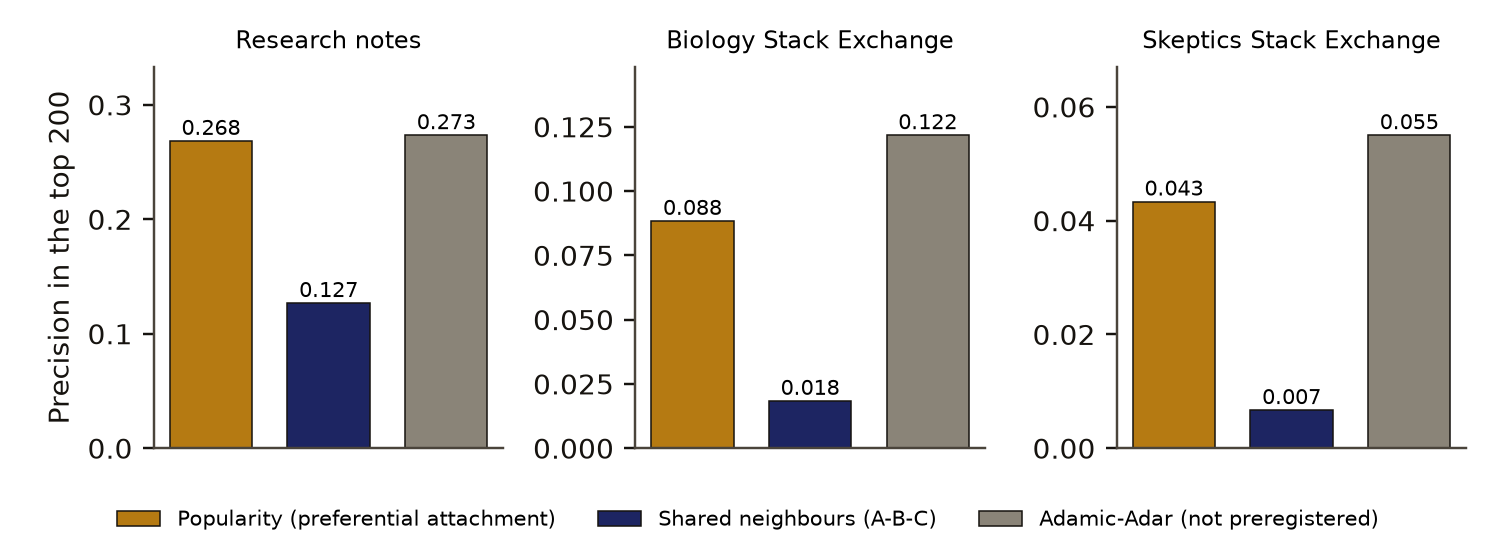
Tools that promise to find undiscovered connections often rank unlinked pairs of concepts by the neighbours they share: if A goes with B and B goes with C, perhaps A goes with C. We tested that ranking against the plainest baseline there is, which pairs the most popular concepts. Each corpus was cut by date, and a ranker scored a hit when a pair it proposed from the early documents appeared together at least twice in the next stretch of documents. Ranking unlinked pairs by shared neighbours found fewer later links than ranking them by popularity on all three corpora: precision in the top 200 of 0.127 against 0.268 on our research notes, 0.018 against 0.088 on Biology Stack Exchange and 0.007 against 0.043 on Skeptics Stack Exchange. On degree-preserving rewired graphs the shared-neighbour score reached a 95th percentile of 0.164, above its real score of 0.127, so at the top of the list it added nothing we could detect beyond popularity. Among pairs of similar popularity the shared-neighbour score still separated later links from the rest: area under the curve 0.569 on the research notes, 0.757 on Biology and 0.696 on Skeptics. Three of four preregistered verdicts failed.
c1 observed, evidence for claim 1
- The numbers in claim 1
- 200; 0.127; 0.268; 0.018; 0.088; 0.007; 0.043 matches the result file, 2026-11-09
- Chart 2
- Precision in the top 200 for each ranker on each corpus.
- Chart 3
- Shared neighbours minus popularity, with its interval, on each corpus.
- Basis
- observed: measured in this study, with a result file
c2 observed, evidence for claim 2
- The numbers in claim 2
- 95; 0.164; 0.127 matches the result file, 2026-11-09
- Chart 1
- The design: rank pairs of concepts that are not yet linked, then count how many link later.
- Chart 4
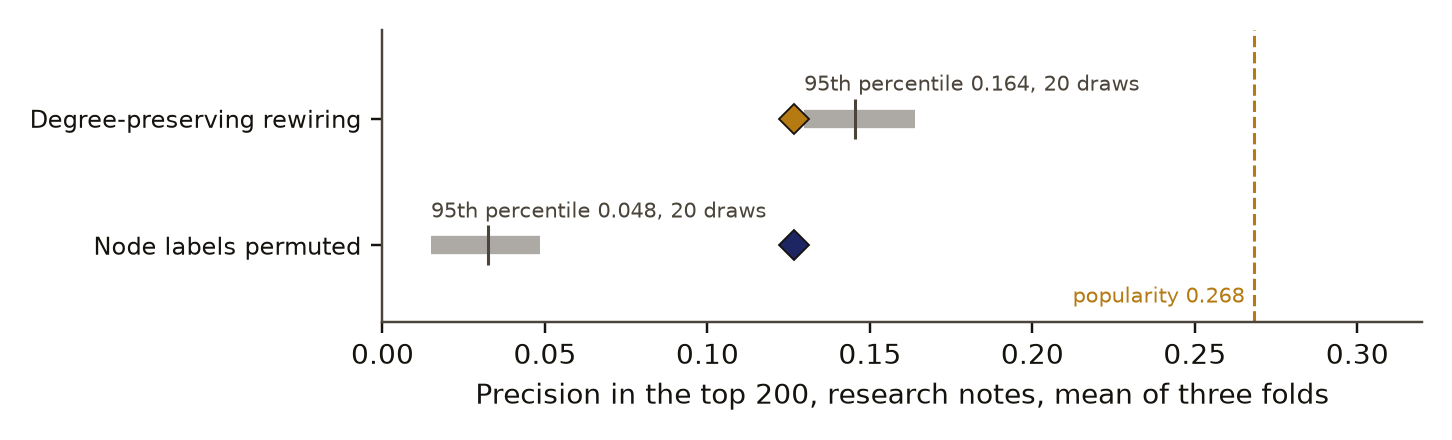
- The shared-neighbour score on the research notes against its two controls.
- Basis
- observed: measured in this study, with a result file
c3 observed, evidence for claim 3
- The numbers in claim 3
- 0.569; 0.757; 0.696 matches the result file, 2026-11-09
- Chart 5
- With popularity held fixed, how well each score separates later links from the rest.
- Basis
- observed: measured in this study, with a result file
Introduction
Swanson [1] described knowledge that is public and still undiscovered: two bodies of literature that each hold half of an argument and never cite each other. His method, now called literature-based discoveryDefinition: literature-based discovery information science, after Swanson The search for connections that no single document states but that follow from linking what separate documents say. Excludes finding links that some document already states, which is ordinary retrieval. full definition, looks for a term C that is linked to a term B in one literature while B is linked to A in another, so that A and C become a candidate pair. Later work recast the problem as link predictionDefinition: link prediction network science Ranking pairs of nodes that are not yet joined in a network by how likely they are to become joined later. Excludes recovering links that exist but were hidden at random from the same snapshot. full definition, the ranking of node pairs in a network by how likely they are to become joined. Liben-Nowell and Kleinberg [2] set out the problem on coauthorship networks, built rankers from measures of how close two nodes sit in the network, and found that subtle proximity measures can outperform direct ones. One such measure is the Adamic-Adar index [3]. Kastrin, Rindflesch and Hristovski [4] applied proximity measures, among them common neighbours, the Adamic-Adar index and preferential attachment, to a network of co-occurring MeSH terms with its history of link formation, and reported that supervised methods outperform the unsupervised ones.
Krenn and Zeilinger [5] built a semantic network of quantum physics concepts from 750,000 papers, linked two concepts when one article studies both, and trained a neural network to predict which concept pairs researchers will study in the next five years. Krenn and colleagues [6] later built a benchmark, Science4Cast, from about 143,000 papers on artificial intelligence and compared ten prediction methods on it; in the authors' public summary, the most effective methods used a curated set of network features.
This study asks a narrower question that sits under all of that work. Before a gap ranking is trusted to point at undiscovered connections, does it beat a ranking that knows only how popular each concept is? The shared-neighbour score in our test discounts popular concepts on purpose, in the form used for time-sliced tests by Krenn and Zeilinger. The baseline is preferential attachmentDefinition: preferential attachment network science A ranking of unlinked pairs by the product of the two concepts' degrees, so the most popular pairs come first. Excludes any use of which neighbours the two concepts share. full definition, the product of the two concepts' degrees.
Preregistration and design
The design was written and hash-locked on 31 October 2026 as a preregistrationDefinition: preregistration research method (metascience) A dated written plan for a study, fixed and hash-locked before any result is seen: the question, the data, the statistic, the controls, the forecasts and the kill conditions. Excludes a plan revised after looking at the outcome, and a protocol written only for the record after the run. full definition, before any score of the study was computed. Exploration before the lock read schemas, field names and date ranges only. The locked file names the corpora, the slicing, the vocabulary rules, the definition of a link and of a target, the ranker and its baseline, both controlsDefinition: control statistics and experimental design A version of the data with the structure under test removed (for example shuffled or pooled), scored the same way as the real data, so the real score has something to beat. Excludes a comparison with a different dataset or with a published number. full definition, the measures, four verdicts, the forecasts and one kill condition. The preregistration's SHA-256 is given in the reproduction section.
Each verdictDefinition: verdict research method (our usage) The pass or fail of one preregistered rule set against the run's numbers, read off by code. Excludes an interpretation written after reading the numbers. full definition is a rule read off by code:
- Beats popularity: the bootstrap interval of the shared-neighbour precision minus the popularity precision lies above zero on the research notes.
- Beats controls: the shared-neighbour precision on the research notes lies above the 95th percentile of both controls.
- Holds with popularity fixed: the within-decile area under the curve on the research notes lies above 0.55.
- Replicates on Biology: the same interval as the first verdict lies above zero on Biology Stack Exchange.
The kill conditionDefinition: kill condition research method (our usage, after Popper's falsification) A rule written in the preregistration that, when met, decides against the claim with no room for judgement after the run. Excludes reasons found after the run for setting a result aside. full definition reads: if the ranking fails to beat popularity and also fails with popularity fixed, absent-link scores say nothing beyond how common a word is, and its top gaps get reported only as prompts for reading.
Data and provenance
Three corpora were used. The first is our own research notes: entries of our findings ledgerDefinition: findings ledger our records The append-only, dated list of every result we have recorded, numbered F1, F2 and on. Corrections are added as new dated lines and old entries are never rewritten. Excludes a curated list of successes. full definition, the titles of saved readings, a catalogue of laws and a table of checks, each dated. They are internal records and are not public, so no one outside can reproduce that arm. Their dates span days of reading, not years, so a slice of them is a stretch of attention, not a stretch of a field's history.
The other two are the question posts of Biology Stack Exchange (28,798 questions) and Skeptics Stack Exchange (11,202 questions), 2011 to 2024, taken from the sites' public data dump. Each question's tags serve as its concepts. Stack Exchange content is licensed CC BY-SA [7]; this paper reports statistics only.
Each corpus was ordered by date and cut into five time slicesDefinition: time slice forecast evaluation One of five blocks of equal document count cut from a corpus ordered by date. A fold trains on the early slices and tests on the next one. Excludes random splits, which let later documents inform the training graph. full definition of equal document count. The fifth slice was held back for a later study and was not read here. A vocabulary was built from the training slices only: at most 1,500 concepts, each appearing in at least four documents and in no more than 10 percent of them, with each document keeping at most 40 concepts by tf-idf weight. On the research notes the concepts are single words and word pairs; on the Stack Exchange sites they are tags.
A linkDefinition: link our usage for this study Two concepts appearing in the same document. A concept here is a question tag on the Stack Exchange sites and a word or word pair on the research notes. Excludes any judgement that the two concepts are related in fact. full definition is two concepts in one document. A targetDefinition: target our usage for this study A pair of concepts never linked in the training slices that appears together in at least two documents of the next slice. Excludes pairs that appear together only once in the test slice, and any check that the later pairing is true. full definition is a pair with no link in the training slices that appears together in at least two documents of the test slice.
Methods
Folds
Three folds trained on slice 1, slices 1 to 2 and slices 1 to 3, and each tested on the slice after its training block. Every number in the results is the mean over the three folds unless a fold is named.
The rankers
Let be the training graph, the degreeDefinition: degree network science The number of other concepts a concept is linked to in the training graph, our measure of how popular it is. Excludes how many documents mention the concept. full definition of concept , and the number of edges. Each edge between and gets a weight that falls as both ends become popular, floored at zero:
The A-B-C rankingDefinition: A-B-C ranking literature-based discovery, after Swanson Scoring an unlinked pair A and C by the intermediate concepts B that each is linked to. Here a cosine over shared neighbours with each edge weighted down when both of its ends are popular. Excludes methods trained on known outcomes, and the expert reading that Swanson applied to each candidate. full definition scores an unlinked pair and by the cosine of their weighted neighbour rows, so that it is high when the two concepts share specific neighbours:
The popularity baseline is
The Adamic-Adar indexDefinition: Adamic-Adar index network science A count of the neighbours two nodes share in which each shared neighbour is weighted by one over the logarithm of its own degree. Excludes the popularity discount on edges that the A-B-C score uses. full definition was reported beside them as a secondary measure. It was not in the preregistration, and its result is read as a lead only:
where the sum runs over the neighbours that and share. Ties in any score are broken by a fixed small noise term, the same in every run.
Measures
The main measure is precision in the top 200Definition: precision in the top 200 information retrieval The share of a ranker's 200 highest-scored unlinked pairs that turn out to be targets. Excludes how the ranker orders pairs below the top 200. full definition:
where is the number of targets among a ranker's 200 highest-scored unlinked pairs. It is set beside the base rateDefinition: base rate statistics The share of all unlinked candidate pairs that are targets, the precision a random ranking would reach on average. Excludes the precision of any particular ranker. full definition, the share of all unlinked candidate pairs that are targets.
The interval for the difference in precision comes from a document bootstrapDefinition: document bootstrap statistics (resampling) Redrawing the test slice's documents with replacement, recomputing which pairs are targets, and rescoring the fixed top-200 lists each time, so the interval shows how much the result depends on which documents happened to arrive. Excludes uncertainty from the training graph, which is held fixed. full definition: 200 times, the test slice's documents are reweighted by a multinomial draw, the targets are recomputed, and both fixed top-200 lists are rescored. The difference is averaged over the three folds within each draw, and the 2.5th and 97.5th percentiles of the 200 averages form the 95 percent intervalDefinition: 95% interval statistics The range that holds the middle 95 percent of the bootstrap or control draws for a number. We report it beside the number. Excludes a statement that the true value lies inside with 95 percent probability. full definition.
The second measure holds popularity fixed. Candidate pairs are split into tenths by the product of their degrees, and the area under the ROC curveDefinition: area under the ROC curve statistics and machine learning The chance that a randomly chosen target scores above a randomly chosen non-target. 0.5 is chance and 1 is perfect. Excludes how the top of the list performs, which precision in the top 200 measures. full definition is computed inside each tenth from 40,000 sampled pairs of a target and a non-target. The within-decile AUCDefinition: within-decile AUC our usage for this study The area under the ROC curve computed separately inside each tenth of the candidate pairs ranked by degree product, then averaged with weights equal to each tenth's number of targets. Excludes any advantage that comes from ranking popular pairs above unpopular ones. full definition is their weighted mean:
where is the area in tenth and its number of targets.
Controls and planted checks
Two controls were run on the research notes, 20 draws each, scored against the true targets of each fold. Degree-preserving rewiringDefinition: degree-preserving rewiring network science, after Maslov and Sneppen Repeatedly swapping the ends of two randomly chosen edges, so every concept keeps its degree while who is linked to whom is scrambled. Excludes changes to any concept's popularity. full definition attempts two random double-edge swaps per edge on the training graph, skipping any swap that would duplicate an edge. Every concept keeps its popularity and loses its real neighbourhood. If the shared-neighbour score finds anything beyond popularity at the top of the list, it must beat this control. Node-label permutationDefinition: node-label permutation statistics (permutation test) Shuffling which concept sits at which node of the training graph, so the graph's shape stays and its link to the real concepts is broken. Excludes any change to the shape of the graph. full definition keeps the graph's shape and breaks its tie to the real concepts. It is the weaker control: a score that loses to it would be worse than noise. The 95th percentile of each control's null distributionDefinition: null distribution statistics The spread of scores a control gives over many random draws. Its 95th percentile is the bar a real score must clear. Excludes a theoretical distribution assumed rather than drawn from the data. full definition is the bar.
- dataThree dated corporaOur research notes and the questions of two Stack Exchange sites, each cut into time slices. A link is two concepts in one document.
- measurementTrain on early slices3 folds. Each builds the concept graph from its training slices and scores every unlinked pair.
- measurementThree rankersShared neighbours scores a pair by the specific neighbours its two concepts share. Popularity multiplies their link counts. Adamic-Adar was added after preregistration.
- measurementScore on the next sliceA target is an unlinked pair that appears together in at least two documents of the next slice. The measure is precision in the top 200.
- controlRewired and permuted graphs20 draws each on the research notes. Rewiring keeps every concept's popularity and breaks its neighbourhood. Permuting the labels breaks everything.
- failedBeats popularityDifference interval on the research notes −0.182 to −0.125, all below 0.
- failedBeats both controls0.127 is below the rewired 95th percentile of 0.164. It is above the permuted one, 0.048.
- heldSignal with popularity held fixedArea under the curve 0.569 among pairs of similar popularity, limit 0.55.
- failedBeats popularity on BiologyDifference interval −0.105 to −0.062.
Read from result.json, run 20261031T065109Z. SHA-256 of the run's file 68475b5fddf1d1f06e40cf67d05c6864f853eff2c9d33f60b2af3ba5ac01bd16 and of the published copy ea4cca13362346cc3158fd2ca7b512b22a2c97dd98613316dcc6b8bbc66ddfa4. In the copy, file paths are cut to the file name and the layout (indentation, line endings) may differ; every value is the same.
There was no planted check. No corpus with a known set of future links was built, so the study cannot say how often the instrument misses a real effect.
Results
Table 1 gives the main measure on each corpus and Figure 1 draws it. Ranking unlinked pairs by shared neighbours found fewer later links than ranking them by popularity on all three corpora: precision in the top 200 of 0.127 against 0.268 on our research notes, 0.018 against 0.088 on Biology Stack Exchange and 0.007 against 0.043 on Skeptics Stack Exchange. All three bootstrap intervals for the difference lie below zero.
difference in precision in the top 200
- shared neighbours minus popularity
- 95% interval from resampling the test slice's documents, averaged over the folds within each draw. On Skeptics the stored difference sits just outside its stored interval; both are drawn as the run recorded them.
- a tie with popularity, 0
Data behind chart 3 3 rows
| Corpus | Shared neighbours | Popularity | Difference | Low | High |
|---|---|---|---|---|---|
| Research notes | 0.127 | 0.268 | −0.142 | −0.182 | −0.125 |
| Biology Stack Exchange | 0.018 | 0.088 | −0.070 | −0.105 | −0.062 |
| Skeptics Stack Exchange | 0.007 | 0.043 | −0.037 | −0.077 | −0.042 |
Read from result.json, run 20261031T065109Z. SHA-256 of the run's file 68475b5fddf1d1f06e40cf67d05c6864f853eff2c9d33f60b2af3ba5ac01bd16 and of the published copy ea4cca13362346cc3158fd2ca7b512b22a2c97dd98613316dcc6b8bbc66ddfa4. In the copy, file paths are cut to the file name and the layout (indentation, line endings) may differ; every value is the same.
Figure 2 sets the research-notes score against its controls. On degree-preserving rewired graphs the shared-neighbour score reached a 95th percentile of 0.164, above its real score of 0.127, so at the top of the list it added nothing we could detect beyond popularity. The rewired draws had a mean of 0.146, and 19 of 20 met or beat the real score (p value from drawsDefinition: p value (from draws) statistics The share of control draws scoring at or above the real score, with one added to the count and to the number of draws, so it is never zero. Excludes a p value from a textbook formula that assumes a distribution. full definition 0.95). The score did beat the node-permuted graphs, whose 95th percentile was 0.048 (p 0.048, the smallest value 20 draws allow).
precision in the top 200
- real graph, shared neighbours
- control draws, 5th to 95th percentile
- control mean
- popularity on the real graph, 0.268
Data behind chart 4 2 rows
| Control | Draws | Mean | 5th percentile | 95th percentile | Real score | p |
|---|---|---|---|---|---|---|
| Rewired, popularity kept | 20 | 0.146 | 0.130 | 0.164 | 0.127 | 0.952 |
| Concept labels permuted | 20 | 0.032 | 0.015 | 0.048 | 0.127 | 0.048 |
Read from result.json, run 20261031T065109Z. SHA-256 of the run's file 68475b5fddf1d1f06e40cf67d05c6864f853eff2c9d33f60b2af3ba5ac01bd16 and of the published copy ea4cca13362346cc3158fd2ca7b512b22a2c97dd98613316dcc6b8bbc66ddfa4. In the copy, file paths are cut to the file name and the layout (indentation, line endings) may differ; every value is the same.
Among pairs of similar popularity the shared-neighbour score still separated later links from the rest: area under the curve 0.569 on the research notes, 0.757 on Biology and 0.696 on Skeptics. Over all candidate pairs, without holding popularity fixed, its area was 0.739 on the research notes against 0.782 for popularity, 0.810 against 0.815 on Biology, and 0.762 against 0.836 on Skeptics.
area under the curve within tenths of popularity
- shared neighbours
- Adamic-Adar
- a coin, 0.5
- limit set in advance, 0.55
Data behind chart 5 3 rows
| Corpus | Shared neighbours, popularity held fixed | Adamic-Adar, popularity held fixed | Shared neighbours, all pairs | Popularity, all pairs |
|---|---|---|---|---|
| Research notes | 0.569 | 0.591 | 0.739 | 0.782 |
| Biology Stack Exchange | 0.757 | 0.786 | 0.810 | 0.815 |
| Skeptics Stack Exchange | 0.696 | 0.730 | 0.762 | 0.836 |
Read from result.json, run 20261031T065109Z. SHA-256 of the run's file 68475b5fddf1d1f06e40cf67d05c6864f853eff2c9d33f60b2af3ba5ac01bd16 and of the published copy ea4cca13362346cc3158fd2ca7b512b22a2c97dd98613316dcc6b8bbc66ddfa4. In the copy, file paths are cut to the file name and the layout (indentation, line endings) may differ; every value is the same.
Adamic-Adar, not preregistered, matched or beat popularity: 0.273 against 0.268 on the research notes and 0.122 against 0.088 on Biology. No interval was computed for that comparison.
c4 observed, evidence for claim 4
- The numbers in claim 4
- 0.273; 0.268; 0.122; 0.088 matches the result file, 2026-11-09
- Basis
- observed: measured in this study, with a result file
The folds explain much of the research-notes result. Table 2 shows that the first fold, with 285 concepts and a base rate of 0.094, holds almost all of the hits. The later folds have 1,500 concepts and base rates near 0.001, and the shared-neighbour score found no target in its top 200 in either of them.
Table 3 sets the forecasts written before the run against the outcomes.
Discussion
Kastrin and colleagues [4] carry preferential attachment among their unsupervised measures, and our test adds a narrow fact to that line of work: a popularity-discounted shared-neighbour score falls below it at the top of the list on these three corpora. The rewired control sharpens that. A graph that keeps every concept's popularity and scrambles its neighbours gives the shared-neighbour score a higher top-200 precision than the real graph does. On the research notes, then, the neighbourhoods the score reads add nothing at the top that popularity alone does not carry.
The within-decile result points the other way, and both can hold at once. Inside a band of similar popularity, shared neighbours do separate future pairs from the rest. The discount in eq. 1 pushes popular pairs down the list, and popular pairs are where most of the later links are. A gap tool built on shared neighbours may therefore be useful as a re-ranker within a popularity band, which this study did not test.
The Adamic-Adar result is the lead worth a new test. It weights shared neighbours by their rarity without discounting the pair itself, and on two corpora it met or passed the popularity baseline. That was not preregistered and carries no interval here.
Krenn and Zeilinger [5] and Krenn and colleagues [6] predict concept pairs with richer features and learned models. Our result does not bear on those methods. It bears on any tool that shows shared-neighbour gaps to a reader as candidate discoveries without first showing how a popularity list would do.
Limitations
- A later co-occurrence is an attention event. A hit means two concepts were later used together; it does not show that a link between them is true or new to science.
- On the research notes almost all hits come from the first fold, with 285 concepts. Later folds ran at base rates near 0.001, where precision in the top 200 rests on a handful of pairs.
- The research notes span days of reading rather than years, come from a few reading batches, and are not public. The two Stack Exchange corpora carry the reproducible part of the result.
- Both controls were run on the research notes only. The rewired control was not run on the public corpora.
- One tokenizer was used on the research notes, with no synonym handling; tags on the Stack Exchange sites are chosen by users and moderators and merge synonyms by their own rules.
- The study does not show that Adamic-Adar is the better method. It was not preregistered.
- There was no planted check, so the study has no measure of how often the instrument misses a real effect.
- Scoring was done by our own code and was not blind.
- For Skeptics the point difference, -0.037, lies outside its own bootstrap interval (-0.077 to -0.042), and the other two differences sit near the upper ends of theirs. That suggests the document bootstrap leans toward larger gaps, so its intervals should not be read as intervals for the differences reported here. The sign of the difference is the same in every resample.
Evidence
Prediction failed. Shared-neighbour ranking found fewer later links than popularity on all three corpora; among pairs of similar popularity it still separated later links (AUC 0.569 to 0.757).
Figures
These are the paper's own figures, numbered as in the PDF, and each "Figure" reference in the text points here. The charts on this page redraw the same results from the result files and carry their own numbers.
Tables
| Corpus | Shared neighbours | Popularity | Adamic-Adar | Base rate | Difference interval | Within-decile AUC |
|---|---|---|---|---|---|---|
| Research notes | 0.127 | 0.268 | 0.273 | 0.032 | -0.182 to -0.125 | 0.569 |
| Biology | 0.018 | 0.088 | 0.122 | 0.0038 | -0.105 to -0.062 | 0.757 |
| Skeptics | 0.007 | 0.043 | 0.055 | 0.0026 | -0.077 to -0.042 | 0.696 |
| Corpus and fold | Concepts | Targets | Candidates | Base rate | A-B-C | Popularity | Adamic-Adar |
|---|---|---|---|---|---|---|---|
| Research notes, 1 | 285 | 2,889 | 30,841 | 0.094 | 0.380 | 0.750 | 0.775 |
| Research notes, 2 | 1,500 | 1,054 | 966,650 | 0.0011 | 0.000 | 0.040 | 0.030 |
| Research notes, 3 | 1,500 | 1,378 | 979,245 | 0.0014 | 0.000 | 0.015 | 0.015 |
| Biology, 1 | 378 | 487 | 66,577 | 0.0073 | 0.040 | 0.150 | 0.205 |
| Biology, 2 | 540 | 371 | 136,117 | 0.0027 | 0.010 | 0.095 | 0.125 |
| Biology, 3 | 609 | 218 | 172,390 | 0.0013 | 0.005 | 0.020 | 0.035 |
| Skeptics, 1 | 252 | 158 | 29,894 | 0.0053 | 0.010 | 0.065 | 0.100 |
| Skeptics, 2 | 391 | 101 | 72,530 | 0.0014 | 0.010 | 0.030 | 0.030 |
| Skeptics, 3 | 476 | 123 | 107,553 | 0.0011 | 0.000 | 0.035 | 0.035 |
| Quantity | Forecast | Outcome |
|---|---|---|
| Research notes, popularity precision | 0.25 | 0.268 |
| Research notes, shared-neighbour precision | 0.15 | 0.127 |
| Research notes, base rate | 0.02 | 0.032 |
| Within-decile AUC, research notes | 0.62 | 0.569 |
| Biology, popularity precision | 0.03 | 0.088 |
| Biology, shared-neighbour precision | 0.03 | 0.018 |
| Beats popularity, research notes | probability 0.25 | no |
| Beats popularity, Biology | probability 0.3 | no |
| Beats both controls | probability 0.85 | no |
Appendix A. The preregistered verdicts
Each verdict is a set of rules written before the run. A verdict passes only when every rule holds. Values are read from the run's result file.
| Verdict | Deciding rule | Value | Holds |
|---|---|---|---|
| Beats popularity | lower end of the research-notes difference interval above 0 | -0.182 | no |
| Beats controls | research-notes precision above the rewired 95th percentile (0.164) | 0.127 | no |
| Beats controls | research-notes precision above the permuted 95th percentile (0.048) | 0.127 | yes |
| Holds with popularity fixed | research-notes within-decile AUC above 0.55 | 0.569 | yes |
| Replicates on Biology | lower end of the Biology difference interval above 0 | -0.105 | no |
| Kill condition | fails to beat popularity and fails with popularity fixed | second part holds | not met |
The verdict "Beats controls" needs both of its rules and so fails. The kill condition did not fire, because the within-decile result passed.
Numbers recorded in our publication register
| What | Value |
|---|---|
| Sample | 3 corpora; precision at 200 |
| Main estimate and interval | shared neighbours minus popularity, research notes: -0.182 to -0.125 |
| Forecast against outcome | beating popularity was given a probability of 0.25 and did not happen; beating the controls was given 0.85 and did not happen |
| Known-answer check | none |
As recorded in the publication register, the summary row each finding gets; the paper's own numbers above were re-read from the result files.
What lowers it
- blinding Not blind. The project chose the corpora and the rules; scoring was by code. from our publication register, on blinding
- scoring Graded by the same agent that ran it. from our publication register, on who scored it
- missing control No positive control. from our publication register, on the known-answer check
- novelty Nearby work exists; novelty is not shown. from our publication register, on the literature
- depth of reading The cited literature was read at the level of abstracts and publisher pages; full texts were not read. from the Verified section
What holds it up
- preregistration Preregistered and hash-locked before the run (sha256 9ccb8658). from the Reproduce section
- control Controls: the rewired-graph control worked (95th percentile 0.164); the real score did not beat it. from our publication register, on controls
- replication Rechecked by F206 (corpus gap ranking): F152's corpus gap ranking stays failed. from a later finding
- open data Part of the data is public and part is not; the data licence line under Reproduce says which. from our publication register, on the data licence
Where the claim stands
- lead
- hypothesis
- thesis
- conjecture
- theorem
- law candidate
- killed
Shared-neighbour ranking as a gap finder lost to popularity on all three corpora, so the claim failed its own test. The preregistered kill condition did not fire, because the within-decile check passed. Tier D: A registered null with real corpora and a rewired control. It agrees with link-prediction practice, where degree baselines are hard to beat, so its value is the honest baseline test for gap tools.
Trail
Versions
- v3 2026-11-14, this page corrected, 1 item; the PDF and its BuildTeX source are still paper version 1.0
- v2 2026-11-09, paper version 1.0, first published PDF sha256 e9660d3b34f12f9b
- v1 2026-10-31, entered in the findings ledger
Corrections
2026-11-14 wording found by a review of the published pages
A review of the published page found that one reported difference lies outside its own interval. now The Skeptics difference is -0.037 and its bootstrap interval is -0.077 to -0.042; the limitations now say what that implies for the three intervals. The line on where the claim stands now says that the claim failed its own test while the preregistered kill condition did not fire.
2026-11-09 wording found by the publication pass
Our earlier write-up called Adamic-Adar's 0.122 on Biology a win over popularity. now It is a higher point value with no interval, and this paper says so.
Standing, and the ledger entries it rests on
2026-10-31 held F206
Set by hand from findings ledger entry F206, dated 2026-10-31: corpus gap ranking. Rests on findings ledger, F206.
Each correction is a dated note; the findings ledger is never rewritten, and a note governs where it differs.
Ledger and version dates up to publication are local dates in US Pacific time. Clock times in the text are UTC, seven or eight hours ahead, so a lock or a run stamped just after midnight UTC belongs to the previous local day. Corrections from 14 November 2026 on are dated in UTC.
References
- Swanson, D. R. (1986). Undiscovered public knowledge. The Library Quarterly 56(2), 103-118. doi:10.1086/601720 abstract or summary, 2026-11-09: abstracts and publisher pages; full text not read used in Introduction
- Liben-Nowell, D. and Kleinberg, J. (2007). The link-prediction problem for social networks. Journal of the American Society for Information Science and Technology 58(7), 1019-1031. doi:10.1002/asi.20591 abstract or summary, 2026-11-09: abstracts and publisher pages; full text not read used in Introduction
- Adamic, L. A. and Adar, E. (2003). Friends and neighbors on the web. Social Networks 25, 211-230. abstract or summary, 2026-11-09: abstracts and publisher pages; full text not read used in Introduction
- Kastrin, A., Rindflesch, T. C. and Hristovski, D. (2016). Link prediction on a network of co-occurring MeSH terms: towards literature-based discovery. Methods of Information in Medicine 55(4), 340-346. doi:10.3414/ME15-01-0108 abstract or summary, 2026-11-09: abstracts and publisher pages; full text not read used in Introduction, Discussion
- Krenn, M. and Zeilinger, A. (2020). Predicting research trends with semantic and neural networks with an application in quantum physics. Proceedings of the National Academy of Sciences 117(4), 1910-1916. doi:10.1073/pnas.1914370116 abstract or summary, 2026-11-09: abstracts and publisher pages; full text not read used in Introduction, Discussion
- Krenn, M., Buffoni, L., Coutinho, B. and others (2023). Forecasting the future of artificial intelligence with machine learning-based link prediction in an exponentially growing knowledge network. Nature Machine Intelligence 5, 1326-1335. doi:10.1038/s42256-023-00735-0 abstract or summary, 2026-11-09: abstracts and publisher pages; full text not read used in Introduction, Discussion
- Stack Exchange, Inc. Stack Exchange data dump, Biology and Skeptics sites, question posts 2011 to 2024. Licensed CC BY-SA. run here Licence: Stack Exchange text under CC BY-SA; our own research notes are not public used in Data and provenance
Cited by later findings
- F206 held, corpus gap ranking, 2026-10-31 (record findings ledger, F206). F152's corpus gap ranking stays failed.
Reproduce
Data
- Stack Exchange, Inc. Licence: Stack Exchange text under CC BY-SA; our own research notes are not public.
Preregistration
sha256 9ccb8658ff6af3c02a9e7d3e6185577c4ba835892b50ed43fd9f4c6baf263b92
plan bc0c19899c7bb9f51879f64bdd951f523953362060ecb0a2b5b84b39cc7d15c2
Steps
- Data: the public Stack Exchange data dump for the Biology and Skeptics sites (CC BY-SA). From each site's posts file keep question posts only, with their id, creation date and tags.
- Order each site's questions by date and cut them into five slices of equal count. Build the vocabulary from the training slices: tags in at least four documents and at most 10 percent of them, the 1,500 most frequent kept.
- For folds training on slice 1, slices 1 to 2 and slices 1 to 3, build the training co-occurrence graph and list as targets the unlinked pairs that co-occur in at least two documents of the next slice.
- Score candidates with eqs. 2, 3 and 4, compute eq. 5 and eq. 6, and take the document-bootstrap interval of the difference with 200 draws.
- Build the rewired control with two double-edge swaps per edge and score the shared-neighbour ranking on it against the true targets, 20 draws.
- Preregistration SHA-256: 9ccb8658ff6af3c02a9e7d3e6185577c4ba835892b50ed43fd9f4c6baf263b92. Plan SHA-256: bc0c19899c7bb9f51879f64bdd951f523953362060ecb0a2b5b84b39cc7d15c2. Run 20261031T065109Z, seed 20261031.
Cost. The run's timing record gives 29 seconds for the analysis and 112 seconds for the two controls, on one desktop CPU. The study was not re-run for this paper.
Downloads
- Whitepaper, PDF F152.pdf, 477 KB
- BuildTeX source F152.bld, 34 KB
- Build receipt F152.buildtex.json, 1 KB
- BuildLang doc module doc.bld, 5 KB, imported by the source
The PDF is typeset by BuildTeX from F152.bld, which is written from the same source as this page. The receipt records the source's SHA-256 and the PDF's (e9660d3b34f1), so anyone can rebuild it and compare. The copy here has its hidden author field blanked, as the site does for every file it publishes; blank the same field in a rebuild before comparing. The name stays on the first page.
Verified
Verified on 2026-11-09. On 9 November 2026 every precision value, base rate, fold count, bootstrap interval, area under the curve, control mean, percentile and p value in this paper was re-read from the run's result file. The headline values match the findings ledger. The preregistration's SHA-256 was recomputed from the locked file and matches the hash recorded in the result file. The question counts for the two Stack Exchange sites were counted from the extracted question file the run read. Both figures were drawn by a script that reads only the result file.
Not checked. The study was not re-run for this paper. The literature in the introduction was found by searches run on 9 November 2026 and read at the level of abstracts and publisher pages; the full texts of the cited papers were not read.
Terms on this page
Each term is defined where it is first used on this page. Each name below opens its entry in the findings glossary, which lists every page that uses it.
- literature-based discovery information science, after Swanson first use
- link prediction network science first use
- preferential attachment network science first use
- preregistration research method (metascience) first use
- control statistics and experimental design first use
- verdict research method (our usage) first use
- kill condition research method (our usage, after Popper's falsification) first use
- findings ledger our records first use
- time slice forecast evaluation first use
- link our usage for this study first use
- target our usage for this study first use
- degree network science first use
- A-B-C ranking literature-based discovery, after Swanson first use
- Adamic-Adar index network science first use
- precision in the top 200 information retrieval first use
- base rate statistics first use
- document bootstrap statistics (resampling) first use
- 95% interval statistics first use
- area under the ROC curve statistics and machine learning first use
- within-decile AUC our usage for this study first use
- degree-preserving rewiring network science, after Maslov and Sneppen first use
- node-label permutation statistics (permutation test) first use
- null distribution statistics first use
- p value (from draws) statistics first use
To report an error, name the finding, the claim number and the source on the Work page, which gives the address. Accepted corrections join the Trail with their date.