Watch the tools move.
The flagship surface plus four recorded workflows. The recordings are each shown twice: a short cut for orientation, then the full run with its transcript, machine-readable evidence, and reproduction notes.
Flywheel · Index · Gather · Forum · Crucible/silent, on-screen captions/local or disclosed offline fixtures
-
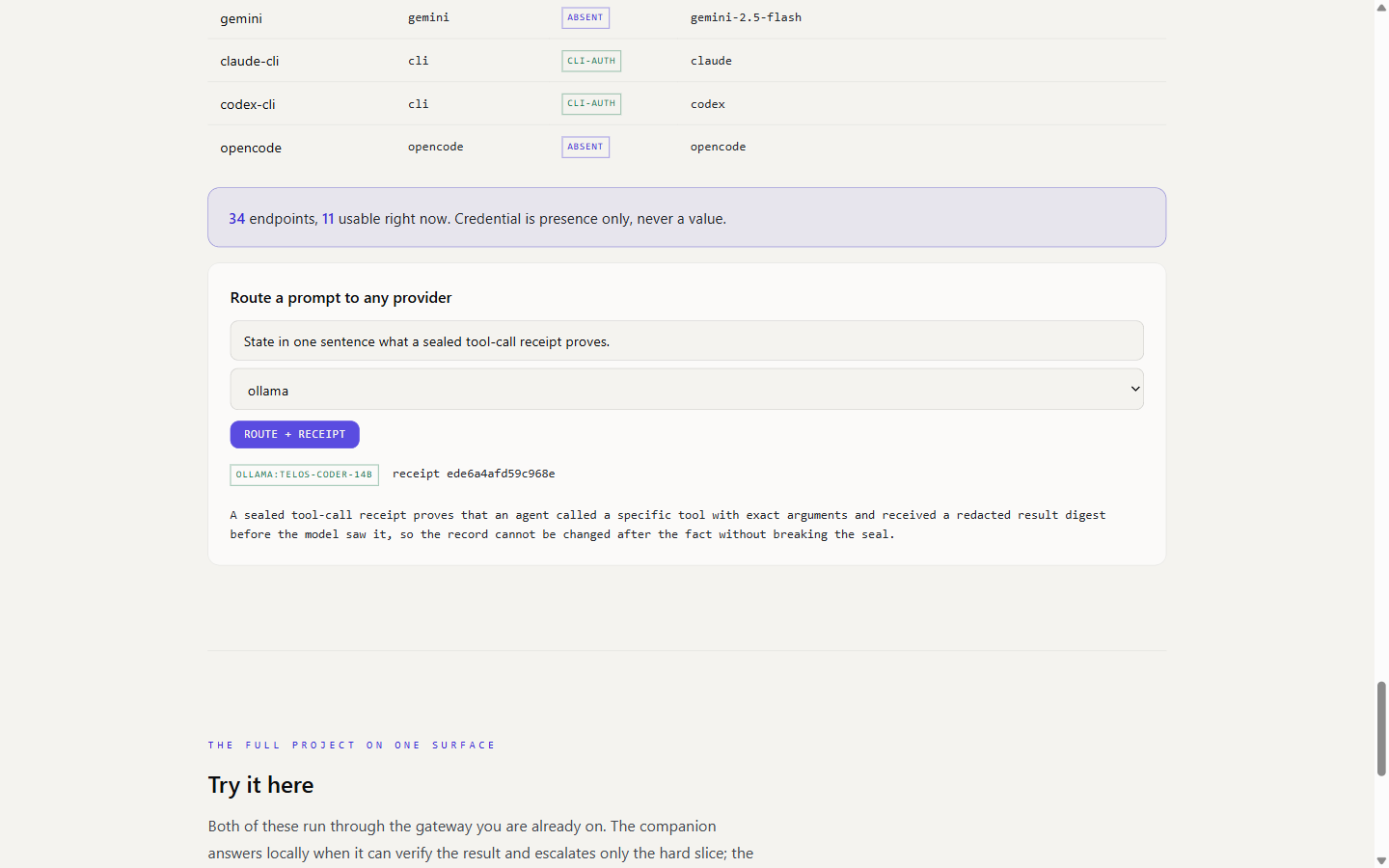
Endpoint table, live route to a local model, and the sealed receipt beside the answer. Flywheel
Gateway surface · live capture + tamper transcript, 2026-08-04
Route a prompt to any of 34 endpoints from one page, get the answer with its sealed receipt, then corrupt one byte of a receipt and watch the offline verifier answer TAMPERED with the recomputed hash named.
- 34 endpoints, 11 usable
- credential presence only
- tamper refused: SEAL_MISMATCH
- stdlib verifier
-
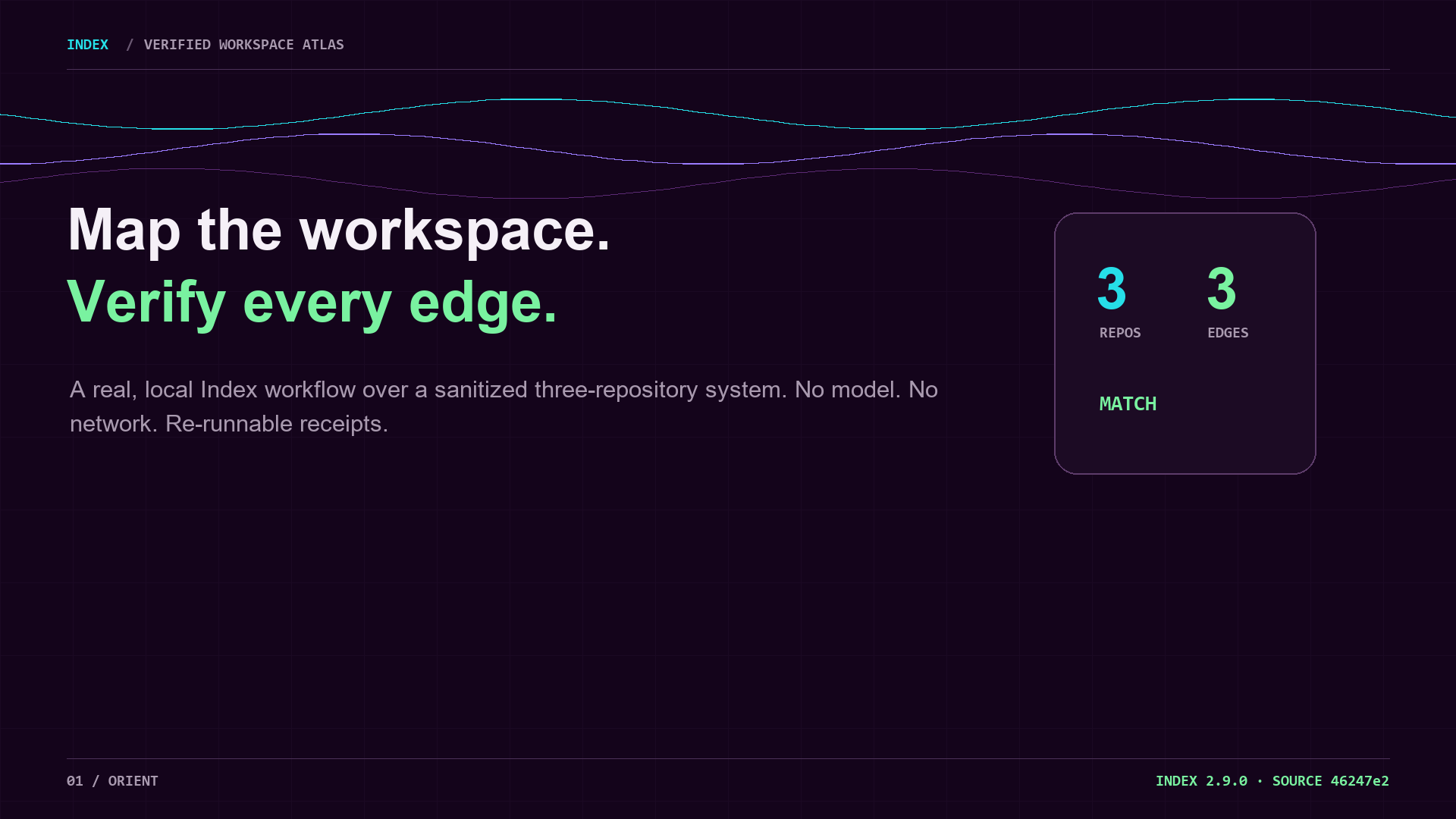
Workspace graph, named-edge check, bounded context, and offline atlas. Index
Recorded on Index 2.9.0 · current package 2.10.0 · 30-second cut + 118-second run
Map a sanitized three-repository workspace, check one dependency back to file-and-line evidence, fit the relevant system into a token budget, and render an offline atlas.
- 3 repositories
- 3 evidenced edges
- no model
- no network
-
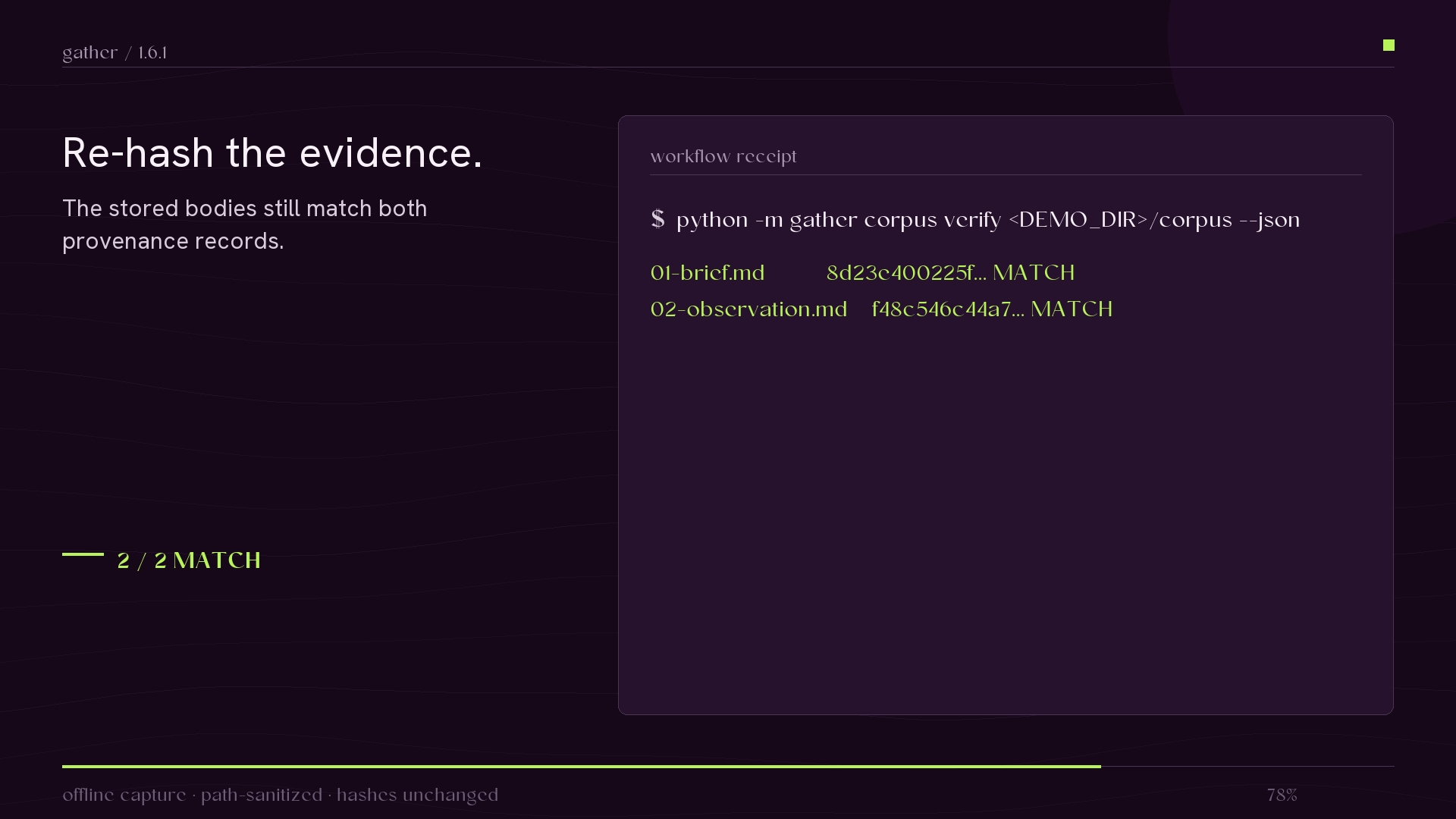
Structured intake, content-addressed storage, recall, verification, and a changed-receipt check. Gather
Gather 1.6.1 · 29-second cut + full run
Extract structured source blocks, retain the useful records in a local corpus, verify both stored bodies against their provenance, then show the changed-receipt path.
- 7 blocks extracted
- 2 records stored
- 2 / 2 match
- tamper caught
-
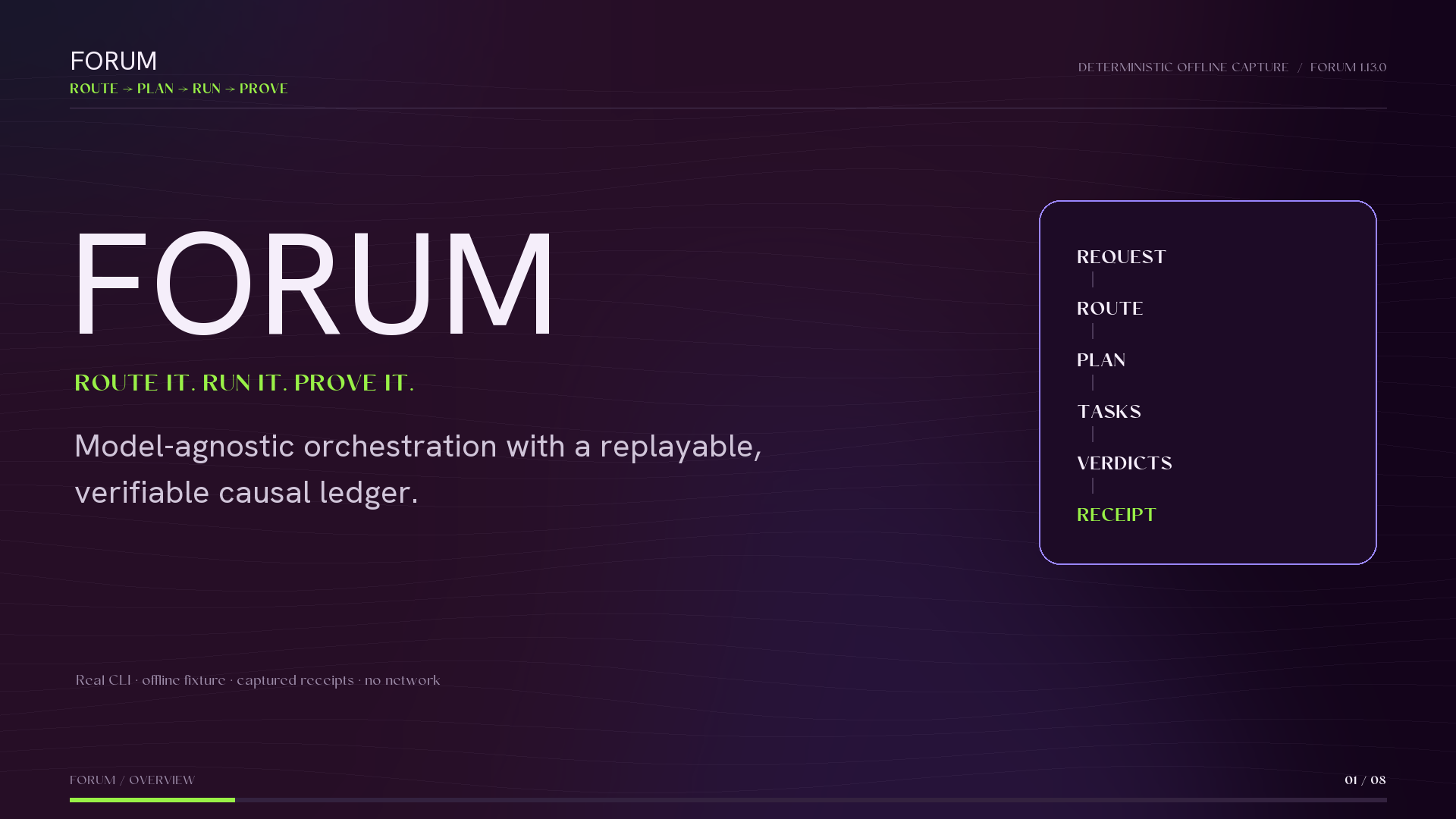
Dependency-aware routing, validated waves, checkpoints, payload handoffs, and causal ledger. Forum
Forum 1.13.0 · 27-second cut + full run
Turn one cross-domain request into three dependent task waves, validate each result, preserve the payload handoffs, and re-check the resulting ledger.
- 3 dependency waves
- 3 validator passes
- 3 checkpoints
- 19 ledger entries
-
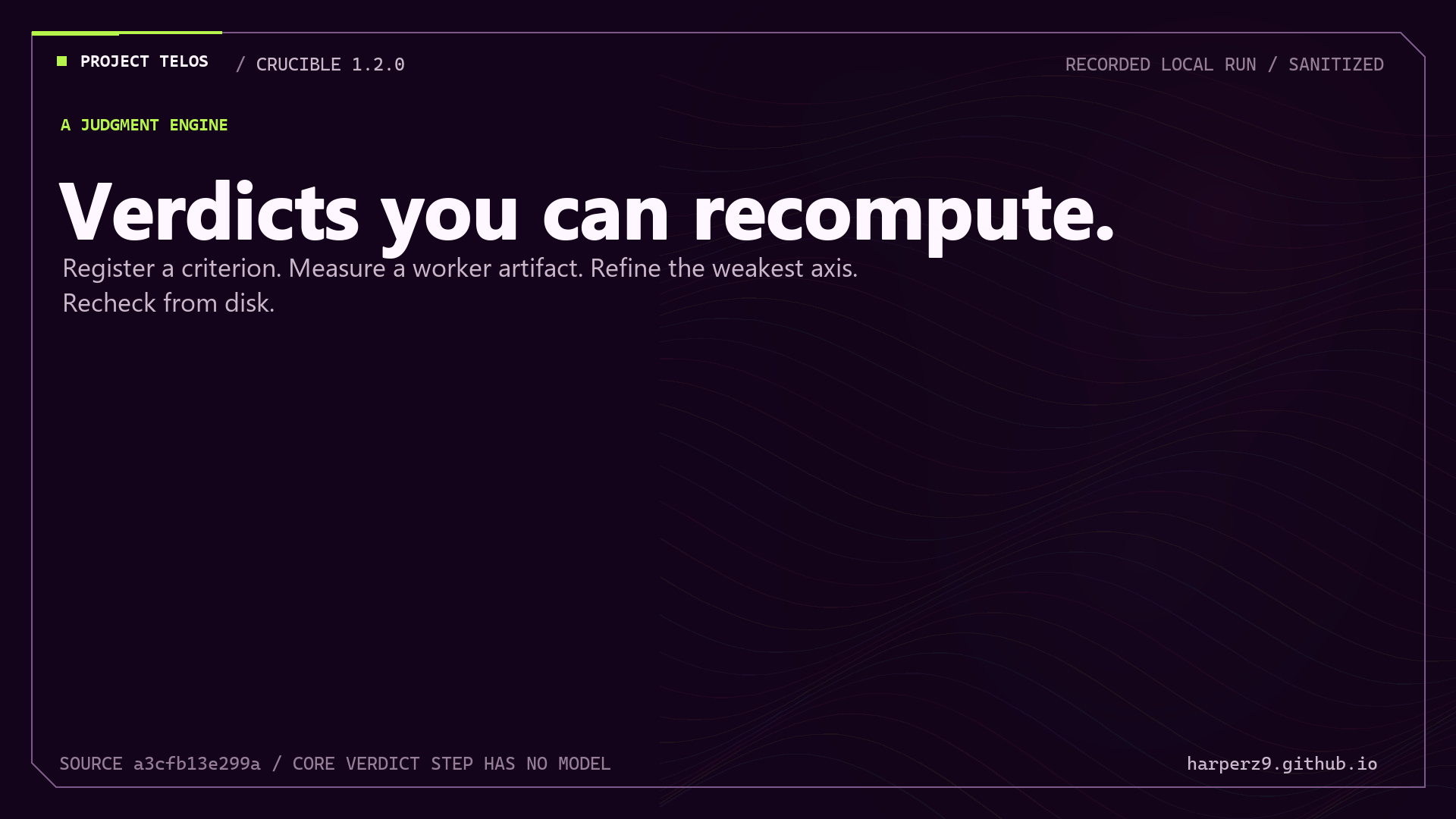
Fixed thesis, measured draft, targeted refinement, cleanroom review, and disk re-check. Crucible
Crucible 1.2.0 · 30-second cut + 94-second run
Measure a three-claim release brief, name the two concrete drifts, refine the artifact without moving the criterion, and re-derive the final verdict from disk.
- 3 claims measured
- 1 match / 2 drift
- 3 match / 0 drift
- 2 reviews pass
Documented in the repository, not yet recorded on video.
Three current buildlang threads, tracked here as they land. Each links straight to its source or its pull request; nothing below is claimed as finished or merged unless its status line says so.
-
Five modes, one receipt chain
On main · documented walkthrough
The same receipt schema seals five distinct computation modes end to end: deterministic, exact-probabilistic, seeded stochastic, Monte Carlo, and budgeted heuristic search, plus a cross-backend bonus mode that runs one kernel through both the C and Rust backends. buildc receipt chain binds any number of receipts into one ordered, tamper-evident bundle. Tampering a chained member without re-sealing it fails chain verify with CHAIN_LINK_UNVERIFIED; reordering, dropping, or substituting a member fails its own named class instead.
- 6 receipts chained
- 5 modes + 1 cross-backend bonus
- exercised by compiler/tests/cli.rs::five_modes_bind_into_one_chain
-
A model proposes, an oracle disposes
In review · dated 2026-07-29
A local model proposes a completion through a shim’s line protocol; buildc verifies the sealed model-boundary receipt over a real socket; a model-free, oracled kernel disposes with an ordinary scientific receipt; the receipt chain binds both together, with each member independently re-verified. Tampering the model member breaks the chain with CHAIN_LINK_UNVERIFIED, and a tampered receipt checked on its own fails SEAL_MISMATCH. Re-verifying the full chain, which re-executes the judged program and re-checks every seal, measures 0.450 seconds warm median over five runs on one machine and spends zero tokens: the checking layer runs no model. The general rule already stands on main: the receipt layer refuses outright to emit or verify a receipt over a program that observes a model, because models propose and oracles dispose.
- chain re-verification 0.450 s warm median, 5 runs, one machine, zero tokens
- buildlang PR #35, open, stacked on PR #34
- local-model PR #20, open (--receipt-dir)
- local-model PR #19 merged (shim wire protocol, 7/7 tests)
-
Executed Monte Carlo intervals, with a witnessed denominator
In review · not yet merged
An open pull request computes the Monte Carlo interval from what the run actually executed, rather than an assumed sample count, then re-verifies it instead of trusting the stored figure. The pull request states its own count refresh: once merged, the invariant corpus would move from main’s current 27/27 to 29/29, the self-test suite from 9/9 to 10/10, and the full Cargo suite from main’s current 1605 passing, 0 failing, 11 ignored, toward 1683 passing, 0 failing.
- buildlang PR #34, open, base main
- corpus 29/29 proposed (main: 27/27)
- self-test 10/10 proposed (main: 9/9)
Surveyed 2026-07-29 against buildlang and local-model origin/main and their open pull requests. Pull request status changes; the linked source is the current record, not this page.
What these recordings establish
They show the named tool paths running over small, inspectable fixtures and preserve the artifacts needed to check what appears on screen. They are not broad product benchmarks, scale tests, or evidence that every input shape is covered.
Recorded and checked 2026-07-12. Each workflow page states its own fixture, runtime, evidence package, and narrower claim boundary.